The Battle of Fiorenzuola: March 16, 934
934 · Fiorenzuola, Italy
The Battle of Fiorenzuola took place between the forces of King Hugh of Italy and those of the rebellious Margrave of Ivrea, Berengar II.
March 11, 1387
The Battle of Castagnaro was fought in Italy, marking a significant victory for the English mercenary leader John Hawkwood and his forces from the city of Padua against the army of Verona, led by Giovanni Ordelaffi.
Castagnaro, Italy
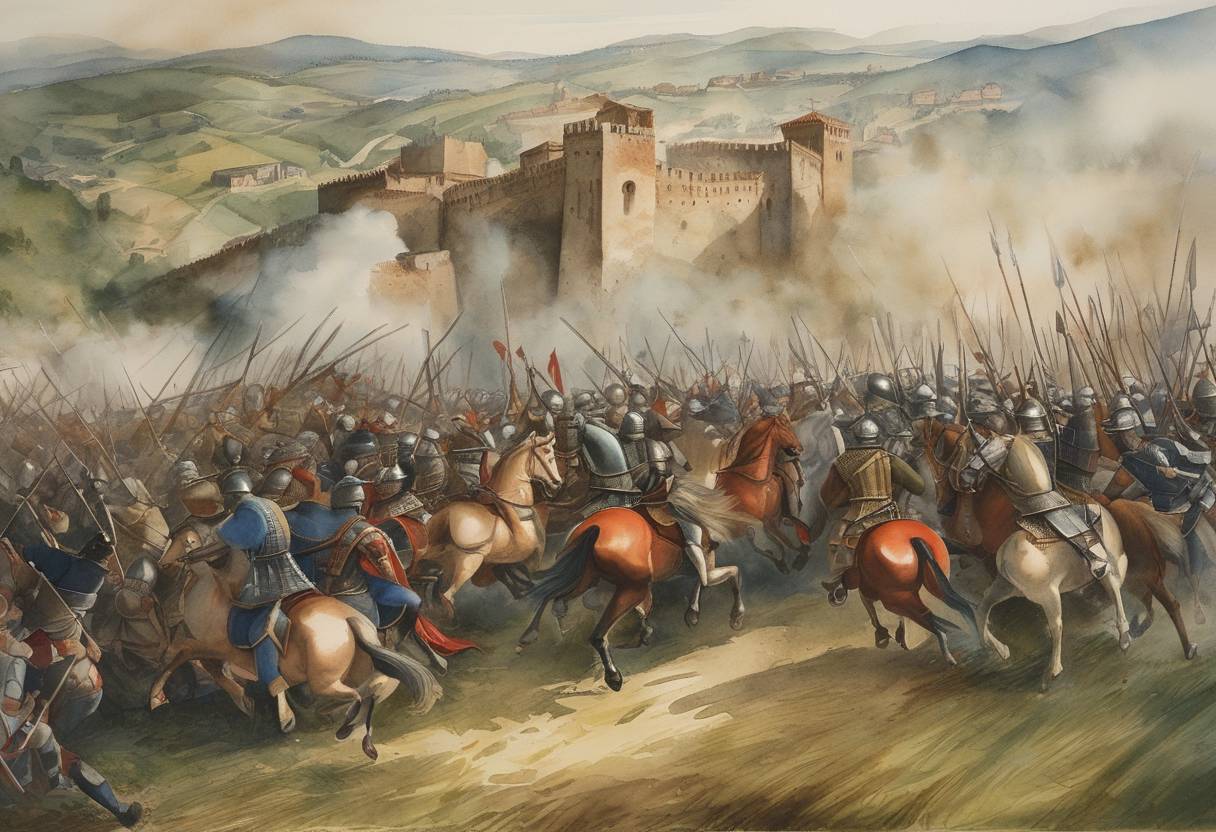
The Battle of Castagnaro, fought on March 11, 1387, was a significant military engagement in the power struggles of the Italian city-states during the late Middle Ages. It took place in Castagnaro, a town in northeastern Italy, and marked a decisive victory for the forces of Padua over the army of Verona.
During the 14th century, Italy was a politically fragmented region with numerous city-states vying for power and influence. These states frequently hired mercenary armies, known as condottieri, to strengthen their military capabilities. Among the most notable mercenary leaders of the time was the Englishman Sir John Hawkwood, who commanded the Paduan forces in this battle.
The conflict between Padua and Verona was part of the larger struggle for regional dominance. Padua sought to defend its autonomy and expand its influence, while Verona, under the leadership of Giovanni Ordelaffi, aimed to assert its power over neighboring territories.
Tactics and Strategy: John Hawkwood, renowned for his military acumen, employed strategic deception on the battlefield. He orchestrated a tactical maneuver by arranging his troops to appear weaker than they were, enticing the Veronese army to engage in what they perceived to be a favorable assault.
Terrain Utilization: Hawkwood effectively used the swampy terrain around Castagnaro, positioning his troops to take advantage of the elements, further complicating the Veronese attack.
Decisive Maneuvers: As the Veronese forces committed to the attack, Paduan soldiers, under Hawkwood’s command, executed a pincer movement, overwhelming the Veronese forces. This maneuver led to a significant breakdown of the enemy’s formation, ultimately resulting in a rout of the Veronese troops.
The victory at the Battle of Castagnaro solidified John Hawkwood’s reputation as one of the most skilled and successful condottieri of his time. The defeat weakened Verona’s ambitions, enhancing Padua’s standing in the region and ensuring its security for a period.
The battle exemplified the tactical innovation of mercenary leaders during this era and highlighted the ongoing political and military rivalries among Italian city-states. It demonstrated the crucial role of skilled commanders in determining the outcomes of battles during the Middle Ages, as well as the importance of tactical ingenuity and understanding of the battlefield’s geography.
Overall, the Battle of Castagnaro remains a notable example of medieval warfare and the intricate power dynamics characterizing 14th-century Italy.
Source: en.wikipedia.org