Mehmed II: Accession to the Ottoman Throne
1451 · Constantinople, Ottoman Empire
The Ottoman sultan Mehmed II, also known as Mehmed the Conqueror, conquered Constantinople and ended the Byzantine Empire.
August 15, 1461
The Empire of Trebizond surrenders to forces of the Sultan Mehmed II, marking the end of the empire and the last remnant of the Byzantine Empire.
Trebizond, Ottoman Empire (present-day Turkey) | Ottoman Empire
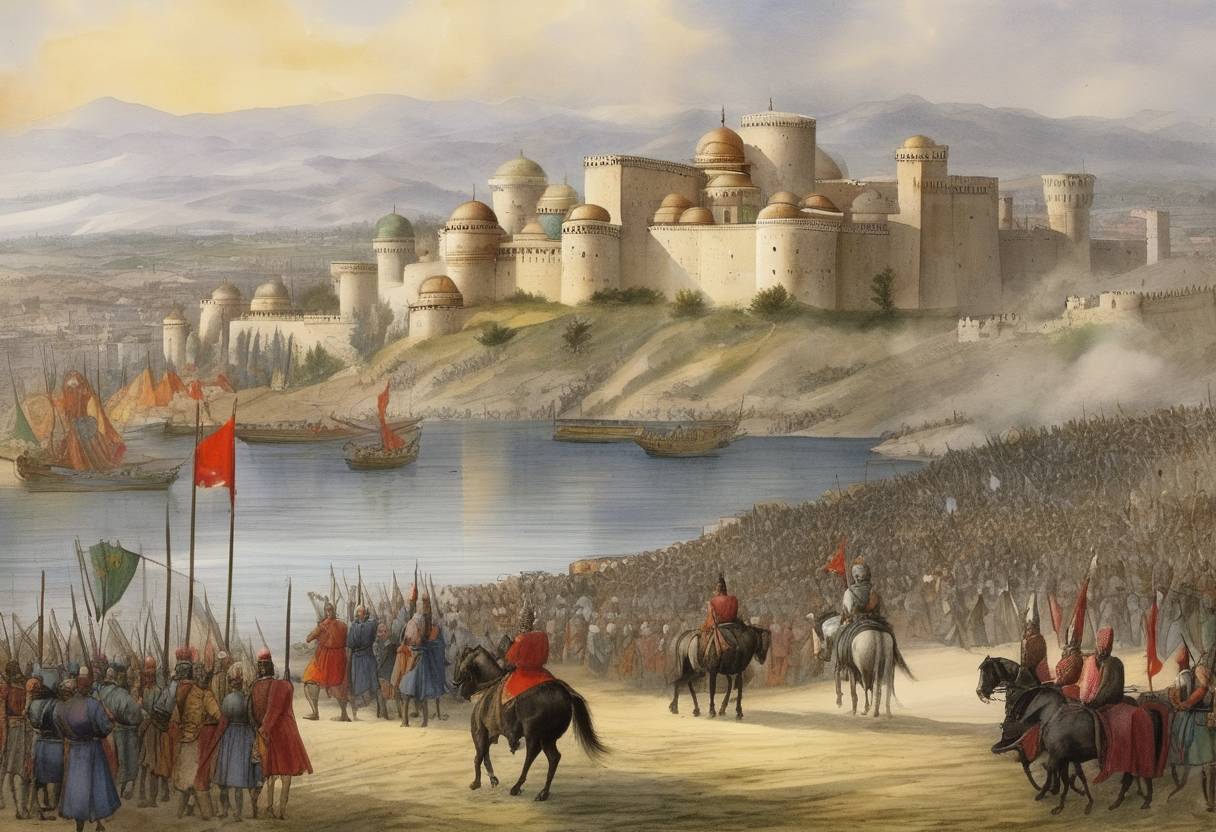
The fall of the Empire of Trebizond on August 15, 1461, marked a significant event in history as it concluded the existence of the last Byzantine successor state. This momentous occasion represented the definitive end of the Byzantine Empire, which had persisted in various forms since the fall of Constantinople in 1204 and its partial restoration in 1261.
The Byzantine Empire’s fragmentation began with the Fourth Crusade’s sack of Constantinople in 1204. The Empire of Trebizond was established that same year by Alexios I of Trebizond, a member of the Komnenos dynasty. It was one of the empire’s splinter states alongside the Despotate of Epirus and the Empire of Nicaea. Though Constantinople was recaptured in 1261, the Byzantine Empire never regained its former power, weakening significantly over the following centuries due to internal strife and external pressures.
Trebizond remained an independent dominion along the Black Sea coast from 1204 until 1461, maintaining its autonomy amid the region’s shifting political landscape. This autonomy was preserved through shrewd alliances, tribute payments, and the geo-strategic advantage of its mountainous terrain.
Sultan Mehmed II, known as Mehmed the Conqueror for his capture of Constantinople in 1453, set his sights on expanding the burgeoning Ottoman Empire. By the early 1460s, the empire’s expansionist agenda turned towards the annexation of smaller, independent states within and beyond its immediate borders. Trebizond was increasingly isolated, with its commercial ties weakened by Ottoman control of regional trade.
In August 1461, Mehmed II laid siege to Trebizond, utilizing both land and naval forces. The Ottoman troops significantly outnumbered the defenders of Trebizond. After a month-long siege, David Komnenos, the last Emperor of Trebizond, capitulated to the inevitable. Realizing the futility of prolonged resistance and to avert needless bloodshed, David surrendered the city and the empire to Sultan Mehmed II on August 15, 1461.
The annexation of Trebizond effectively eliminated the last vestige of the Byzantine political structure. With Trebizond incorporated into the Ottoman Empire, Mehmed II further consolidated his rule over Anatolia and reinforced Ottoman dominion in the Black Sea region.
The Komnenoi of Trebizond faced mixed fates following their surrender. While initially treated with a semblance of honor and allowed estates in Thrace, the family soon fell victim to internal and external plots, leading to their eventual execution on charges of treason years later.
The fall of Trebizond signified the full appropriation of Byzantine legacies into the Ottoman domain and underscored the relentless expansion of Ottoman power during the 15th century. It also heralded a new epoch in regional history dominated by the Ottomans, deeply impacting the cultural and political landscapes of Southeast Europe and the Near East for centuries to come.