Annexation of the California Republic: July 9, 1846
1846 · Monterey, United States
The United States formally annexed the California Republic under the leadership of Commodore John D. Sloat.
June 14, 1846
Bear Flag Revolt begins in California, leading to the establishment of the California Republic.
Sonoma, United States
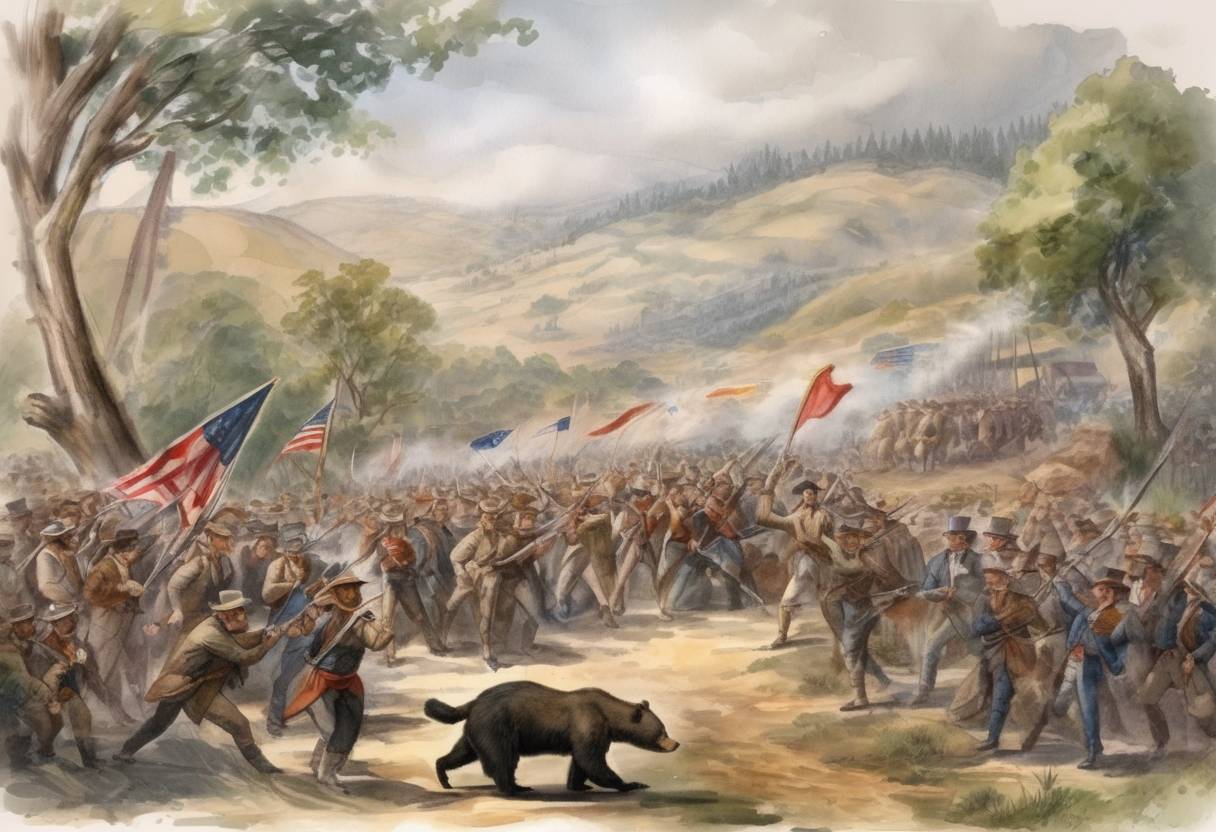
On June 14, 1846, the Bear Flag Revolt marked a pivotal moment in California’s history, leading to the brief establishment of the California Republic. This event was part of the larger context of American expansionism and the Mexican-American War.
In the mid-19th century, California was a sparsely populated region under Mexican control. However, the area was increasingly attracting American settlers, who were motivated by the promise of land and opportunity. Tensions between these settlers and the Mexican government were exacerbated by the broader geopolitical ambitions of the United States, which was pursuing a policy of Manifest Destiny—aiming to expand its territory across the North American continent.
The Bear Flag Revolt was initiated by a group of American settlers in the Sonoma region of California. On June 14, 1846, a small band of these settlers, led by figures such as William B. Ide and Ezekiel Merritt, seized the Mexican garrison in Sonoma. They declared independence from Mexican rule, raising a hastily crafted flag featuring a grizzly bear and a lone star, which became known as the “Bear Flag.”
The California Republic was short-lived, lasting only about 25 days. During this period, the rebels attempted to establish a government independent of Mexico. However, the Republic’s existence was largely symbolic, as it lacked the resources and recognition to sustain itself.
The Bear Flag Revolt coincided with the outbreak of the Mexican-American War (1846-1848). In July 1846, U.S. military forces, led by Commodore John D. Sloat, arrived in California and took control of the region, effectively ending the California Republic. The territory was subsequently annexed by the United States as part of the Treaty of Guadalupe Hidalgo in 1848, which concluded the Mexican-American War.
The Bear Flag Revolt remains a significant episode in California’s history, symbolizing the complex interactions between American settlers and Mexican authorities, and the broader narrative of U.S. territorial expansion.
Source: en.wikipedia.org