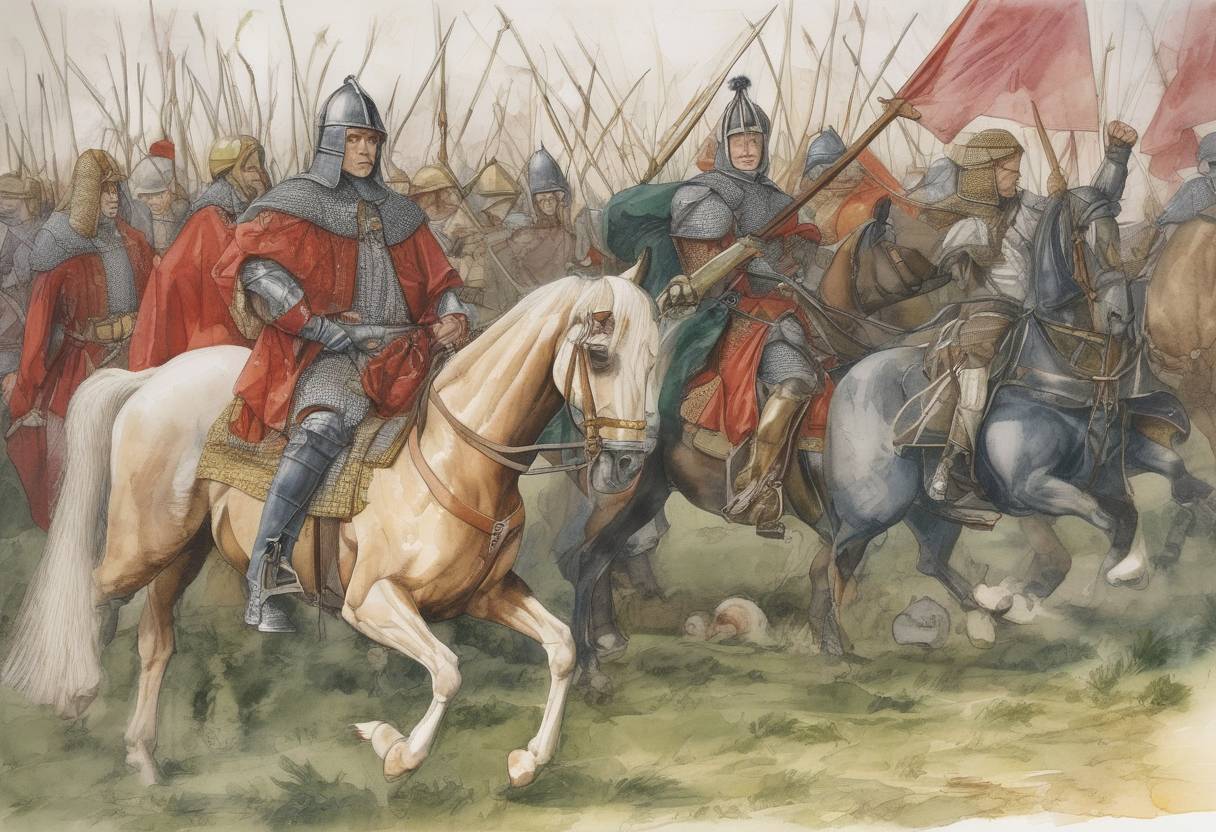
The Battle of Flodden: September 9, 1513
On September 9, 1513, the Battle of Flodden, also known as the Battle of Flodden Field, took place near Branxton in Northumberland, England. This significant conflict was part of the larger War of the League of Cambrai, a series of military engagements involving major European powers.
Context and Prelude
The battle was a result of the complex web of alliances and enmities in early 16th-century Europe. James IV of Scotland had entered into the “Auld Alliance” with France, a mutual defense pact against England. When Henry VIII of England invaded France in 1513, James IV felt compelled to honor this alliance by opening a second front against England.
James IV gathered a large Scottish army, estimated to be around 30,000 strong, and crossed the border into England. His campaign aimed to divert English forces from the French front and to assert Scottish power.
The Battle
The English army, commanded by Thomas Howard, the Earl of Surrey, was significantly smaller, numbering around 20,000. Despite being outnumbered, the English forces were well-prepared and strategically positioned.
The battle took place on the slopes of Flodden Hill. James IV, leading his troops personally, made the critical decision to engage the English on unfavorable terrain. The Scottish forces, equipped with long pikes, struggled on the marshy ground, which nullified their advantage.
The English, using billhooks and other shorter weapons, were able to effectively counter the Scottish pike formations. The battle was fierce and brutal, lasting several hours. Ultimately, the English forces prevailed, inflicting heavy casualties on the Scots.
Aftermath and Consequences
The Battle of Flodden was a devastating defeat for Scotland. James IV was killed in the fighting, becoming the last monarch from the British Isles to die in battle. His death left Scotland in a precarious position, with his infant son, James V, succeeding him under a regency.
The loss at Flodden had significant repercussions for Scotland. It weakened the Scottish nobility, many of whom perished alongside their king, and left the country vulnerable to internal strife and external threats. The defeat also strained the Auld Alliance, as France was unable to provide substantial support to its Scottish ally.
For England, the victory at Flodden was a significant military achievement, bolstering the reputation of the Earl of Surrey and securing the northern border. However, it did little to alter the broader strategic situation in Europe, as Henry VIII remained embroiled in his continental ambitions.
Historical Significance
The Battle of Flodden remains one of the most famous conflicts in Scottish history, symbolizing the perilous nature of medieval warfare and the complex interplay of alliances. It marked a turning point in Anglo-Scottish relations, setting the stage for future conflicts and shaping the political landscape of the British Isles for years to come.