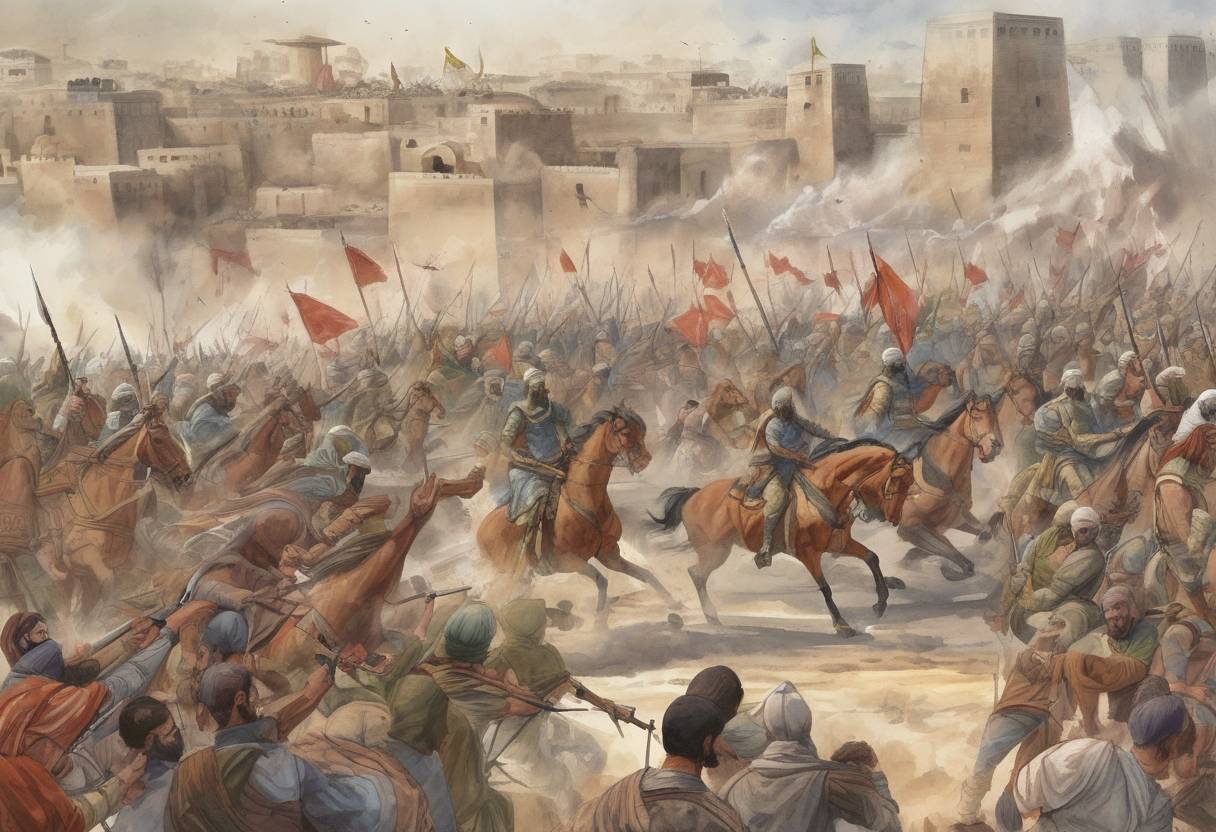
The Battle of Siffin Ends
Background
The Battle of Siffin was a pivotal conflict during the First Fitna, the first Islamic civil war, which erupted following the assassination of the third Caliph, Uthman ibn Affan, in 656 CE. The battle was fought between the forces of Ali ibn Abi Talib, the fourth Caliph, and Muawiyah I, the governor of Syria. The conflict was primarily over the legitimacy of Ali’s caliphate and the demand for justice for Uthman’s murder.
Key Events Leading Up to the Battle
Assassination of Uthman (656 CE): The murder of Caliph Uthman led to significant unrest and division within the Muslim community. Ali was chosen as the next Caliph, but his rule was contested by several factions.
Muawiyah’s Opposition: Muawiyah, a relative of Uthman and the powerful governor of Syria, refused to pledge allegiance to Ali. He demanded retribution for Uthman’s death and used this as a rallying point to gather support against Ali.
Escalation to War: Tensions escalated as both sides amassed armies. Ali sought to consolidate his rule and quell opposition, while Muawiyah aimed to challenge Ali’s authority and assert his own power.
The Battle of Siffin
Location and Duration: The battle took place near Siffin, along the Euphrates River, in present-day Syria. It began in late 657 CE and lasted for several months, with intermittent skirmishes and negotiations.
Stalemate and Arbitration: The battle reached a stalemate, with neither side able to secure a decisive victory. To avoid further bloodshed, both parties agreed to arbitration, a decision that was controversial and led to further divisions.
Aftermath and Consequences
Arbitration and Division: The arbitration process failed to resolve the conflict and instead deepened the rift within the Muslim community. It led to the emergence of the Kharijites, a radical faction that opposed both Ali and Muawiyah.
Continued Conflict: The First Fitna continued after the Battle of Siffin, with ongoing skirmishes and political maneuvering. The conflict ultimately weakened Ali’s position and contributed to his assassination in 661 CE.
Rise of the Umayyad Caliphate: Following Ali’s death, Muawiyah established the Umayyad Caliphate, marking a significant shift in Islamic leadership and the beginning of a new era in Islamic history.
Historical Significance
The Battle of Siffin was a critical moment in early Islamic history, highlighting the challenges of leadership and legitimacy in the nascent Muslim community. It set the stage for the Sunni-Shia split and had lasting implications for the political and religious landscape of the Islamic world.