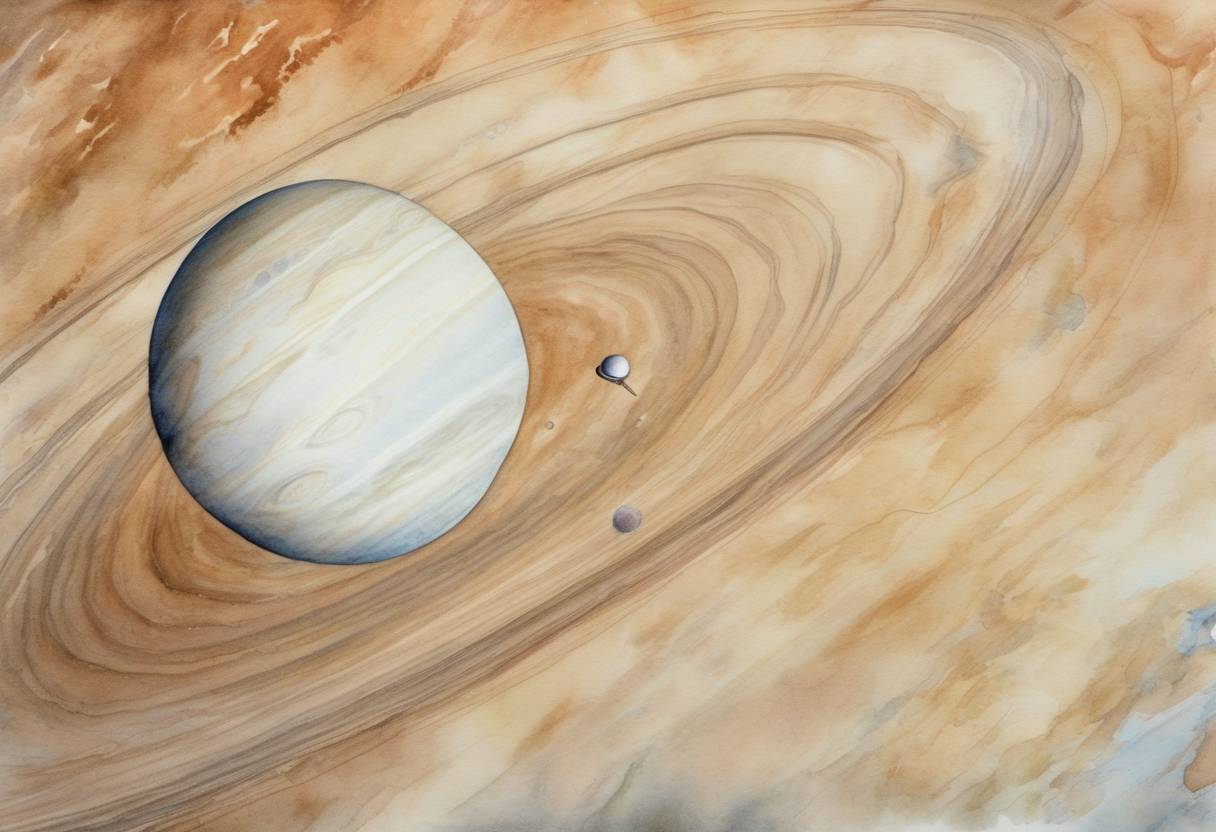
Voyager 1’s Closest Approach to Jupiter - March 5, 1979
On March 5, 1979, NASA’s Voyager 1 spacecraft made its closest approach to Jupiter, marking a significant milestone in space exploration. This event was pivotal in enhancing our understanding of the largest planet in our solar system and its diverse moons.
Background
Voyager 1 was launched on September 5, 1977, as part of NASA’s Voyager program, which aimed to explore the outer planets of the solar system. The mission was designed to take advantage of a rare planetary alignment that occurs once every 176 years, allowing a spacecraft to visit multiple planets with minimal fuel consumption.
Key Events Leading Up to the Encounter
- Launch and Trajectory: After its launch, Voyager 1 followed a trajectory that would take it past Jupiter, Saturn, and eventually out of the solar system.
- Approach to Jupiter: As Voyager 1 approached Jupiter, it began transmitting data and images back to Earth, providing unprecedented insights into the planet’s atmosphere, magnetic field, and moons.
Closest Approach
- Date: March 5, 1979
- Distance: Voyager 1 came within approximately 349,000 kilometers (217,000 miles) of Jupiter’s cloud tops.
- Observations: During its flyby, Voyager 1 captured detailed images of Jupiter’s atmosphere, revealing complex cloud patterns and the Great Red Spot, a massive storm larger than Earth.
Discoveries and Data
- Jupiter’s Atmosphere: The spacecraft provided detailed data on the composition and dynamics of Jupiter’s atmosphere, including its cloud layers and wind speeds.
- Magnetic Field: Voyager 1 measured Jupiter’s intense magnetic field, which is the strongest of any planet in the solar system.
- Moons: The mission delivered groundbreaking images and data on Jupiter’s moons, particularly the four largest, known as the Galilean moons:
- Io: Voyager 1 discovered active volcanism on Io, making it the most geologically active body in the solar system.
- Europa: The spacecraft provided evidence of a subsurface ocean beneath Europa’s icy crust, sparking interest in its potential for harboring life.
- Ganymede and Callisto: Detailed images of these moons revealed their varied surfaces and geological histories.
Aftermath and Significance
- Scientific Impact: The data collected by Voyager 1 revolutionized our understanding of the Jovian system and laid the groundwork for future missions to Jupiter, such as Galileo and Juno.
- Cultural Impact: The images and discoveries captured the public’s imagination, highlighting the capabilities of robotic exploration and the potential for discovering new worlds.
- Legacy: Voyager 1 continued its journey, making a close approach to Saturn in 1980 before heading towards interstellar space. It remains one of the most distant human-made objects from Earth.
Voyager 1’s encounter with Jupiter on March 5, 1979, remains a landmark achievement in space exploration, showcasing the power of human ingenuity and the quest for knowledge beyond our planet.