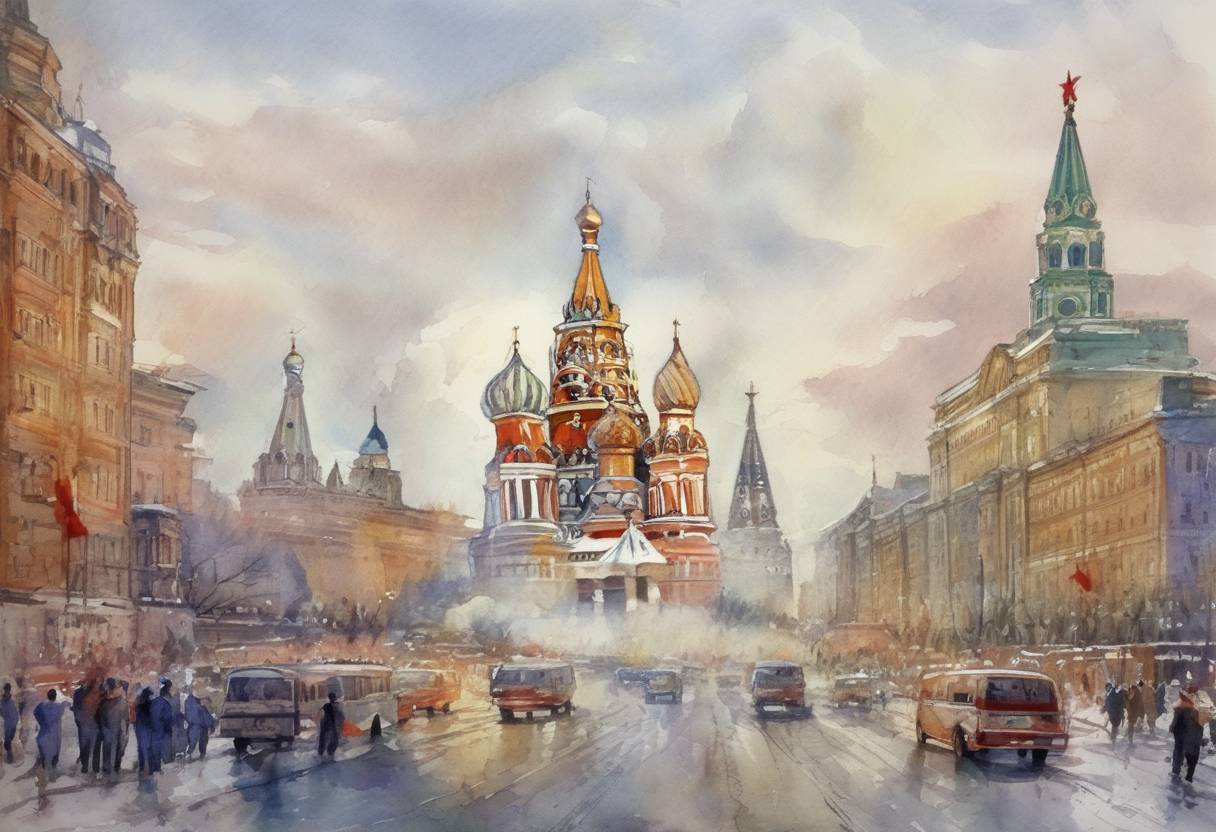
The Russian Federation Gains Independence from the Soviet Union
Background
The dissolution of the Soviet Union was a complex process that unfolded over several years, marked by political, economic, and social upheaval. By the late 1980s, the Soviet Union was experiencing significant internal challenges, including economic stagnation, political unrest, and a growing desire for reform among its constituent republics. Mikhail Gorbachev, who became the General Secretary of the Communist Party in 1985, introduced policies of glasnost (openness) and perestroika (restructuring) in an attempt to modernize the Soviet system. However, these reforms inadvertently accelerated the push for independence among the Soviet republics.
Key Events Leading to December 12, 1991
August 1991 Coup Attempt: In August 1991, a failed coup by hardline members of the Communist Party against Gorbachev further weakened the central Soviet government and bolstered the independence movements within the republics.
Belavezha Accords: On December 8, 1991, leaders of Russia, Ukraine, and Belarus met in Belavezha Forest in Belarus and signed the Belavezha Accords, declaring that the Soviet Union had effectively ceased to exist and announcing the formation of the Commonwealth of Independent States (CIS).
Russian Independence: On December 12, 1991, the Russian Federation formally declared its independence from the Soviet Union. This was a pivotal moment in the dissolution process, as Russia was the largest and most influential of the Soviet republics.
Significance
End of the Soviet Union: The declaration of independence by Russia was a decisive step in the formal dissolution of the Soviet Union, which was officially recognized on December 26, 1991, when the Supreme Soviet of the USSR voted to dissolve itself.
Emergence of New States: The dissolution of the Soviet Union led to the emergence of 15 independent republics, including Russia, Ukraine, Belarus, and the Baltic states, among others.
Global Impact: The end of the Soviet Union marked a significant shift in global geopolitics, effectively ending the Cold War and leading to a unipolar world dominated by the United States.
Economic and Political Transition: Russia and the other former Soviet republics faced significant challenges in transitioning from a centrally planned economy to market economies, as well as establishing democratic political systems.
Aftermath
The independence of the Russian Federation set the stage for a new era in Russian history. Boris Yeltsin, who had been elected as the first President of Russia in June 1991, played a crucial role in navigating the early years of independence. The transition was marked by economic turmoil, political instability, and significant social change. The legacy of the Soviet Union’s dissolution continues to influence Russian politics and international relations to this day.