Julian the Apostate Enters Constantinople as Sole Emperor
361 · Constantinople, Byzantine Empire
Julian the Apostate enters Constantinople as sole Emperor of the Roman Empire after the death of Constantius II.
November 3, 0361
Roman Emperor Constantius II dies of fever at Mopsuestia in Cilicia, leading to the ascension of Julian the Apostate as the sole ruler of the Roman Empire.
Mopsuestia, Roman Empire (modern-day Turkey) | Roman Empire
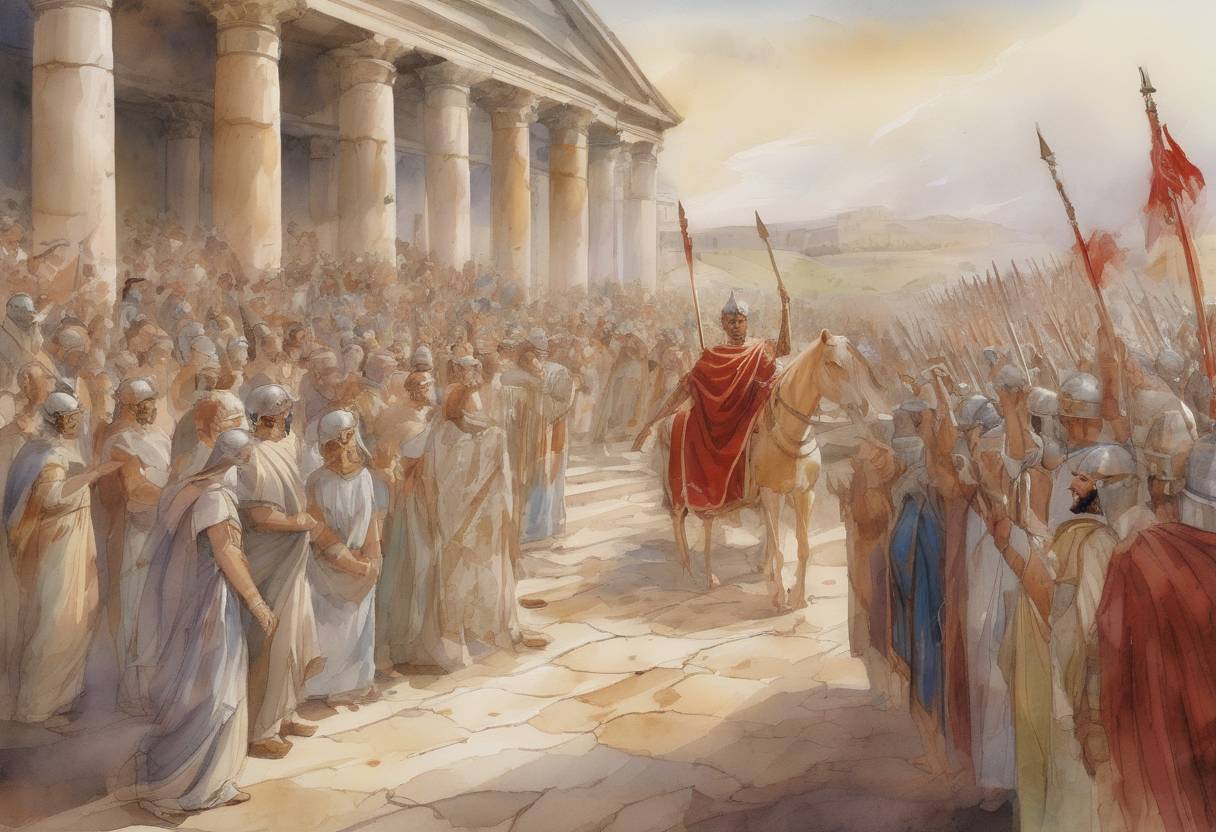
On November 3, 361, Roman Emperor Constantius II died of fever in Mopsuestia, Cilicia, marking a significant transition in the Roman Empire’s leadership. This event paved the way for Julian, known posthumously as Julian the Apostate, to become the sole ruler of the Roman Empire.
Constantius II, born in 317, was the second son of Constantine the Great and Fausta. He became Caesar in 324 and was elevated to Augustus in 337 following the death of his father. Constantius II’s reign was marked by internal strife and external threats, including conflicts with the Sassanian Empire and various Germanic tribes. His rule was also characterized by religious controversies, particularly the Arian controversy, which divided the Christian Church.
Constantius II’s reign was part of a broader period of division within the Roman Empire. Initially, the empire was divided among Constantine’s three sons: Constantine II, Constans, and Constantius II. After a series of fraternal conflicts and deaths, Constantius II emerged as the sole ruler by 353.
However, his rule was challenged by his cousin Julian, who had been appointed Caesar in 355 and tasked with defending the western provinces. Julian’s military successes and popularity among the troops led to his proclamation as Augustus by his soldiers in 360, creating a potential civil war scenario.
As tensions mounted, Constantius II marched eastward to confront Julian. However, during this campaign, Constantius fell ill with a fever in Mopsuestia, Cilicia. Recognizing the gravity of his condition, he named Julian as his successor, thus averting a civil war. Constantius II died on November 3, 361, and was buried in the Church of the Holy Apostles in Constantinople.
With Constantius II’s death, Julian became the sole ruler of the Roman Empire. Known for his philosophical inclinations and military prowess, Julian’s reign was notable for his efforts to restore paganism and reduce the influence of Christianity, earning him the epithet “the Apostate.” His policies aimed at reviving traditional Roman religious practices marked a significant departure from the Christianization policies of his predecessors.
The transition from Constantius II to Julian the Apostate was a pivotal moment in Roman history. It highlighted the ongoing religious and political transformations within the empire. Julian’s short reign (361-363) was marked by attempts to consolidate power and implement religious reforms, but his untimely death during a campaign against the Persians curtailed these efforts.
Julian’s legacy remains a subject of historical debate, with his reign often viewed as a last attempt to restore Rome’s pagan past before the empire’s eventual Christianization. The events surrounding Constantius II’s death and Julian’s ascension underscore the complex interplay of power, religion, and politics in late antiquity.
Source: en.wikipedia.org