The Human Be-In: Prelude to the Summer of Love
1967 · San Francisco, United States
The Human Be-In, a prelude to San Francisco's Summer of Love, takes place in Golden Gate Park, San Francisco.
November 27, 1978
San Francisco Mayor George Moscone and Supervisor Harvey Milk were assassinated by former Supervisor Dan White, leading to significant political and social repercussions.
San Francisco, United States | none
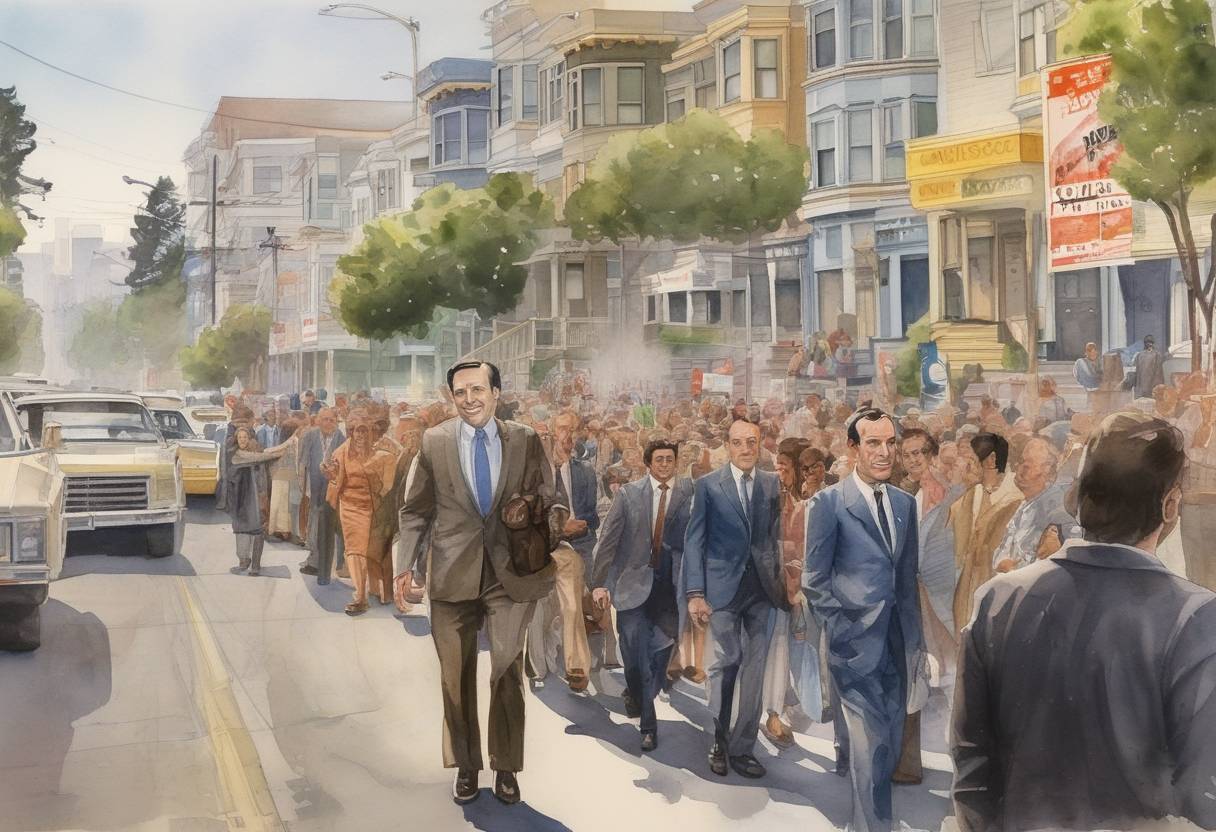
On November 27, 1978, a tragic event unfolded in San Francisco that had profound political and social repercussions. George Moscone, the Mayor of San Francisco, and Harvey Milk, a member of the San Francisco Board of Supervisors, were assassinated by Dan White, a former city supervisor. This event marked a significant moment in the history of the city and the broader LGBTQ+ rights movement.
George Moscone was elected as the Mayor of San Francisco in 1975. He was known for his progressive policies and efforts to promote diversity and inclusion within the city. Moscone’s administration was marked by his support for civil rights and his efforts to integrate various communities into the political process.
Harvey Milk was one of the first openly gay elected officials in the United States. Elected to the San Francisco Board of Supervisors in 1977, Milk was a prominent advocate for LGBTQ+ rights and worked tirelessly to combat discrimination and promote equality. His election was a milestone for the LGBTQ+ community and symbolized a growing acceptance and political empowerment.
Dan White was a former police officer and firefighter who served on the San Francisco Board of Supervisors. He resigned from his position in November 1978, citing financial difficulties, but later sought to be reinstated. Mayor Moscone initially considered reinstating White but ultimately decided against it, influenced in part by Harvey Milk and others who opposed White’s conservative views.
On the morning of November 27, 1978, Dan White entered San Francisco City Hall through a basement window to avoid metal detectors. Armed with a revolver, he went to Mayor Moscone’s office and shot him multiple times. White then proceeded to Harvey Milk’s office and similarly shot him multiple times. Both Moscone and Milk died from their injuries.
Dan White was arrested and charged with the murders of Moscone and Milk. During his trial, his defense team argued that he was suffering from diminished capacity due to depression, a defense that became infamously known as the “Twinkie defense” due to claims that his mental state was affected by junk food consumption. White was convicted of voluntary manslaughter rather than murder, receiving a sentence of seven years and eight months, of which he served just over five years.
The verdict sparked outrage and led to the “White Night Riots” on May 21, 1979, where thousands of people protested in San Francisco. The LGBTQ+ community and its allies were particularly incensed by what they perceived as a lenient sentence influenced by societal biases against LGBTQ+ individuals.
The assassinations of Moscone and Milk had lasting impacts on San Francisco and the LGBTQ+ rights movement. Harvey Milk became a martyr and an enduring symbol of the fight for LGBTQ+ rights. The events highlighted the need for greater protections and representation for marginalized communities. In 2009, Milk was posthumously awarded the Presidential Medal of Freedom, and his legacy continues to inspire activists worldwide.
The tragic events of November 27, 1978, underscored the volatility of the political climate of the time and the ongoing struggle for civil rights and equality.
Source: en.wikipedia.org