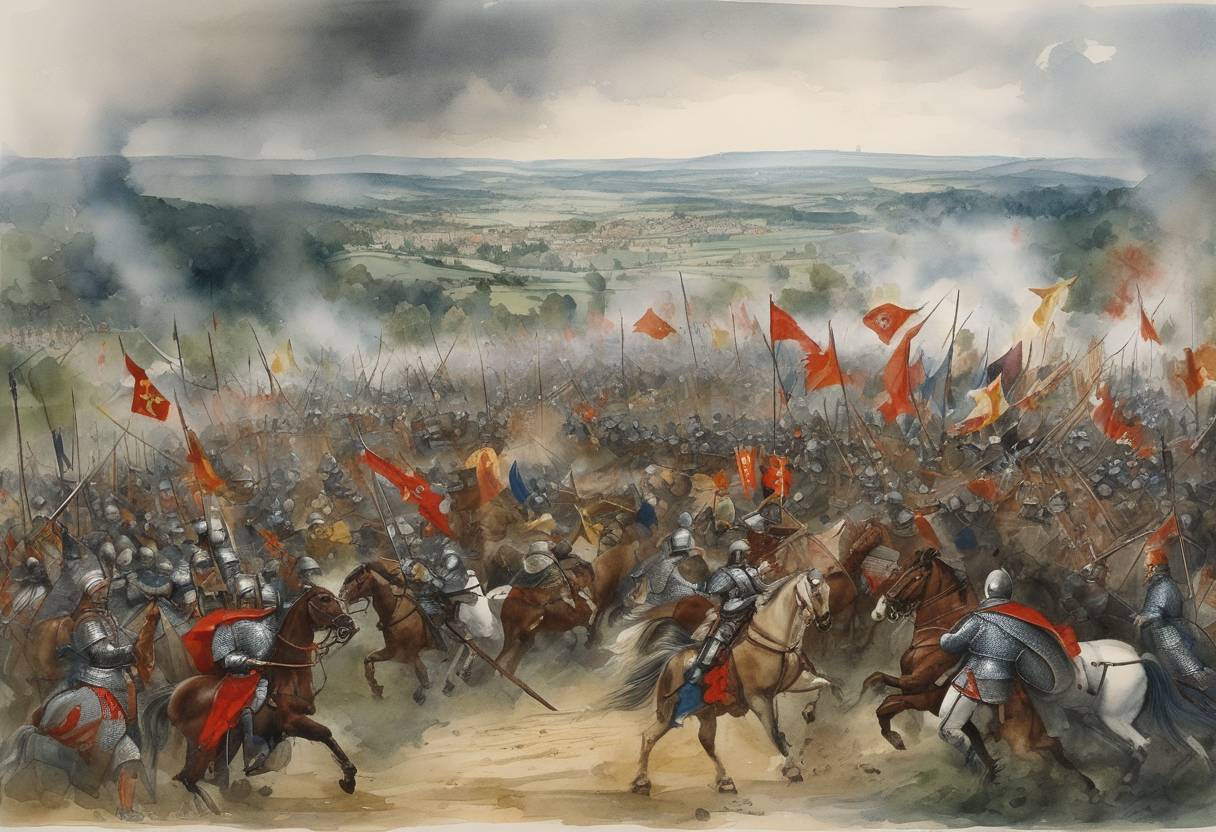
The Battle of Andernach - October 8, 876
On October 8, 876, the Battle of Andernach was a pivotal moment in the Carolingian struggle for power, marking a significant victory for King Louis the Younger. This battle was a key part of the ongoing territorial and political conflicts that embroiled the remnants of the Frankish Empire following the death of Emperor Louis the Pious.
Background
The fragmentation of the Carolingian Empire began after the death of Emperor Louis the Pious in 840, leading to the Treaty of Verdun in 843. This treaty divided the empire among his three sons. Louis the Younger inherited East Francia following the further subdividing of Middle Francia after his father Louis the German’s death. His uncle, Charles the Bald, ruled West Francia and sought to extend his influence over his nephew’s territories, capitalizing on perceived vulnerabilities.
The Conflict
In 876, Charles the Bald invaded East Francia, aiming to expand his domain and assert control over the contested regions between his and Louis the Younger’s territories. The clash at Andernach occurred when Charles’s forces encountered the much smaller but well-prepared armies of Louis the Younger along the Rhine River near the town of Andernach.
The Battle
Despite being outnumbered, Louis the Younger’s forces were strategically positioned and managed to repulse Charles the Bald’s larger army. The battle proved decisive, as Louis utilized both strategic acumen and the advantage of the terrain to turn the tide against his uncle. The defeat dealt a severe blow to Charles the Bald’s ambitions in East Francia.
Aftermath and Significance
The victory at Andernach solidified Louis the Younger’s control over East Francia, reinforcing the position of the Carolingian lineage there. Charles the Bald’s failure to capture East Francia demonstrated the shifting dynamics within the Frankish territories and underscored the declining power of the once-united empire.
This battle is historically significant as it reinforced the division established by the Treaty of Verdun and highlighted the political fragmentation and regional consolidation that would characterize the later years of the Carolingian Empire. It foreshadowed the further decentralization of power in Europe and the eventual rise of distinct, feudal territories.
The Battle of Andernach remains a crucial event in the history of medieval Europe, illustrating the complexities of Carolingian politics and the persistent strife over territorial control that defined this era.