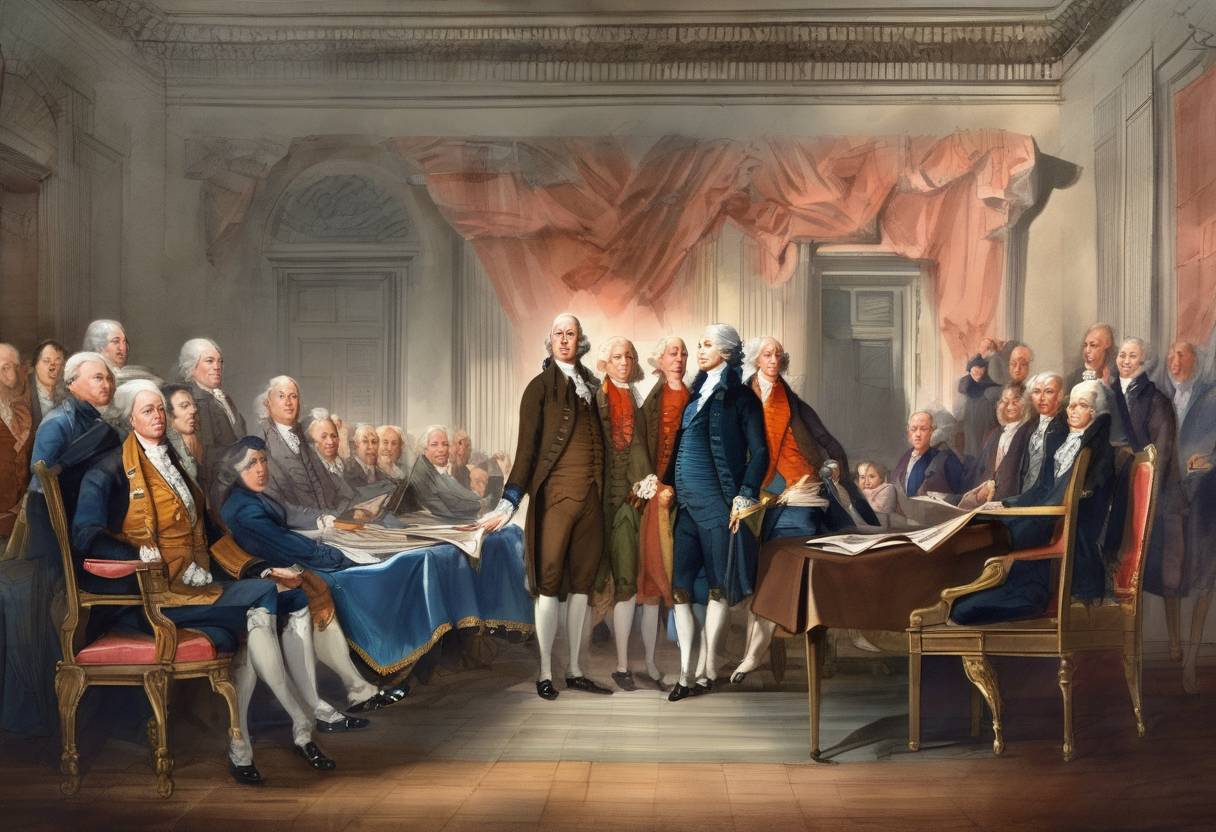
Signing of the United States Constitution
Date: September 17, 1787
Context and Background
The signing of the United States Constitution on September 17, 1787, marked the culmination of the Constitutional Convention, which convened in Philadelphia, Pennsylvania. The Convention was called to address the weaknesses of the Articles of Confederation, the nation’s first governing document, which had proven inadequate in providing a strong federal government. The Articles lacked provisions for a robust executive branch, a national judiciary, and the power to levy taxes, leading to economic difficulties and interstate disputes.
Key Events Leading to the Convention
- Annapolis Convention (1786): A precursor to the Constitutional Convention, this meeting highlighted the need for a stronger federal government and led to the call for a broader convention in Philadelphia.
- Shays’ Rebellion (1786-1787): This armed uprising in Massachusetts underscored the weaknesses of the Confederation government in maintaining order and protecting property rights, further motivating the push for a new constitution.
The Constitutional Convention
- Duration: The Convention began on May 25, 1787, and lasted until September 17, 1787.
- Participants: 55 delegates from 12 states (Rhode Island did not send representatives) attended the Convention. Notable figures included George Washington, who presided over the meetings, James Madison, often called the “Father of the Constitution,” and Benjamin Franklin.
- Debates and Compromises: The delegates engaged in extensive debates over the structure of the new government. Key compromises included:
- The Great Compromise: Established a bicameral legislature with proportional representation in the House of Representatives and equal representation in the Senate.
- The Three-Fifths Compromise: Determined that three-fifths of the enslaved population would be counted for representation and taxation purposes.
- The Electoral College: Created as a mechanism for electing the President.
The Signing
On September 17, 1787, 39 of the 55 delegates signed the Constitution. The document established a federal government with three branches: legislative, executive, and judicial, each with checks and balances to prevent any single branch from gaining too much power.
Aftermath and Ratification
- Ratification Process: The Constitution required ratification by nine of the thirteen states to become effective. This process involved intense debates between Federalists, who supported the Constitution, and Anti-Federalists, who opposed it due to concerns over centralized power and the lack of a Bill of Rights.
- The Federalist Papers: A series of essays written by Alexander Hamilton, James Madison, and John Jay, advocating for the Constitution’s ratification.
- Bill of Rights: To address Anti-Federalist concerns, the first ten amendments, known as the Bill of Rights, were introduced and ratified by 1791, ensuring protections for individual liberties.
Historical Significance
The signing of the United States Constitution laid the foundation for the American political system and has served as a model for democratic governance worldwide. Its principles of federalism, separation of powers, and individual rights continue to influence political thought and constitutional design globally.
The Constitution remains a living document, with amendments and interpretations adapting it to changing societal needs while maintaining its core principles.