The Treaty of Versailles Takes Effect: January 10, 1920
1920 · Paris, France
The Treaty of Versailles takes effect, officially ending World War I.
September 10, 1919
The Treaty of Saint-Germain was signed, formally ending World War I for Austria. It dissolved the Austro-Hungarian Empire and recognized the independence of several Central European nations.
Saint-Germain-en-Laye, France | Allied Powers
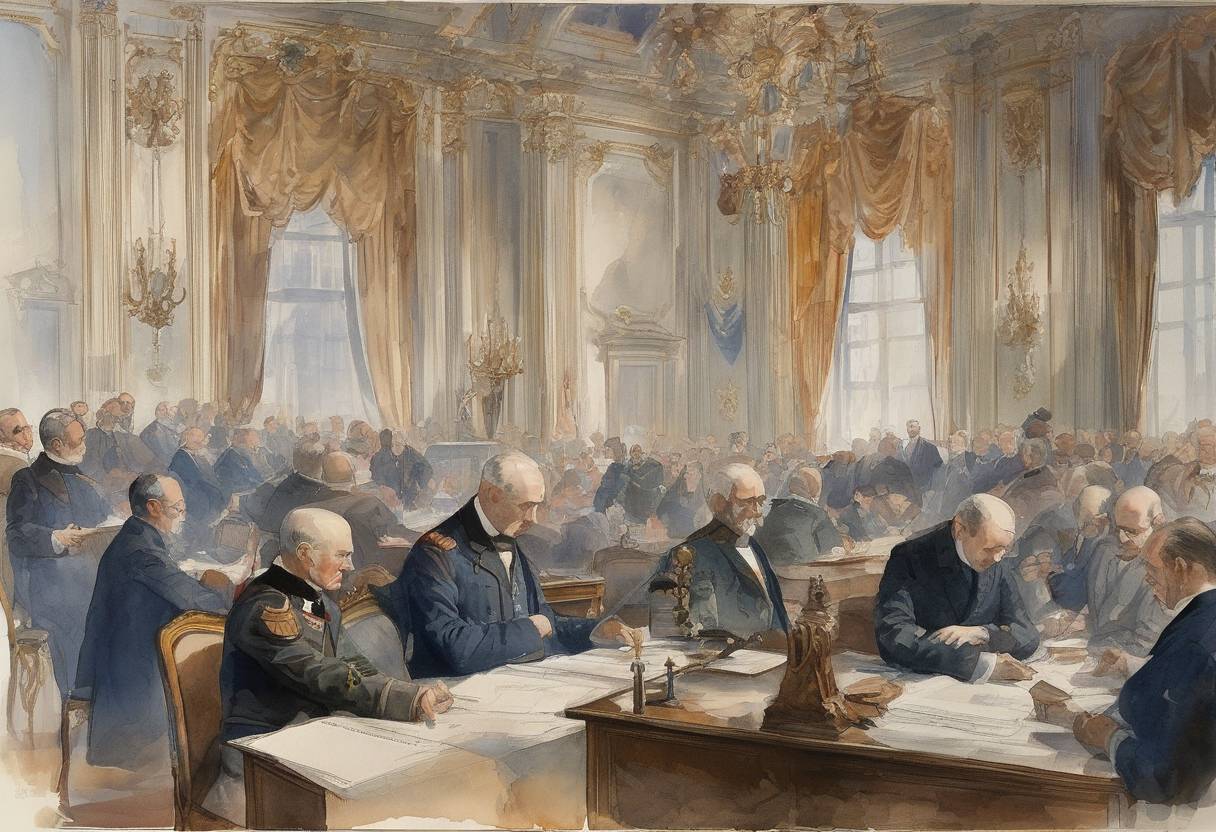
On September 10, 1919, the Treaty of Saint-Germain-en-Laye was signed, marking a significant moment in the aftermath of World War I. This treaty formally ended hostilities between the Allied Powers and Austria, one of the successor states of the Austro-Hungarian Empire. The treaty had profound implications for Central Europe, reshaping national boundaries and altering the political landscape.
The Austro-Hungarian Empire, a major player in World War I, had been a multi-ethnic empire comprising numerous nationalities. The war’s end saw the empire’s disintegration, driven by both military defeat and rising nationalist movements within its territories. The Treaty of Saint-Germain was part of the series of treaties that sought to address the complex issues arising from the collapse of empires in Europe.
Dissolution of the Austro-Hungarian Empire: The treaty officially dissolved the Austro-Hungarian Empire, recognizing the independence of several nations that emerged from its former territories.
Territorial Changes:
Recognition of New States: The treaty recognized the independence of Hungary, Czechoslovakia, Poland, and the Kingdom of Serbs, Croats, and Slovenes.
Military Restrictions: Austria’s military was significantly reduced, with strict limitations on the size and capabilities of its armed forces.
Economic and Reparations Clauses: Austria was required to pay reparations, although the exact amounts were not specified in the treaty and were later adjusted.
League of Nations: Austria was required to adhere to the principles of the League of Nations, the international organization established to maintain peace and prevent future conflicts.
The Treaty of Saint-Germain had lasting impacts on Central Europe. It not only redrew national boundaries but also set the stage for future tensions in the region. The loss of territory and economic resources left Austria in a precarious position, contributing to political instability and economic hardship in the interwar period.
The treaty also highlighted the challenges of creating nation-states in a region with diverse ethnic groups, leading to minority issues and border disputes that would persist throughout the 20th century.
In a broader context, the Treaty of Saint-Germain, along with other treaties like the Treaty of Versailles, shaped the post-war order in Europe. However, the punitive measures and unresolved nationalistic tensions contributed to the conditions that eventually led to World War II.
Overall, the Treaty of Saint-Germain was a pivotal moment in European history, symbolizing both the end of an era and the beginning of a new, complex chapter in the continent’s political landscape.
Source: en.wikipedia.org