Tiberius II Constantine Crowned as Byzantine Emperor
582 · Constantinople, Byzantine Empire
Tiberius II Constantine is crowned as the Byzantine Emperor, succeeding Justin II.
January 6, 1449
Constantine XI was crowned Byzantine Emperor at Mistra.
Mistra, Byzantine Empire | Byzantine Empire
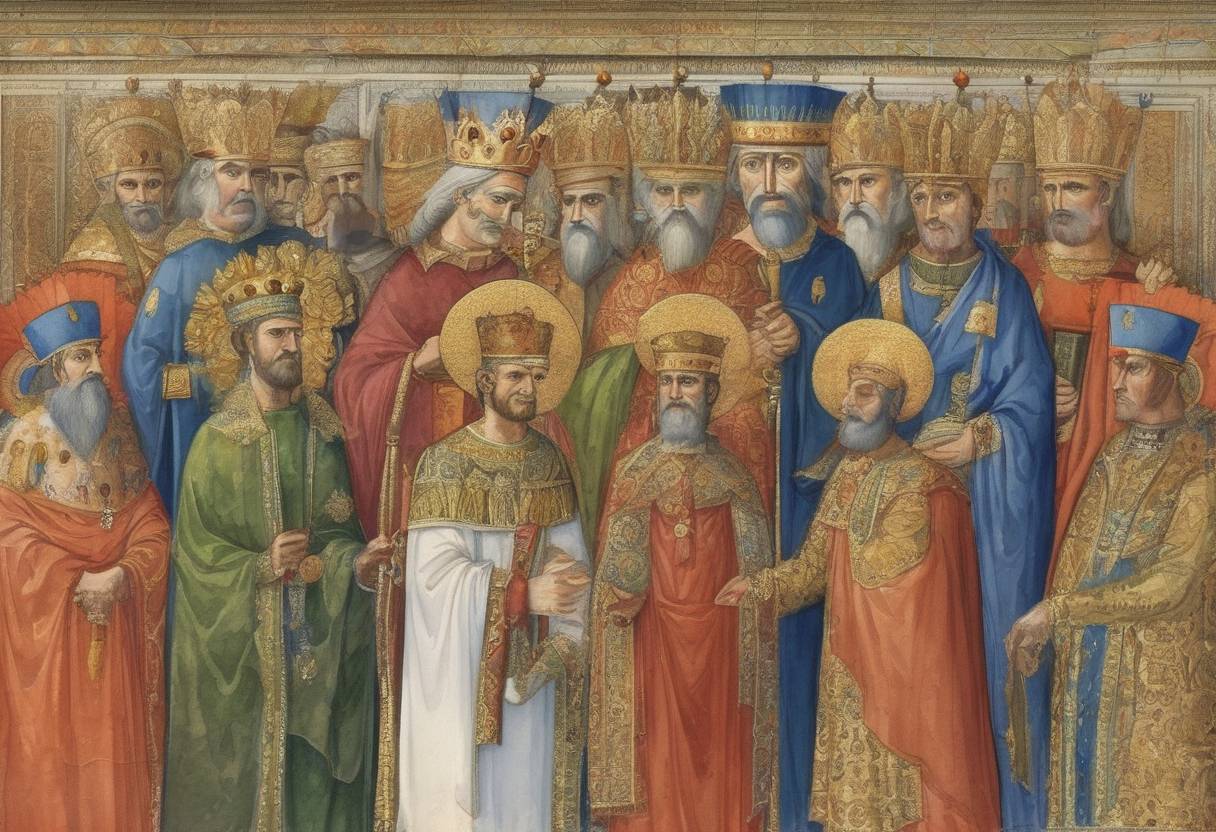
On January 6, 1449, Constantine XI Palaiologos was crowned as the Byzantine Emperor at Mistra, a significant event marking the final chapter of the Byzantine Empire’s storied history. Constantine XI, the last reigning Byzantine Emperor, ascended to the throne during a period of great turmoil and decline for the empire.
The Byzantine Empire, once a dominant power in the Mediterranean and a bastion of Christian Orthodoxy, had been in decline for centuries due to internal strife, economic difficulties, and external pressures. By the mid-15th century, the empire was reduced to the city of Constantinople and a few surrounding territories, with the Ottoman Empire posing an existential threat.
Constantine XI was born on February 8, 1405, as the eighth son of Emperor Manuel II Palaiologos and Helena Dragaš. Before his coronation, Constantine had served as the Despot of the Morea, a semi-autonomous region of the Byzantine Empire located in the Peloponnese. His governance there was marked by efforts to fortify the region and resist Ottoman encroachment.
Mistra, located near ancient Sparta, was a cultural and intellectual center of the Byzantine world and served as the capital of the Despotate of the Morea. The choice of Mistra for Constantine’s coronation was both practical and symbolic, reflecting the diminished state of the empire and the need to consolidate power in the face of Ottoman advances.
The coronation ceremony was conducted with traditional Byzantine pomp and religious solemnity, despite the empire’s precarious situation. Constantine’s ascension was seen as a beacon of hope for the beleaguered Byzantine state, with expectations that he might be able to rally support and defend Constantinople against the Ottomans.
Constantine XI’s reign was dominated by the looming threat of the Ottoman Empire, led by Sultan Mehmed II. Despite his efforts to secure military and financial aid from Western Europe, Constantine faced significant challenges in uniting Christendom against the Ottomans.
His reign culminated in the Siege of Constantinople in 1453, where he famously led the defense of the city. On May 29, 1453, after a prolonged and desperate defense, Constantinople fell to the Ottomans, marking the end of the Byzantine Empire. Constantine XI is believed to have died fighting on the city walls, becoming a symbol of resistance and martyrdom in Greek folklore.
Constantine XI’s coronation and subsequent reign represent the final chapter of the Byzantine Empire, a civilization that had profoundly influenced the cultural, religious, and political landscape of Europe and the Near East. His legacy is remembered for his bravery and dedication in the face of overwhelming odds, and his death marked the end of an era, paving the way for the rise of the Ottoman Empire as a dominant power in the region.
The fall of Constantinople also had far-reaching consequences, including the migration of Greek scholars to the West, which contributed to the Renaissance, and the shift in trade routes that eventually led to the Age of Exploration.
Source: en.wikipedia.org