1768 · Rome, United States
The Treaty of Fort Stanwix is signed between the British government and representatives of the Iroquois Confederacy.
October 7, 1763
King George III issued the Royal Proclamation of 1763, which was intended to organize Great Britain's new North American empire and to stabilize relations with Native Americans through regulation of trade, settlement, and land purchases on the western frontier.
London, United Kingdom | British Government
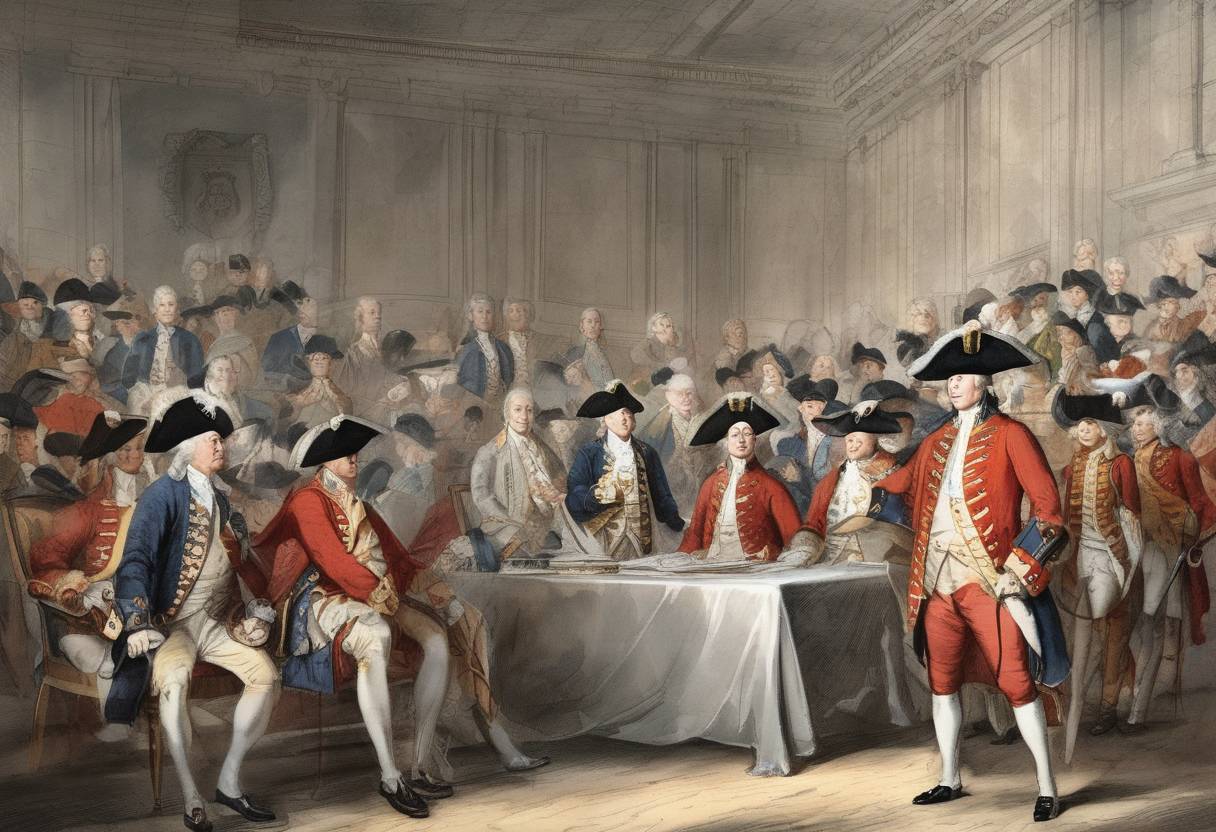
On October 7, 1763, King George III issued the Royal Proclamation of 1763, a significant document in the history of British North America. This proclamation was a response to the conclusion of the Seven Years’ War, known in the American context as the French and Indian War, which ended with the Treaty of Paris in 1763. The treaty ceded vast territories in North America from France to Great Britain, fundamentally altering the geopolitical landscape of the continent.
The Seven Years’ War had left Britain with a vast new empire in North America, including Canada and lands east of the Mississippi River. However, the war had also been costly, and the British government faced the challenge of managing and defending these new territories. Additionally, the war had exacerbated tensions between British settlers and Native American tribes, who were concerned about the encroachment on their lands.
The Royal Proclamation of 1763 aimed to address these issues through several key measures:
Boundary Establishment: The proclamation established a boundary, known as the Proclamation Line, along the Appalachian Mountains. This line was intended to separate British colonial settlements on the Atlantic coast from Native American lands to the west. Settlers were prohibited from moving westward beyond this line without official permission.
Regulation of Trade and Settlement: The proclamation sought to regulate trade with Native American tribes and prevent unauthorized land purchases. Only the British Crown could negotiate land deals with Native Americans, aiming to prevent exploitation and conflict.
Creation of New Colonies: The proclamation also organized the newly acquired territories into distinct colonies, including Quebec, East Florida, West Florida, and Grenada, providing a framework for governance and administration.
The Royal Proclamation of 1763 had significant and lasting impacts:
Colonial Discontent: Many British colonists were frustrated by the restrictions on westward expansion, as they had hoped to settle the fertile lands beyond the Appalachians. This discontent contributed to growing tensions between the colonies and the British government, eventually leading to the American Revolutionary War.
Native American Relations: The proclamation was initially intended to stabilize relations with Native American tribes by recognizing their land rights. However, enforcement was inconsistent, and tensions continued as settlers often ignored the boundary.
Legal and Historical Significance: The proclamation is considered a foundational document in the history of Native American land rights in Canada and the United States. It established the principle that Indigenous lands could not be taken without consent, a concept that continues to influence legal interpretations and treaties.
In summary, the Royal Proclamation of 1763 was a pivotal document in the management of Britain’s North American empire, with profound implications for colonial policy, Native American relations, and the eventual path to American independence.
Source: en.wikipedia.org