Adoption of Belgium's Constitution - February 7, 1831
1831 · Brussels, Belgium
Belgium's National Congress adopted the country's constitution, establishing Belgium as a constitutional monarchy.
October 4, 1830
The Kingdom of Belgium was established after the Belgian Revolution, which led to its independence from the Netherlands.
Brussels, Belgium | Provisional Government of Belgium
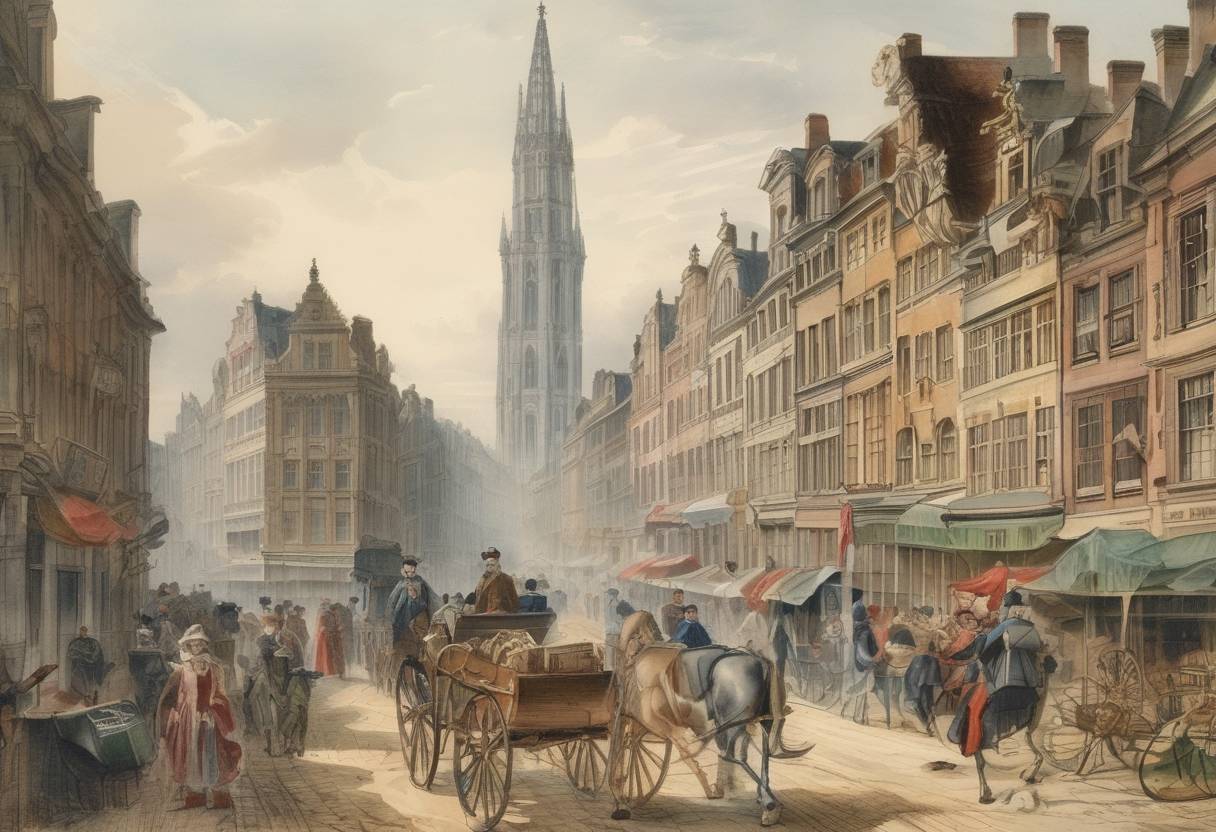
The Kingdom of Belgium was officially established on October 4, 1830, following the Belgian Revolution, which marked its independence from the United Kingdom of the Netherlands. This pivotal moment in European history was the culmination of a series of political, social, and cultural tensions that had been brewing for years.
The roots of the Belgian Revolution can be traced back to the Congress of Vienna in 1815, which redrew the map of Europe after the Napoleonic Wars. As part of the post-war settlement, the Congress created the United Kingdom of the Netherlands, merging the former Austrian Netherlands (modern-day Belgium) with the Dutch Republic. This union was intended to create a strong buffer state against France.
However, the merger was fraught with issues:
Cultural and Religious Differences: The predominantly Catholic and French-speaking Belgians found themselves under the rule of a Protestant and Dutch-speaking monarchy. This cultural and religious divide led to significant discontent among the Belgian population.
Economic Disparities: The southern provinces (Belgium) were industrially advanced compared to the northern provinces (Netherlands), which were more focused on trade and agriculture. The economic policies favored by King William I of the Netherlands often seemed to benefit the north disproportionately.
Political Grievances: Belgians were underrepresented in the national government, and there was widespread dissatisfaction with the autocratic style of King William I, who resisted calls for political reform and greater autonomy for the southern provinces.
The revolution was sparked by a combination of political unrest and cultural expression. On August 25, 1830, a performance of the opera “La Muette de Portici” in Brussels incited nationalist fervor, leading to riots and demands for independence. The unrest quickly spread across the southern provinces.
September 1830: Revolutionary forces took control of Brussels, and the Dutch military response failed to quell the uprising. The revolutionaries established a provisional government and declared independence.
October 4, 1830: The provisional government formally declared the independence of Belgium from the Netherlands. This declaration was a decisive step in the establishment of Belgium as a sovereign state.
International Recognition: Belgium’s independence was recognized by the major European powers at the London Conference of 1830-1831, although it took several years for full diplomatic recognition and the resolution of territorial disputes.
Constitutional Monarchy: Belgium adopted a liberal constitution in 1831, establishing a constitutional monarchy. Leopold I of Saxe-Coburg was invited to become the first King of the Belgians, taking the throne on July 21, 1831.
Impact on Europe: The Belgian Revolution inspired other nationalist movements across Europe, contributing to the wave of revolutions in 1848. It also highlighted the challenges of managing multi-ethnic states, influencing future European political developments.
The establishment of the Kingdom of Belgium marked a significant shift in the European balance of power and set the stage for Belgium’s development as a modern, independent nation.
Source: en.wikipedia.org