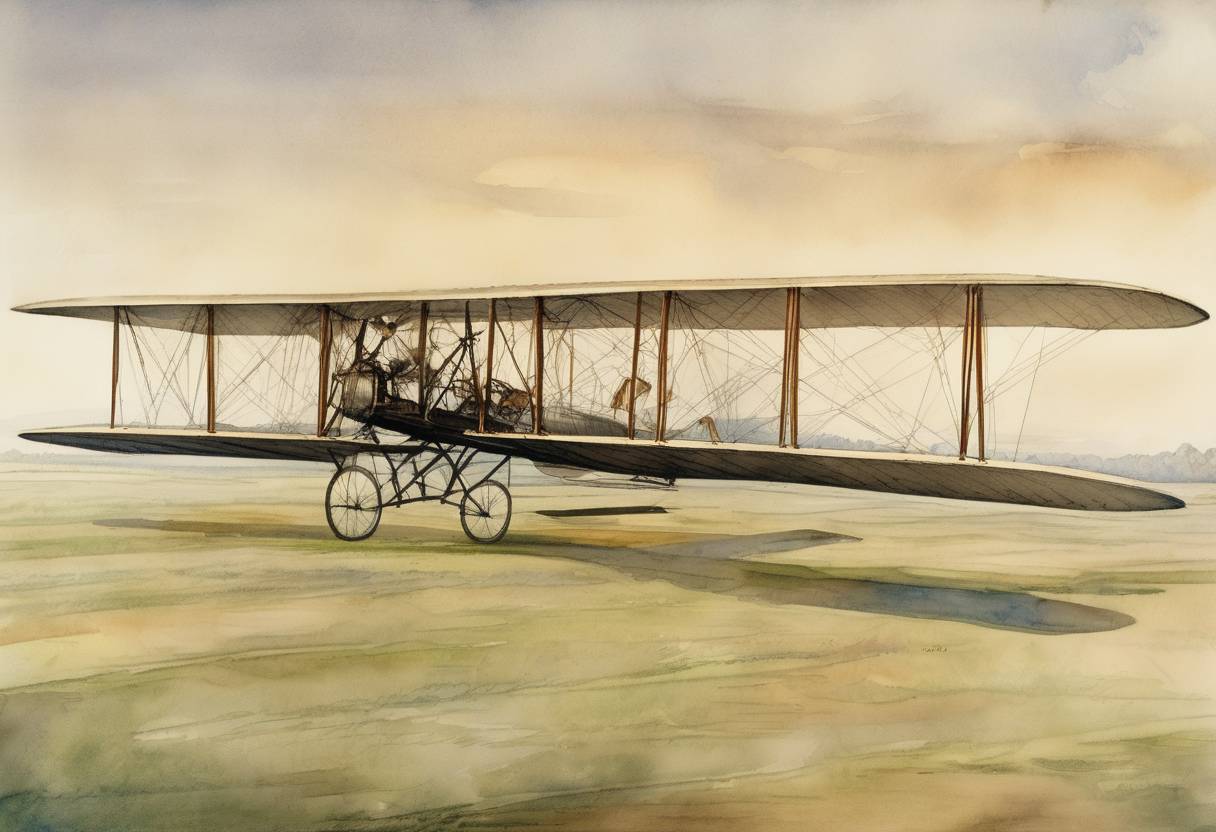
The Wright Brothers and the Patent Application for the Wright Flyer
On March 23, 1903, the Wright brothers, Orville and Wilbur Wright, took a significant step in the history of aviation by applying for a patent for their invention, the Wright Flyer. This event marked a pivotal moment in the development of powered flight, as the Wright brothers sought to protect their innovative design that would eventually lead to the first successful powered flight later that year.
Background
The Wright brothers, originally bicycle manufacturers from Dayton, Ohio, had been fascinated by the concept of flight for many years. They were inspired by the work of earlier aviation pioneers such as Otto Lilienthal and Samuel Langley. Through extensive research and experimentation, the Wright brothers developed a keen understanding of aerodynamics and control, which were crucial to achieving sustained flight.
Key Innovations
The Wright Flyer, the aircraft for which they sought a patent, incorporated several groundbreaking innovations:
Three-Axis Control System: The Wright brothers’ most significant contribution to aviation was their development of a three-axis control system, which allowed the pilot to steer the aircraft effectively and maintain its equilibrium. This system included wing-warping for roll control, a movable rudder for yaw control, and an elevator for pitch control.
Propeller Design: The Wrights also designed efficient propellers, which they realized were essentially rotating wings. Their understanding of propeller dynamics was crucial in achieving powered flight.
Lightweight Engine: They collaborated with their mechanic, Charlie Taylor, to build a lightweight gasoline engine that provided the necessary power without adding excessive weight to the aircraft.
The Patent Application
The patent application filed on March 23, 1903, was for a “Flying Machine” and focused primarily on the control system that distinguished their aircraft from others. The application was eventually granted on May 22, 1906, as U.S. Patent No. 821,393. This patent was instrumental in establishing the Wright brothers’ claim to the invention of controlled, powered flight.
Historical Significance
The patent application and subsequent patent were crucial in the Wright brothers’ efforts to secure their place in aviation history. It provided them with the legal protection needed to defend their invention against competitors and imitators. The Wright Flyer itself made its historic first flight on December 17, 1903, at Kitty Hawk, North Carolina, marking the dawn of the aviation age.
Aftermath
The Wright brothers’ patent and their successful flights paved the way for the rapid development of aviation technology in the early 20th century. Their work laid the foundation for modern aeronautics and inspired countless inventors and engineers to explore the possibilities of flight.
In summary, the Wright brothers’ patent application on March 23, 1903, was a critical milestone in their journey to achieving powered flight and securing their legacy as pioneers of aviation. Their innovations continue to influence aircraft design and aviation technology to this day.