Theodore Roosevelt’s Assassination Attempt on October 14, 1912
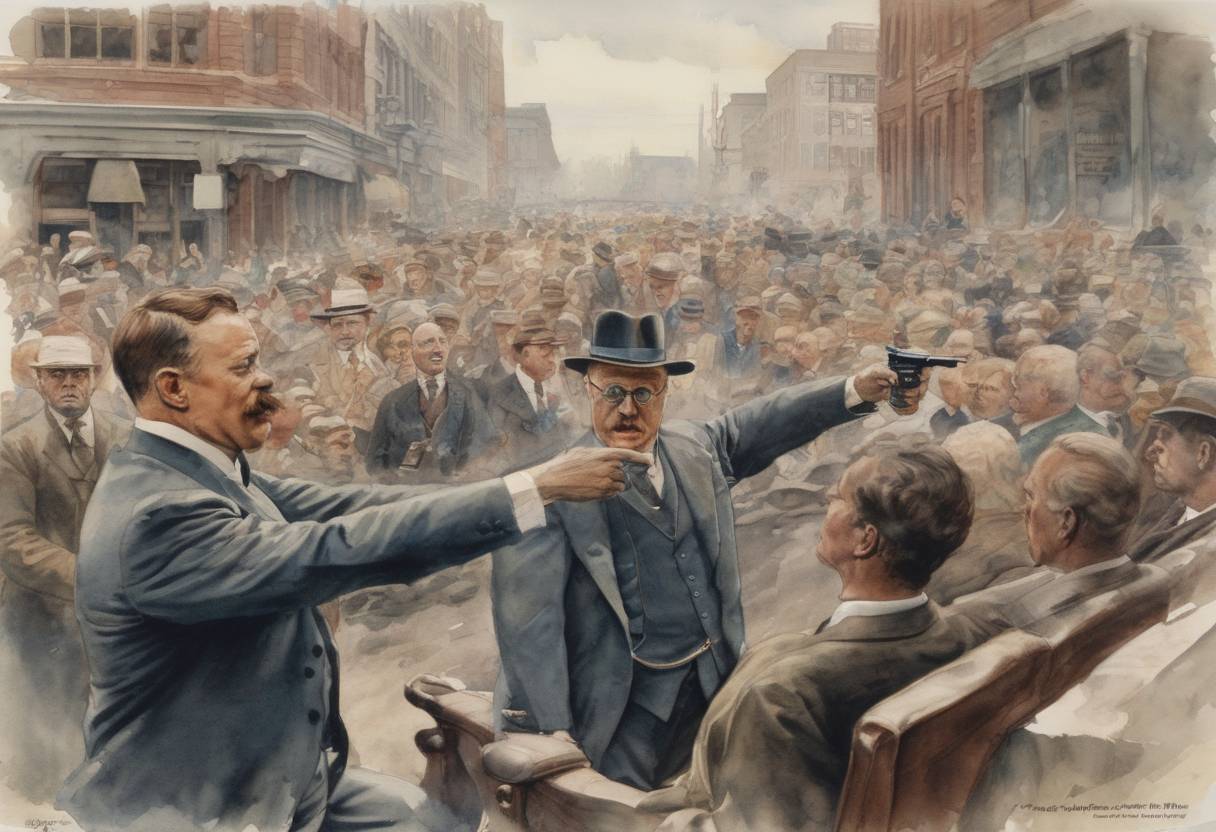
On October 14, 1912, former U.S. President Theodore Roosevelt survived an assassination attempt while campaigning for a third term as president. This dramatic event took place in Milwaukee, Wisconsin, during his run as the Progressive Party candidate, also known as the “Bull Moose Party.”
Context Leading Up to the Event
The 1912 Presidential Election: The election of 1912 was a highly contested race featuring four major candidates: incumbent President William Howard Taft (Republican), Woodrow Wilson (Democrat), Eugene V. Debs (Socialist), and Theodore Roosevelt (Progressive). Roosevelt, dissatisfied with Taft’s presidency, decided to run again, splitting the Republican vote.
The Progressive Party: Roosevelt’s campaign was marked by his advocacy for progressive reforms, including women’s suffrage, labor rights, and social welfare programs. His platform was a continuation of his earlier presidency’s “Square Deal” policies.
The Assassination Attempt
The Shooter: The assailant was John Flammang Schrank, a saloonkeeper from New York. Schrank, who was mentally unstable, believed that no president should serve a third term and claimed to have been inspired by a dream in which the ghost of President William McKinley accused Roosevelt of seeking a third term.
The Shooting: As Roosevelt was leaving the Gilpatrick Hotel in Milwaukee to deliver a speech at the Milwaukee Auditorium, Schrank approached him and fired a .38 caliber revolver at close range. The bullet struck Roosevelt in the chest.
The Speech: Despite the bullet wound, Roosevelt insisted on delivering his scheduled speech. He spoke for 90 minutes, famously beginning with, “Ladies and gentlemen, I don’t know whether you fully understand that I have just been shot; but it takes more than that to kill a Bull Moose.”
The Bullet’s Path: The bullet was slowed by a steel eyeglass case and a thick 50-page speech manuscript in Roosevelt’s breast pocket, preventing it from penetrating deeper into his chest. The bullet lodged in his rib, and he carried it for the rest of his life.
Aftermath and Historical Significance
Medical Attention: After the speech, Roosevelt was taken to a hospital where doctors determined that the bullet had not penetrated his lung. They decided not to remove it, as it posed no immediate threat.
Impact on the Election: Roosevelt’s resilience and determination garnered public admiration, but it was not enough to secure victory. Woodrow Wilson won the election, with Roosevelt finishing second and Taft third.
Legacy: The incident highlighted Roosevelt’s robust character and commitment to his principles. It remains a testament to his indomitable spirit and is often cited as an example of his larger-than-life persona.
This event is a significant moment in American political history, illustrating the intense political climate of the early 20th century and the personal risks faced by public figures. Roosevelt’s response to the assassination attempt further cemented his legacy as one of the most dynamic and resilient leaders in U.S. history.