Mahatma Gandhi's First Act of Civil Disobedience
1893 · Pietermaritzburg, South Africa
Mahatma Gandhi committed his first act of civil disobedience by refusing to leave his seat in the 'whites-only' section of a train in South Africa.
November 6, 1913
Mahatma Gandhi was arrested while leading a march of Indian miners in South Africa, an event that highlighted his philosophy of nonviolent resistance.
Dundee, South Africa | Indian National Congress
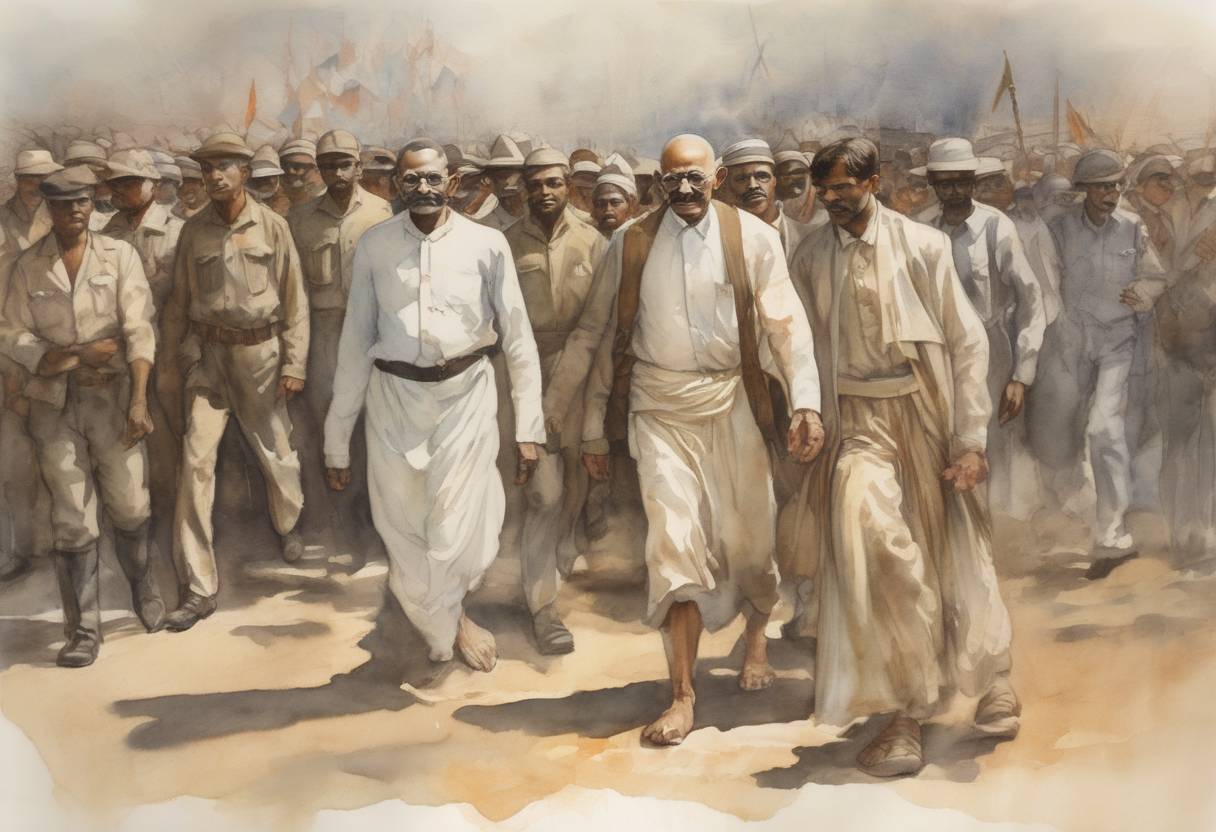
On November 6, 1913, Mahatma Gandhi was arrested while leading a march of Indian miners in South Africa, an event that underscored his commitment to nonviolent resistance, or Satyagraha. This pivotal moment was part of a larger struggle against discriminatory laws affecting the Indian community in South Africa.
In the early 20th century, the Indian community in South Africa faced severe discrimination under colonial rule. Laws such as the Immigration Act and the Transvaal Asiatic Registration Act imposed harsh restrictions on Indians, including mandatory registration and carrying of passes, which were seen as demeaning and unjust.
Gandhi, who had been in South Africa since 1893, emerged as a leader advocating for the rights of Indians. He developed the philosophy of Satyagraha, which emphasized nonviolent resistance as a means to achieve social and political change. This philosophy would later become a cornerstone of his leadership in India’s struggle for independence.
The march that led to Gandhi’s arrest was part of a broader campaign against the £3 tax imposed on former indentured laborers, which was financially crippling for many Indian workers. Gandhi organized a mass protest involving thousands of Indian miners from the Natal region, who marched towards the Transvaal border in defiance of the discriminatory laws.
On November 6, 1913, as the march progressed, Gandhi was arrested by the South African authorities. His arrest was intended to suppress the movement and discourage further protests. However, it had the opposite effect, drawing international attention to the plight of the Indian community in South Africa and garnering widespread support for their cause.
Gandhi’s arrest did not deter the movement. Instead, it galvanized further protests and strikes, leading to increased pressure on the South African government. Eventually, these efforts contributed to the easing of some discriminatory laws and laid the groundwork for future civil rights advancements in the region.
The event was significant not only for its immediate impact but also for its demonstration of the power of nonviolent resistance. Gandhi’s leadership and the success of the Satyagraha campaign in South Africa served as a precursor to his later work in India, where he would lead the nation to independence using similar principles.
In summary, the arrest of Mahatma Gandhi on November 6, 1913, was a defining moment in the history of civil rights movements, highlighting the effectiveness of nonviolent protest and setting a precedent for future struggles against injustice worldwide.
Source: www.britannica.com