The Constitutional Act of 1791
1791 · London, United Kingdom
The British Parliament passes the Constitutional Act of 1791, splitting the Province of Quebec into Upper and Lower Canada.
June 22, 1774
The Quebec Act is passed by the British Parliament, establishing procedures of governance in the Province of Quebec.
London, United Kingdom | British Parliament
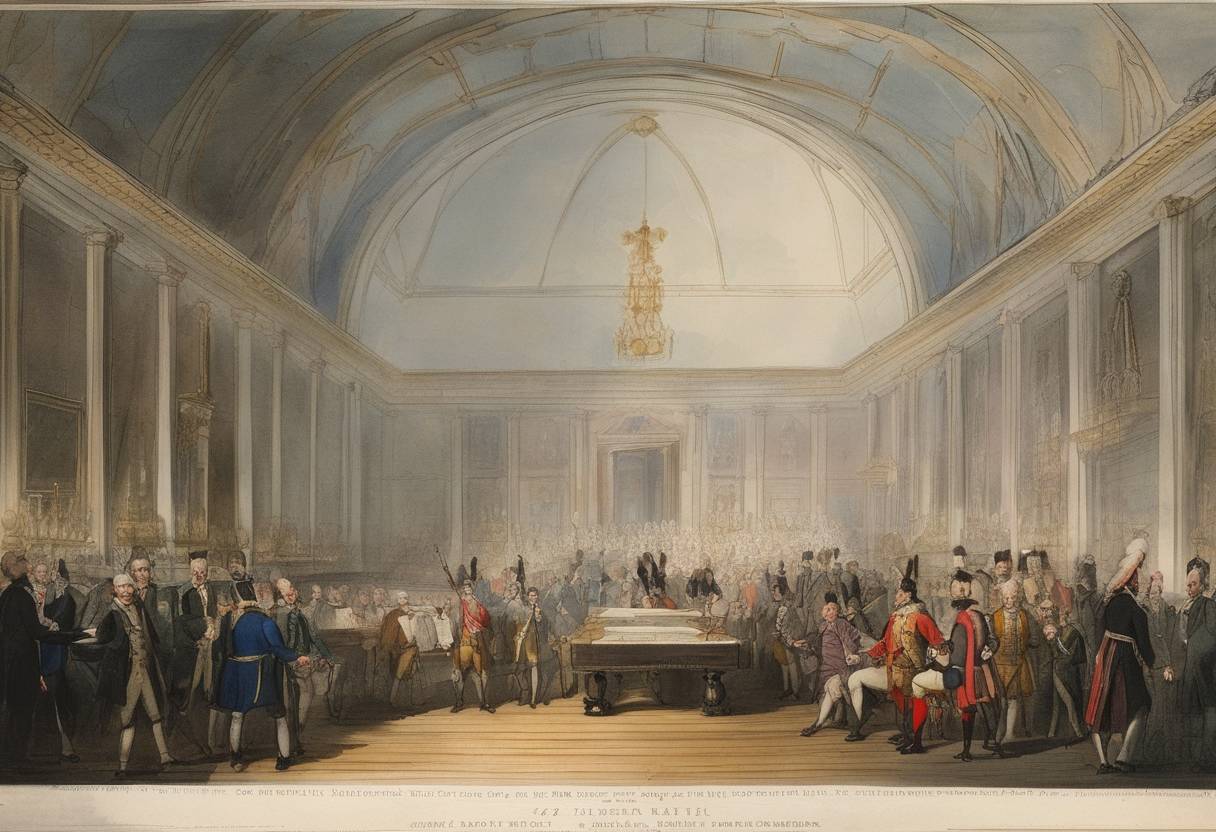
On June 22, 1774, the British Parliament passed the Quebec Act, a significant legislative move that addressed the governance and administration of the Province of Quebec following the British acquisition of French territories after the Seven Years’ War (known in North America as the French and Indian War).
Following the Treaty of Paris in 1763, France ceded its North American territories to Britain. This transfer included Canada and various lands claimed by France west of the Appalachian Mountains. The British government faced the challenge of integrating a largely French-speaking, Catholic population into an overwhelmingly Protestant and English-speaking empire.
The Quebec Act aimed to structure the governance of Quebec in a manner that reflected its distinct cultural and social composition. Key provisions included:
Religious Freedom: The act allowed the free practice of the Roman Catholic faith, a significant concession given the predominantly Protestant British Empire. It legally recognized the Roman Catholic Church’s rights to collect tithes.
French Civil Law: The Act reinstated the use of French civil law for private matters, such as property and contracts, while maintaining English criminal law, which was seen as more advanced in terms of protecting individual rights.
Territorial Expansion: It expanded Quebec’s boundary south to the Ohio River, doubling its size and encompassing vast territories where European settlement was limited, critically affecting the American colonies’ expansion aspirations.
Government Structure: The Act established a government without an elected assembly, placing legislative power in a governor and council appointed by the British crown. This was consistent with the administrative approach Britain used in other colonies but lacked democratic representation, leading to criticism.
The Quebec Act had significant repercussions, both in Canada and the American colonies:
In Quebec, it helped ease tensions by acknowledging the cultural and religious rights of French Canadians, fostering cooperation between them and British authorities.
Conversely, the Act was perceived negatively in the Thirteen Colonies. Dubbed one of the “Intolerable Acts” by American colonists, it contributed to the growing dissatisfaction that led to the American Revolutionary War. Colonists viewed the territorial provisions and the lack of democratic governance as threats to their own expansionist intentions and liberties.
The Act laid the foundation for Quebec’s distinct legal and cultural identity within Canada, aspects that continue to influence its socio-political landscape today.
Overall, the Quebec Act stands as an early instance of British imperial legislative intervention that balanced governance with cultural accommodation, albeit with complex and lasting ripple effects throughout North American history.
Source: en.wikipedia.org