The Battle of Freiberg - October 29, 1762
1762 · Freiberg, Holy Roman Empire
During the Seven Years' War, the Battle of Freiberg took place, resulting in a Prussian victory over Austrian forces.
August 21, 1760
The Battle of Leutershausen took place during the Seven Years' War as an encounter between French forces under the command of Maurille Joseph La Tour Maubourg and the Prussian army led by Prince Ferdinand of Brunswick.
Leutershausen, Germany | Prussian Army
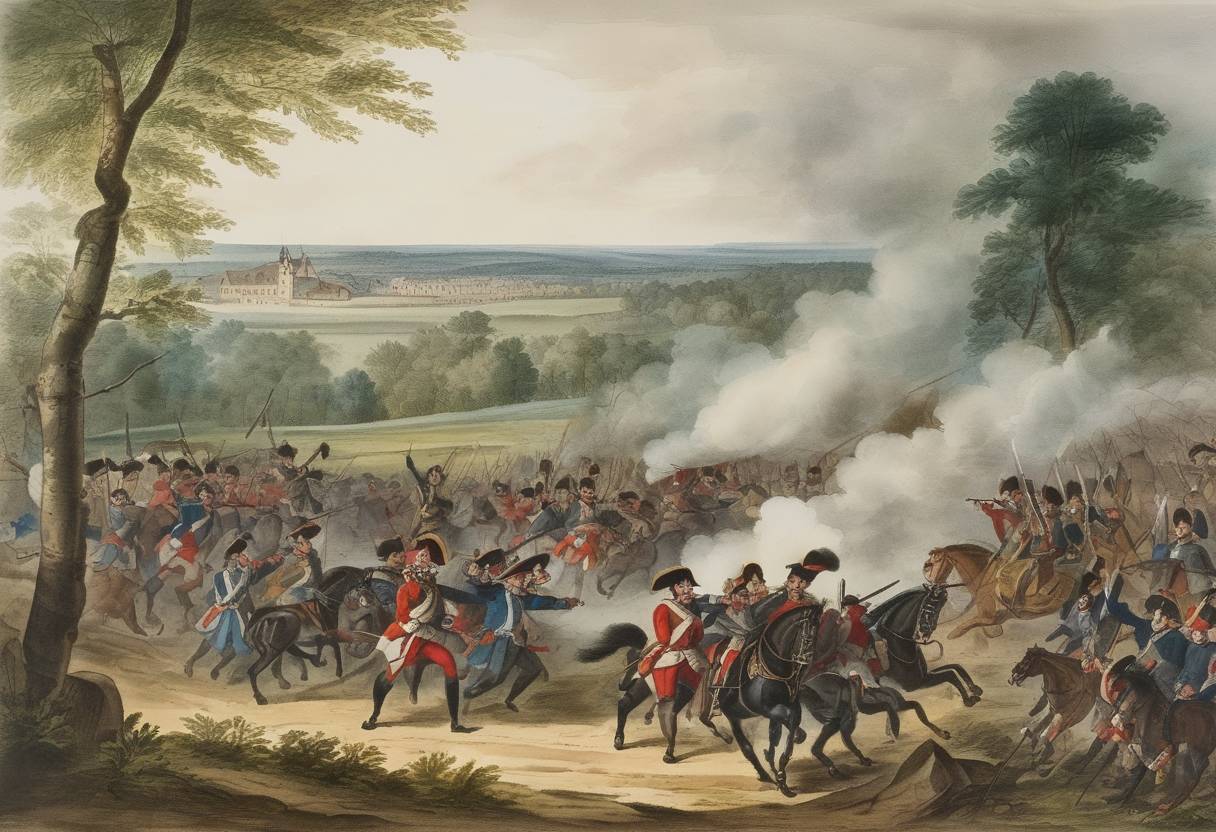
The Battle of Leutershausen was a significant engagement during the Seven Years’ War, taking place on August 21, 1760. It involved French forces, commanded by Maurille Joseph La Tour Maubourg, engaging with the Prussian army led by Prince Ferdinand of Brunswick. This encounter is one of many during the protracted conflict which engulfed much of Europe from 1756 to 1763.
The Seven Years’ War was a global conflict that pitted major European powers against one another, with ramifications reaching into the Americas, Africa, and Asia. The war in Europe largely revolved around long-standing conflicts over territorial control and influence. The principal belligerents saw Britain and Prussia facing an alliance that included France, Austria, and Russia, among others.
Prince Ferdinand of Brunswick was one of Frederick the Great’s most trusted generals. By 1760, the war had reached a critical phase, with campaigns being conducted across multiple theaters. The French had consistently worked to undermine Prussian and British positions in Germany, attempting to relieve pressure on their allies and open new fronts.
The small yet strategically significant battle at Leutershausen unfolded in the broader context of Ferdinand’s attempts to disrupt French maneuvers. French forces under La Tour Maubourg sought to consolidate their positions, but Ferdinand aimed to challenge and demoralize them, taking advantage of his knowledge of the terrain and tactical prowess.
While detailed accounts of the encounter are sparse compared to larger battles of the war, the confrontation at Leutershausen illustrated the mobile and dynamic nature of warfare during this period. Both commanders attempted to outmaneuver each other, leveraging the element of surprise and tactical adaptability.
While the battle itself did not lead to a decisive victory for either side, it exemplified the ongoing struggle for dominance in central Europe during the Seven Years’ War. These engagements gradually wore down the combatants, contributing to war fatigue and shaping subsequent military strategies.
Prince Ferdinand continued his efforts throughout the campaign, maintaining pressure on French forces and disrupting their operations whenever possible. Although the terrain and climate of the time could impose significant obstacles, leaders like Ferdinand showcased the critical role of leadership and strategy in the war.
The conflict at Leutershausen, along with other engagements during the war, played an essential role in defining the geopolitical realities of Europe in the latter half of the 18th century. The outcomes of the Seven Years’ War set the stage for future diplomatic and military developments, influencing the rise of the British Empire and the decline of French influence overseas.
Overall, the Battle of Leutershausen, while not as celebrated or documented as larger battles, holds a critical place in the intricate mosaic of the Seven Years’ War and its transformative effects on European and global history.
Source: en.wikipedia.org