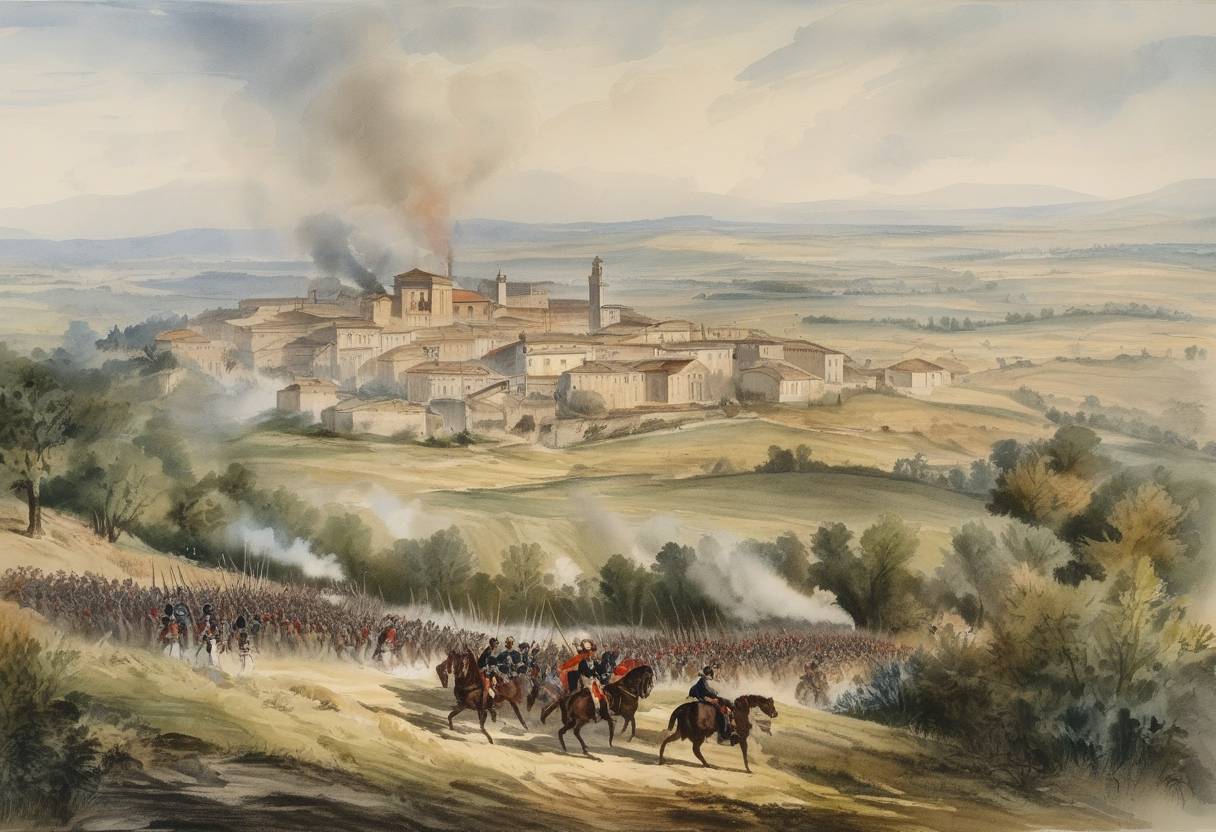
The Battle of Solferino - June 24, 1859
Overview
The Battle of Solferino, fought on June 24, 1859, was a pivotal conflict during the Second Italian War of Independence. It involved the forces of the Austrian Empire, led by Emperor Franz Joseph I, against the allied armies of France and the Kingdom of Sardinia, commanded by Napoleon III and Victor Emmanuel II, respectively. This battle was key to the eventual unification of Italy.
Context and Prelude
Following growing nationalist sentiments across the Italian states, the Kingdom of Sardinia sought to end Austrian dominance over the Italian Peninsula. The Franco-Sardinian alliance was formed against the backdrop of a common objective—driving Austrian forces out of northern Italy. The war began in April 1859, culminating in two major battles before Solferino: the battles of Magenta and Palestro, where the allies secured important victories.
The Battle
The Battle of Solferino took place near the towns of Solferino and San Martino in Lombardy, northern Italy. This engagement involved around 300,000 soldiers—one of the largest since the Napoleonic Wars.
Key Developments
- Strategic Positioning: The battle was fought over a heavily contested terrain of hills and fortifications. The French and Sardinian forces aimed to dislodge Austrian control from strategic high points.
- Engagement: The battle began in the early morning hours and stretched into a day-long, grueling engagement marked by brutal hand-to-hand combat.
- Decisive Maneuvers: French forces, utilizing their artillery and superior numbers, managed to breach the Austrian lines. Meanwhile, Sardinian troops effectively engaged on the southern flank at San Martino, ensuring the Austrian positions couldn’t regroup.
Outcome
The battle concluded with a victory for the Franco-Sardinian alliance. The Austrians, despite their strong position, were forced to retreat. This defeat compelled Austria to reconsider their hold on Italian territories.
Aftermath and Significance
- Treaty of Villafranca: Soon after the battle, peace negotiations commenced, resulting in the Treaty of Villafranca on July 12, 1859, where Austria ceded Lombardy to France, which then transferred it to Sardinia.
- Path to Unification: The victory was a crucial step towards the unification of Italy, spurring movements across the peninsula that culminated in the proclamation of the Kingdom of Italy in 1861.
- Humanitarian Impact: The widespread casualties and suffering observed during and after the battle inspired Henry Dunant, a Swiss businessman and social activist, to advocate for the formation of the International Committee of the Red Cross and the establishment of the Geneva Conventions on war conduct.
The Battle of Solferino remains a significant historical event, not only for its immediate military and political outcomes but also for its lasting humanitarian legacy.