Inauguration of Charles de Gaulle as President of the French Fifth Republic
1959 · Paris, France
Charles de Gaulle was inaugurated as the first President of the French Fifth Republic, marking a significant shift in French politics and governance.
June 1, 1958
Charles de Gaulle became the Prime Minister of France.
Paris, France | French Government
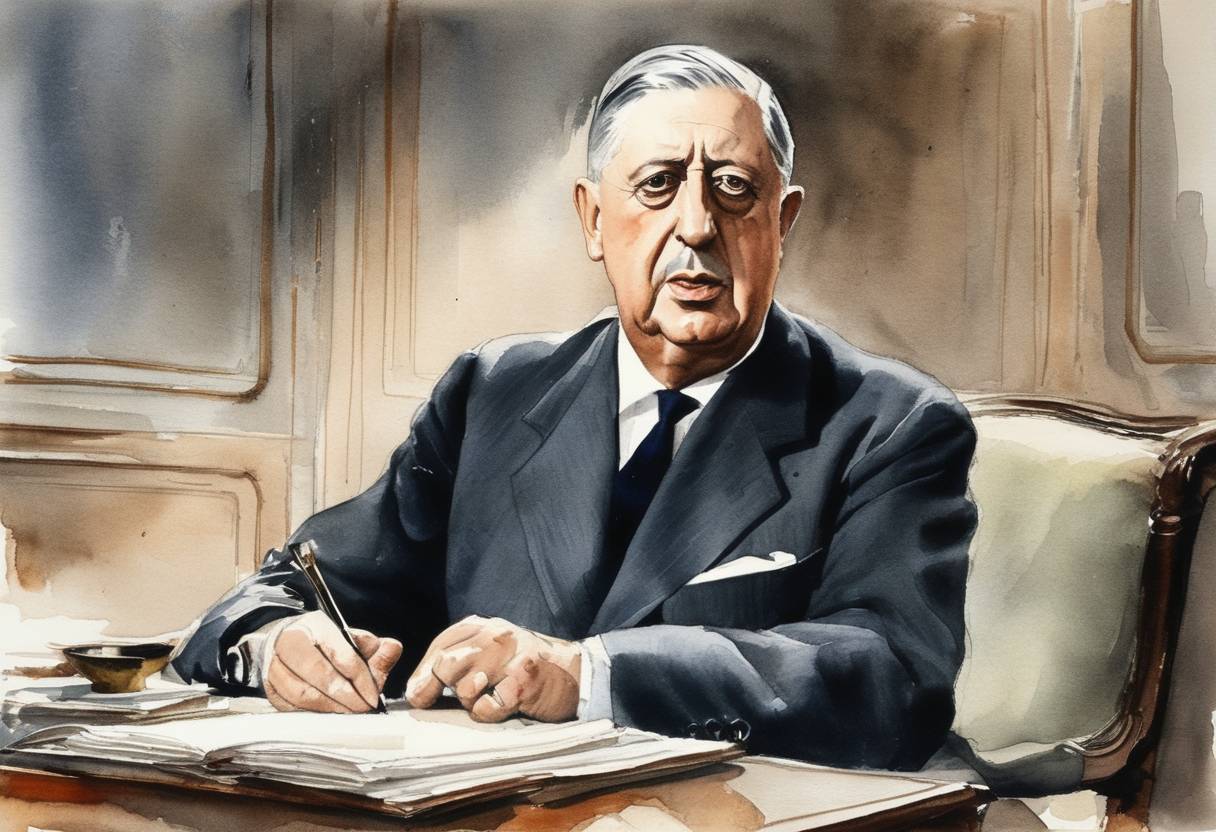
On June 1, 1958, Charles de Gaulle assumed the position of Prime Minister of France amid a period of intense political instability and national crisis known as the “May 1958 Crisis.” This pivotal moment was marked by his efforts to address the sociopolitical turmoil in France and restructure the French government.
In the late 1950s, France was embroiled in the Algerian War of Independence, which was causing deep divisions within the French political sphere. The Fourth Republic, established after World War II, was struggling with systemic instability, characterized by frequent government changes and an inability to effectively manage the Algerian conflict.
The crisis in May 1958 reached a tipping point when a coup d’état in Algeria by French military leaders and settlers demanded the return of de Gaulle to power. They believed that only de Gaulle could ensure the continued French presence in Algeria and restore order.
Reappointment: On June 1, 1958, the French National Assembly voted to reinstate Charles de Gaulle as Prime Minister, with a significant majority. De Gaulle was entrusted with full governmental powers for a six-month period, reflecting the Assembly’s desperation for stabilizing leadership.
Mandate for a New Constitution: Upon becoming Prime Minister, de Gaulle was also tasked with drafting a new constitution, effectively leading to the transition from the Fourth to the Fifth Republic. He was given extraordinary powers to enact reforms that would address the inadequacies of the existing political system.
De Gaulle’s appointment marked the beginning of the end for the French Fourth Republic. He swiftly moved to draft and implement a new constitution, which was later approved by a national referendum in October 1958. This established the Fifth Republic, with a strong executive branch and a new political framework that significantly reduced parliamentary fragmentation.
De Gaulle’s assumption of power represented a turning point in French history, stabilizing the nation politically and establishing a governmental structure that endures to this day. His leadership also marked a new approach towards the decolonization processes in Algeria and other territories, eventually paving the way for Algerian independence in 1962.
Charles de Gaulle would go on to become the first President of the Fifth Republic later in December 1958, continuing his influence on French politics and international affairs. His leadership style and policies would leave a lasting impact on both France and the broader geopolitical landscape.
Source: www.britannica.com