The Attack on Pearl Harbor: December 7, 1941
1941 · Pearl Harbor, United States
The Imperial Japanese Navy attacks the United States naval base at Pearl Harbor, Hawaii, leading to the United States' entry into World War II.
February 25, 1941
In the Battle of the Java Sea, British and Dutch ships are sunk by Japanese forces, marking a significant naval battle during the Pacific campaign of World War II.
Java Sea, Indonesia | Imperial Japanese Navy
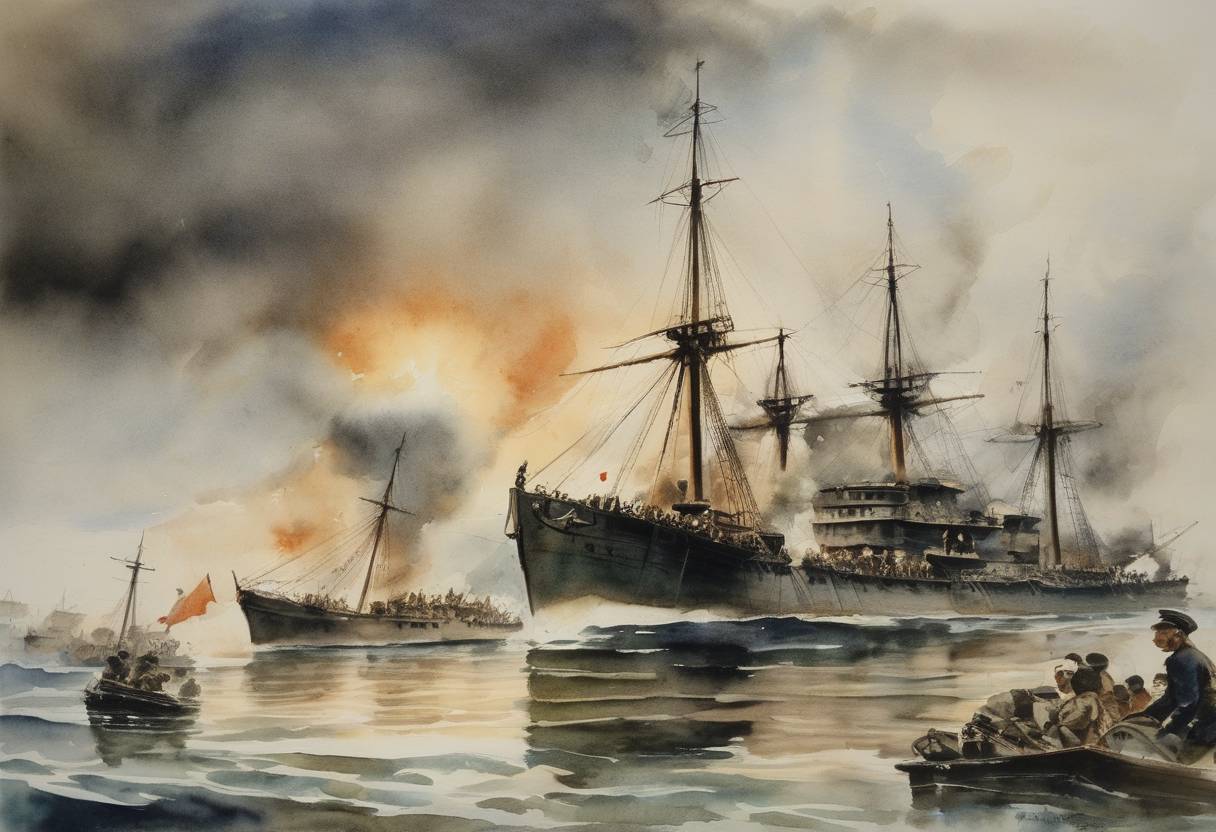
The Battle of the Java Sea, a critical engagement during the Pacific campaign of World War II, took place on February 27, 1942, rather than February 25, 1941, as was previously suggested. This naval battle marked a significant confrontation between the Imperial Japanese Navy and the Allied naval forces consisting primarily of British, Dutch, Australian, and American warships.
The Japanese Empire sought to expand its influence and control over the resource-rich regions of Southeast Asia during World War II. Following their initial successes in Malaya, the Philippines, and the Dutch East Indies, the Japanese aimed to secure Java, the most populous and economically vital island in the region.
In response, the Allied forces under the command of Dutch Rear Admiral Karel Doorman assembled a multi-national fleet, known as the American-British-Dutch-Australian Command (ABDACOM), tasked with halting the Japanese advance.
On February 27, 1942, Admiral Doorman led a fleet that included the Dutch cruisers HNLMS De Ruyter and HNLMS Java, the British cruiser HMS Exeter, the American cruiser USS Houston, and several destroyers from the respective Allied nations.
The Allied plan was to intercept and disrupt a major Japanese invasion convoy heading to Java, protected by a formidable escort. The battle unfolded in the Java Sea, and the Allies were significantly outgunned and outmaneuvered by the Japanese fleet, which comprised heavy and light cruisers under Vice Admiral Takeo Takagi.
Despite their numerical inferiority and outdated equipment, the Allied fleet fought valiantly. However, the Japanese forces, equipped with superior torpedoes and naval tactics, managed to inflict heavy losses on the Allies. Key ships such as HNLMS De Ruyter and HNLMS Java were sunk during the battle, with significant casualties, including Admiral Doorman.
The defeat at the Battle of the Java Sea resulted in the near-annihilation of the Allied naval presence in Southeast Asia, paving the way for Japanese forces to complete their invasion of Java and much of the Dutch East Indies. This victory solidified Japanese control over the region, further straining Allied resources and strategic positioning in the Pacific theater.
The loss also highlighted the challenges faced by the Allied forces in terms of coordination, logistical support, and technological disparities compared to the Imperial Japanese Navy. The battle was a catalyst for the Allies to reassess their strategies and improve their naval tactics, training, and technology, which played a crucial role in later successes in the Pacific war.
The Battle of the Java Sea remains a stark example of the challenges of coalition warfare, the risks of technological inferiority, and the strategic significance of naval power during World War II.
Source: www.history.com