1214 · Alarcos, Spain
Alfonso VIII of Castile and the forces of the Almohad Caliphate clash in the Battle of Alarcos. This battle establishes Almohad dominance in southern Iberia for a period.
May 24, 1086
During the reign of King Alfonso VI of León and Castile, the Battle of Zallaqah took place, where Muslim forces led by Almoravid general Yusuf ibn Tashfin defeated Christian forces near Sagrajas, reinforcing the Muslim presence in the Iberian Peninsula.
Zallaqah, Almoravid Empire (present-day Spain) | Almoravid Empire
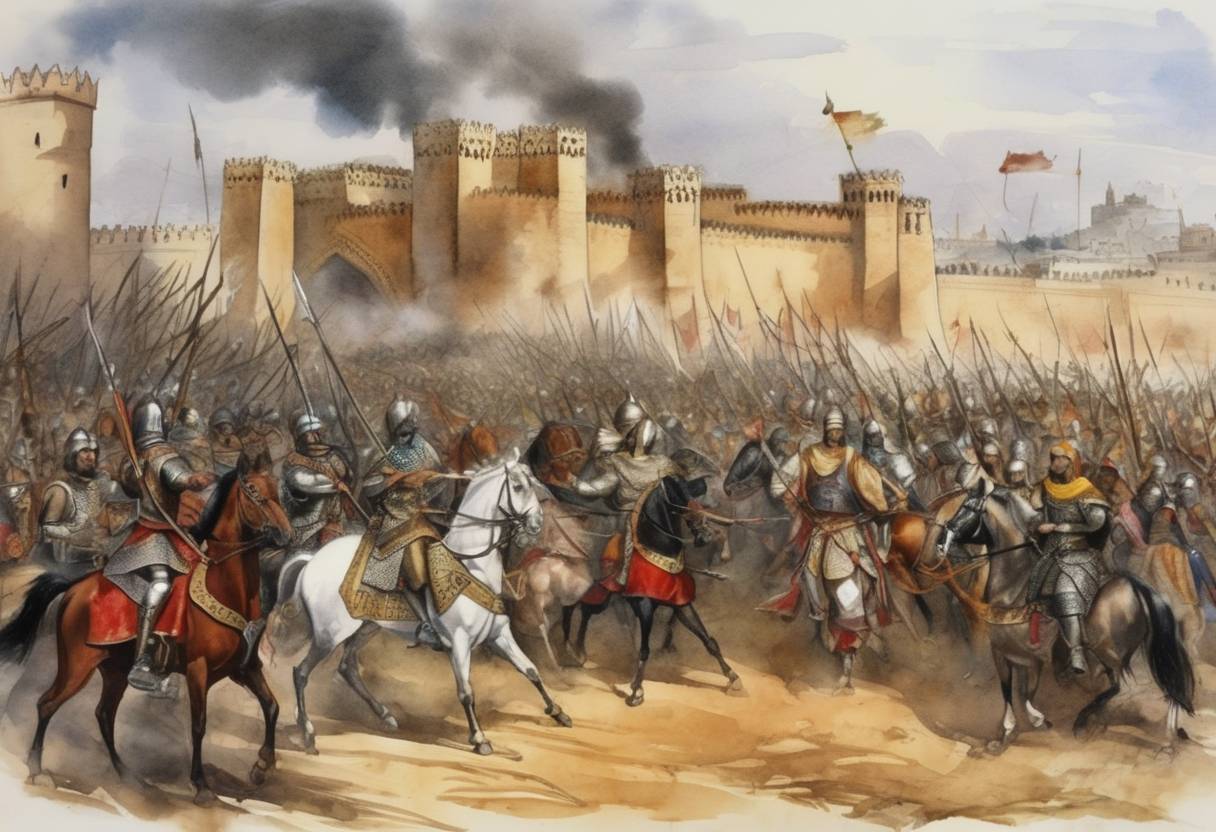
The Battle of Zallaqah, also known as the Battle of Sagrajas, was a significant conflict that occurred on October 23, 1086, during the reign of King Alfonso VI of León and Castile. This battle marked a crucial moment in the history of the Iberian Peninsula as it reinforced Muslim presence amidst the Christian Reconquista efforts.
In the late 11th century, the Iberian Peninsula was a contested region between Christian kingdoms in the north and Muslim-controlled territories in the south. King Alfonso VI had gained considerable ground through military conquests and political maneuvering. The Almoravid dynasty, a powerful Muslim empire originating from North Africa, was called upon by Andalusian Muslim taifas (small kingdoms) to counter the Christian advances.
The battle took place near the town of Sagrajas, close to present-day Badajoz in Spain. Yusuf ibn Tashfin and his forces crossed the Strait of Gibraltar to join the battle against Alfonso VI. The Muslim army was not only comprised of Almoravid warriors but was also supported by soldiers from various Andalusian taifas.
The battle opened with an initial attack by the Christians, who forced the Muslim forces to retreat temporarily. However, Yusuf ibn Tashfin reorganized his troops and implemented a strategic counteroffensive. His tactical maneuver, which involved a feigned retreat followed by an encirclement, proved decisive. The Christian forces were overwhelmed and suffered a major defeat.
The victory at Zallaqah had far-reaching consequences for the Iberian Peninsula:
The Battle of Zallaqah stands as a pivotal event that shaped the geopolitical landscape of medieval Spain, reflecting the intense struggle between Christian and Muslim forces over control of the peninsula.
Source: en.wikipedia.org