Jeannette Rankin: First Woman in the U.S. House of Representatives
1917 · Washington, D.C., United States
Jeannette Rankin of Montana becomes the first woman member of the United States House of Representatives.
March 8, 1884
Susan B. Anthony testified before the House of Representatives Judiciary Committee arguing for an amendment to the U.S. Constitution granting women the right to vote.
Washington, D.C., United States | United States House of Representatives
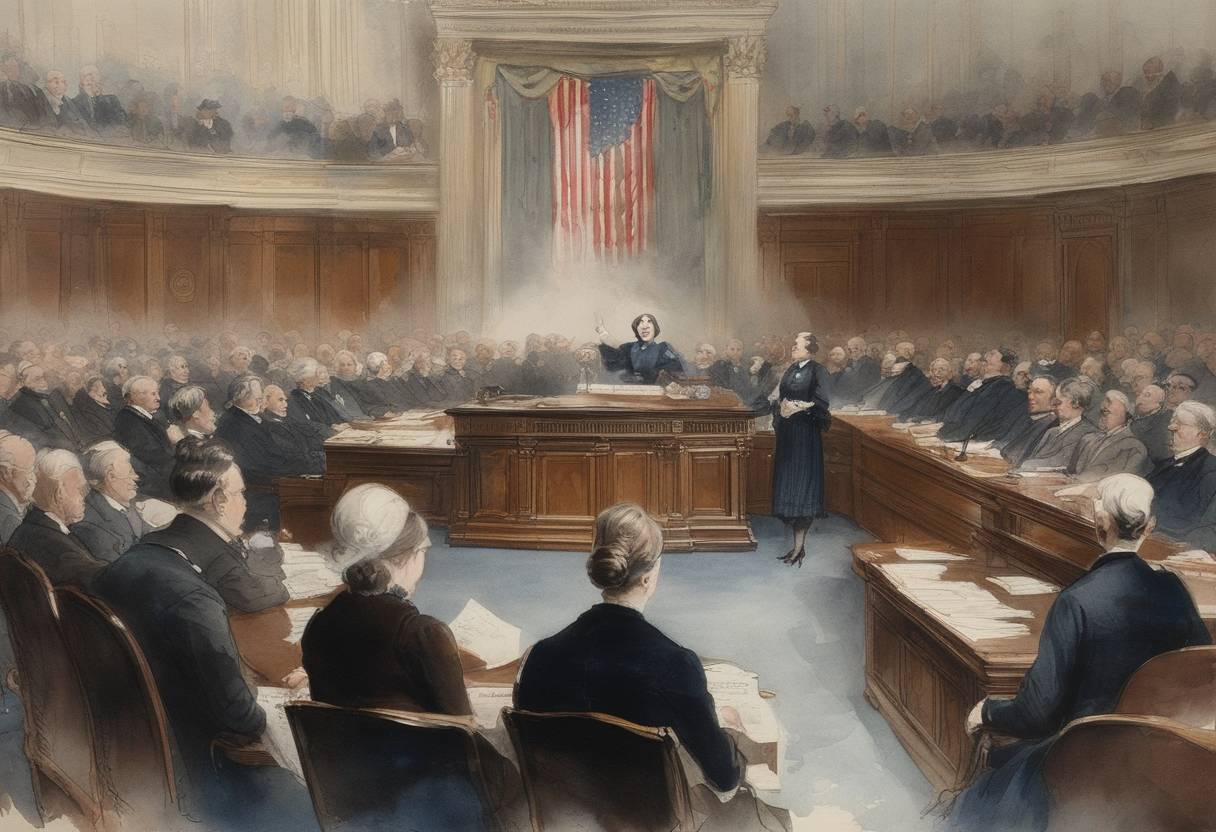
On March 8, 1884, prominent suffragist Susan B. Anthony presented testimony before the House of Representatives Judiciary Committee, advocating for a constitutional amendment that would grant women the right to vote. This event was a critical moment in the women’s suffrage movement in the United States, highlighting the tireless efforts of activists to secure voting rights for women.
Susan B. Anthony was one of the leading figures in the American women’s suffrage movement, having spent decades championing equal rights for women. By the time of her testimony in 1884, Anthony had already established a legacy as a relentless advocate for women’s rights.
The fight for women’s suffrage had been ongoing since the mid-19th century, gaining momentum with the Seneca Falls Convention of 1848, where the Declaration of Sentiments was presented, marking the beginning of a formal movement. As the movement progressed, activists like Anthony and her peers, including Elizabeth Cady Stanton, organized campaigns, gave speeches, and lobbied government officials to acknowledge women’s right to participate in the democratic process.
During her testimony before the House Judiciary Committee, Anthony provided a compelling argument in favor of women’s suffrage. Her address underscored the inconsistent application of democratic principles when women, despite being citizens, were denied the right to vote:
Equality and Justice: Anthony emphasized the fundamental democratic principle that the government derives its powers from the consent of the governed. She pointed out the hypocrisy inherent in a system that afforded rights and representation to certain citizens while excluding others based on gender.
Universal Suffrage: Arguing that enfranchisement should be universal, Anthony highlighted the stances of the founding fathers, citing the Declaration of Independence and the Constitution as documents that inherently supported the idea of equal rights for all citizens.
Addressing Objections: She also tackled common objections to women’s suffrage, challenging notions about women’s supposed incapacity for political involvement and refuting arguments that women’s suffrage would undermine traditional gender roles.
Although Anthony’s 1884 testimony did not lead to immediate congressional action toward adopting a constitutional amendment, her efforts continued to galvanize the suffrage movement. The movement would persist for several more decades with activists tirelessly campaigning for the vote.
Susan B. Anthony’s advocacy and her strategic use of congressional testimony were integral to maintaining suffrage as a national issue. Her work laid the groundwork for future legislative efforts, culminating in the ratification of the 19th Amendment in 1920, which granted women the right to vote nationwide. Anthony’s legacy endures as a testament to the power of determined activism and advocacy in the fight for equality.
Source: www.loc.gov