1819 · Paris, France
The first successful parachute jump from a balloon is made by Jean-François Pilâtre de Rozier, landing safely after leaping from a height of 3,000 feet.
January 7, 1785
Frenchman Jean-Pierre Blanchard and American John Jeffries travel from Dover, England, to Calais, France, in a gas balloon, marking the first successful overflight of the English Channel.
Calais, France | None
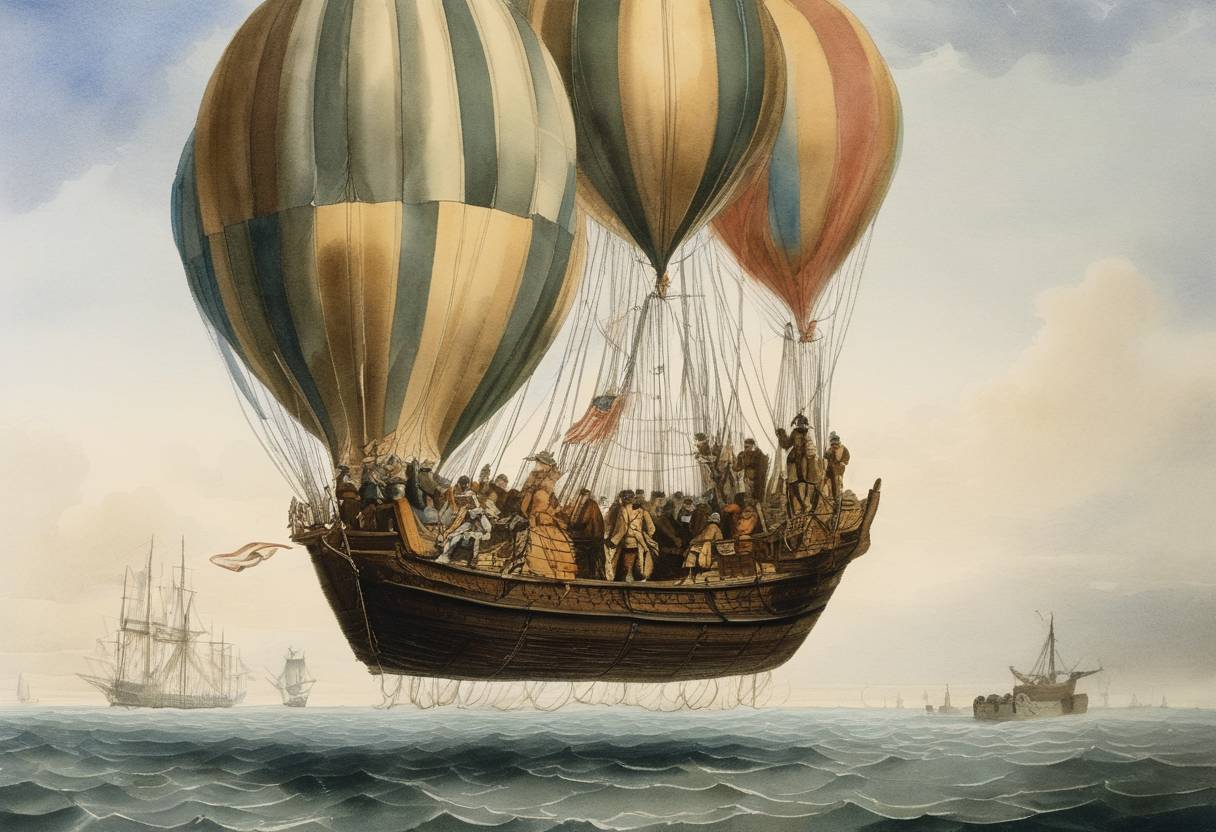
On January 7, 1785, the French aeronaut Jean-Pierre Blanchard and his American co-pilot, Dr. John Jeffries, achieved a significant milestone in aviation history by completing the first successful flight across the English Channel in a gas balloon. This event marked a key development in aeronautics and demonstrated the potential of human flight over long distances.
Jean-Pierre Blanchard was a pioneering balloonist, renowned in Europe for his ambitious flights and daring spirit. He had become well-known for his public demonstrations of ballooning, bringing attention to the possibilities of air travel. Dr. John Jeffries, an American-born physician and scientist, shared Blanchard’s enthusiasm for ballooning and was eager to advance scientific understanding through aerial voyages. They planned to collect meteorological data during their flight, making their journey not only a test of endurance and navigation but also a scientific expedition.
The journey began in Dover, England, where Blanchard and Jeffries took off in their hydrogen-filled balloon, equipped with various scientific instruments for atmospheric measurements. Their initial ascent was smooth, but they soon encountered difficulties. As they approached the midpoint of their flight, the balloon began to lose altitude unexpectedly, forcing the two aeronauts to discard ballast and most of their equipment—including scientific instruments and even clothing—to maintain elevation.
Despite these challenges, Blanchard and Jeffries skillfully managed the balloon’s buoyancy and course. Overcoming adverse conditions, they finally touched down safely near Calais, France, successfully completing the historic crossing in just over two and a half hours. This remarkable achievement made them the first humans to cross the Channel by air, proving that sustained flight over significant distances was possible.
The success of Blanchard and Jeffries’ crossing had substantial implications for the future of aviation. It demonstrated the feasibility of international air travel and inspired further innovations in balloon technology. Moreover, the successful journey foreshadowed future developments that would lead to modern aeronautics.
The flight was celebrated across Europe and America, heralding a new era of exploration and scientific discovery. Blanchard continued to push the boundaries of ballooning, while Jeffries contributed valuable atmospheric data gathered during the flight to the scientific community.
In conclusion, the triumphant crossing of the English Channel by Jean-Pierre Blanchard and John Jeffries on January 7, 1785, stands as a landmark event in aviation history, setting the stage for the evolution of flight as a crucial component of the transportation and scientific landscape.
Source: en.wikipedia.org