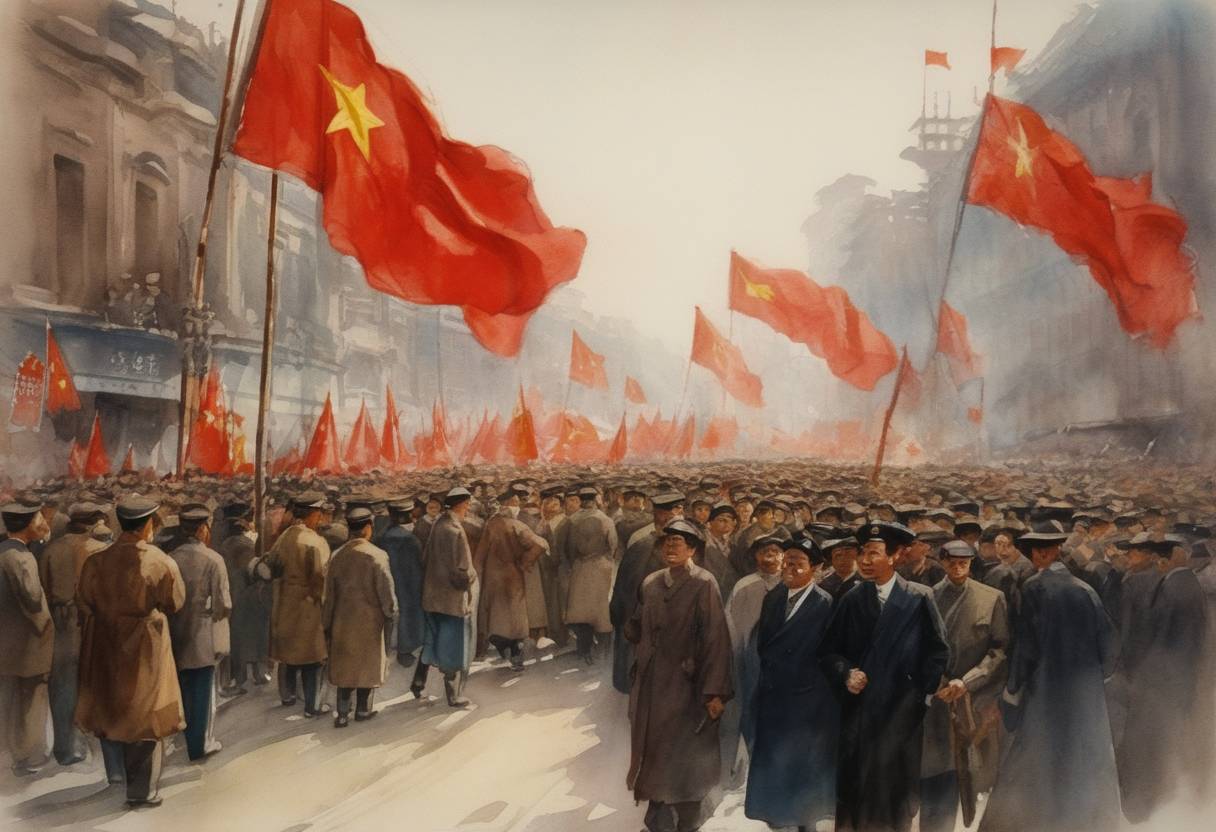
The Founding of the Communist Party of China
On July 23, 1921, the Communist Party of China (CPC) was founded during the first National Congress, marking a significant milestone in Chinese political history. This event laid the groundwork for the eventual establishment of the People’s Republic of China in 1949.
Background
In the early 20th century, China was undergoing tremendous social and political upheaval. The Qing Dynasty had collapsed in 1912, leading to a period of warlordism and fragmentation. The fall of imperial rule and the subsequent instability created a fertile ground for new political ideologies to take root. Influential Chinese intellectuals, inspired by the Russian Revolution of 1917 and disillusioned with Western imperialism after the Versailles Treaty, which ignored China’s interests, began to explore Marxist ideas.
The First National Congress
The first National Congress of the Communist Party of China took place in Shanghai, although initially held in secret. It was attended by 12 to 13 delegates representing about 57 members nationwide. Key figures present at the Congress included Mao Zedong, Chen Duxiu, and Li Dazhao, who are recognized as early leaders of the movement. The meetings were eventually relocated to a boat on South Lake in Jiaxing, Zhejiang province, due to police interference.
During this Congress, the party’s charter was discussed and adopted, and foundational goals were set, emphasizing the need for revolution and the establishment of a proletarian state as inspired by Marxist-Leninist ideology.
Significance and Consequences
The establishment of the CPC was pivotal in shaping China’s modern political landscape. Despite its modest beginnings, the party focused on organizing workers and aligning itself with the broader international socialist movement. The CPC’s evolution in subsequent decades led to significant events in Chinese history, including:
- The Long March (1934-1935): A strategic retreat of communist forces, which consolidated their leadership under Mao Zedong.
- The Chinese Civil War: The CPC eventually emerged victorious over the Kuomintang forces, leading to the declaration of the People’s Republic of China in 1949.
- Subsequent Economic and Social Policies: The CPC has been central to China’s economic reforms and its rise as a major global power in the late 20th and early 21st centuries.
The founding congress of the CPC on July 23, 1921, not only marked the inception of a major political entity but also the beginning of a transformative era that has had lasting impacts on China and the world.