Battle of Albuera: May 16, 1811
1811 · Albuera, Spain
The Peninsular War: In the Battle of Albuera, British, Spanish, and Portuguese forces under the command of Sir William Beresford defeated the French army under Marshal Soult.
January 16, 1809
The Battle of Corunna took place during the Peninsular War. British forces, commanded by Sir John Moore, fought against the French army led by Marshal Soult in Corunna, Spain, allowing for the successful evacuation of British troops, although Moore was killed in the battle.
Corunna, Spain
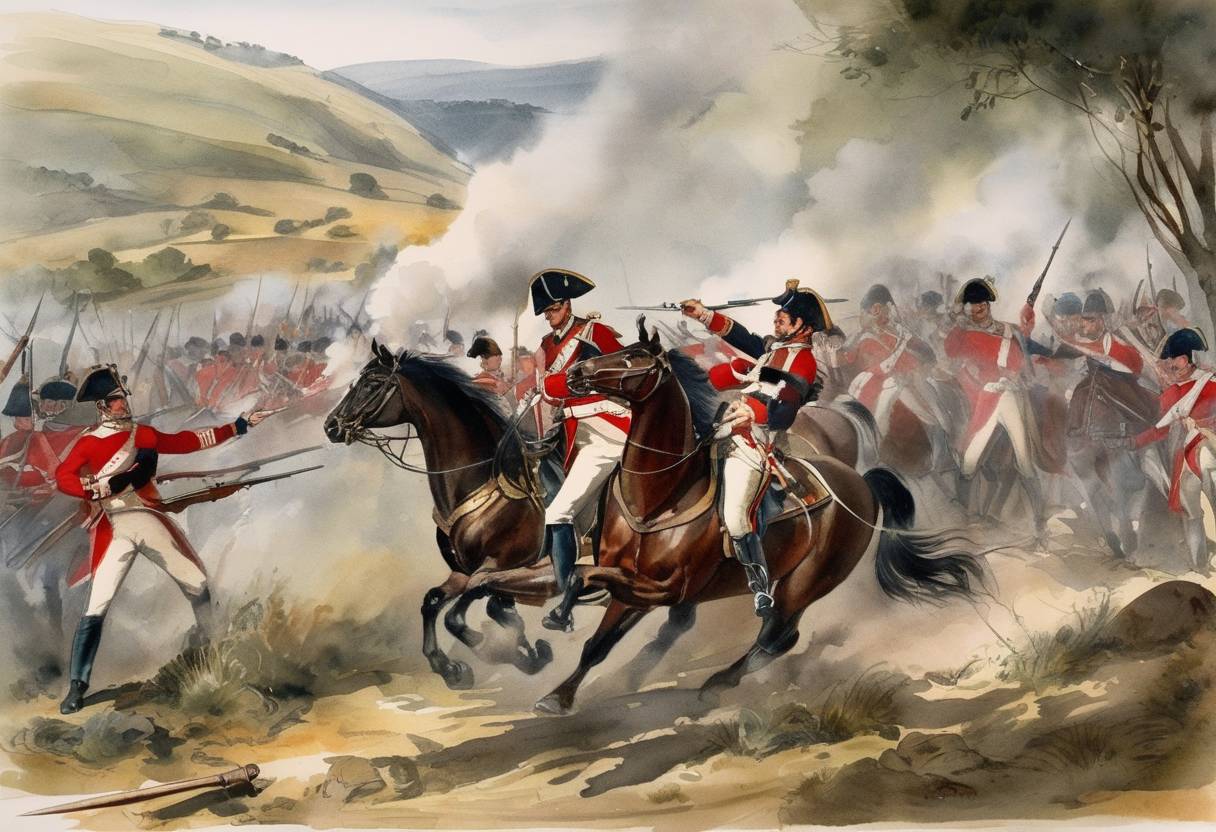
The Battle of Corunna was a significant engagement during the Peninsular War, a crucial theater of conflict within the broader Napoleonic Wars. Fought on January 16, 1809, this battle marked a pivotal moment for the British forces under the command of Lieutenant General Sir John Moore.
The Peninsular War began in 1808 following the invasion of Spain by Napoleon’s forces, intending to strengthen French control over the Iberian Peninsula. The British were drawn into the conflict to support their Spanish allies and to counter French expansion. By late 1808, British forces, commanded by Sir John Moore, had advanced into Spain to meet the French forces, aiming to disrupt their operations and support the Spanish resistance.
Moore’s campaign initially aimed to engage the French strategically; however, the overwhelming numbers and tactical prowess of the French, commanded by Emperor Napoleon Bonaparte himself, forced Moore into a strategic retreat towards Corunna in northwestern Spain. His goal was to evacuate the British troops by sea to prevent their encirclement and annihilation.
On January 16, 1809, the French army, now under Marshal Nicolas Jean de Dieu Soult following Napoleon’s return to France for political reasons, caught up with the British at Corunna. The British forces, despite being exhausted and in retreat, were organized to defend against the attacking French troops to ensure the safe embarkation of their forces.
The battle was hard-fought, with both sides displaying tactical acumen. Despite suffering from recent hardships and a numerically superior enemy, the British troops held their ground effectively. Sir John Moore, demonstrating leadership at the frontline, was mortally wounded during the battle but continued to direct his forces. His leadership and strategic planning allowed the British to maintain their defensive positions long enough to complete their evacuation mission.
The successful evacuation of British troops at Corunna secured Sir John Moore’s place in military history, despite the loss of his life. His death, seen as heroic and selfless, became a rallying point and inspired British efforts in the Peninsular War. While the French claimed victory on the battlefield, the strategic withdrawal of British forces preserved their strength for future engagements.
The loss of Moore was deeply felt, but his actions ensured that the British army could regroup and continue to play a vital role in the eventual defeat of Napoleon in the Iberian Peninsula. The withdrawal from Corunna allowed Britain to sustain its military presence and continue its support for the Spanish resistance, which would eventually contribute to the broader coalition efforts against Napoleonic France.
Source: www.britannica.com