The Port Chicago Disaster: July 17, 1944
1944 · Port Chicago, United States
The Port Chicago disaster occurred when a munitions explosion killed 320 people at the Port Chicago Naval Magazine in California.
February 28, 1844
A gun on the USS Princeton explodes during a demonstration, killing six people, including two United States Cabinet members.
Alexandria, United States | United States Navy
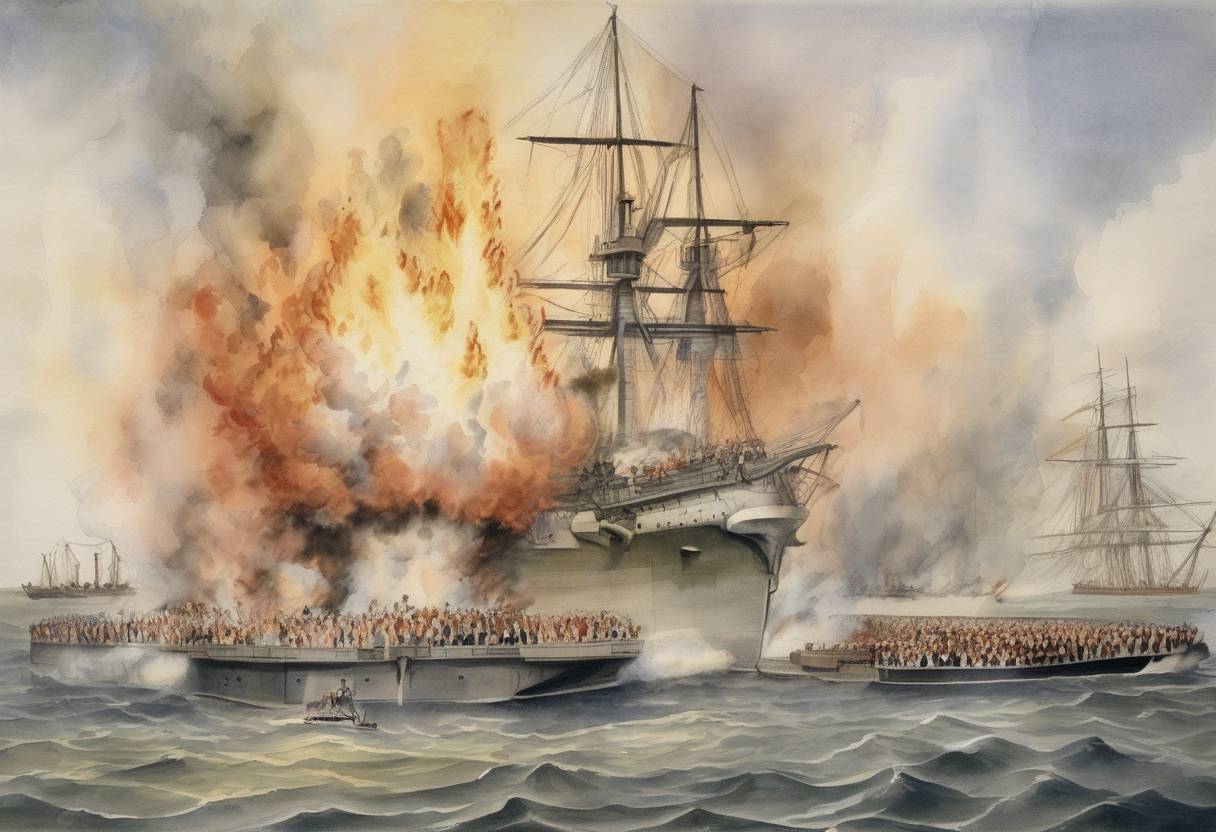
On February 28, 1844, a tragic accident occurred aboard the USS Princeton, a newly commissioned warship of the United States Navy, during a demonstration cruise on the Potomac River. This event resulted in the deaths of six people, including two prominent members of President John Tyler’s Cabinet.
The USS Princeton was a state-of-the-art warship, notable for being the first screw-propelled steamship in the U.S. Navy. It was designed by the renowned Swedish-American engineer John Ericsson and was equipped with advanced weaponry, including two large guns named “Peacemaker” and “Oregon.”
The demonstration on February 28 was intended to showcase the ship’s capabilities to government officials, dignitaries, and guests. Among the attendees were President John Tyler, several Cabinet members, and other high-profile individuals.
During the demonstration, the “Peacemaker,” a 12-inch muzzle-loading cannon, was fired multiple times successfully. However, on its third firing, the gun exploded. The catastrophic failure resulted in the immediate deaths of six individuals:
Several others were injured, and the incident caused widespread shock and mourning across the nation.
The explosion on the USS Princeton had significant political and personal repercussions:
Political Impact: The deaths of two Cabinet members created a sudden vacuum in President Tyler’s administration, necessitating immediate replacements. This incident also highlighted the risks associated with emerging military technologies and the need for stringent safety measures.
Personal Impact: President Tyler narrowly escaped injury, as he was below deck at the time of the explosion. The tragedy brought him closer to Julia Gardiner, whom he married in 1844, just months after the incident.
Technological Implications: The disaster underscored the dangers of experimental weaponry and led to increased scrutiny and caution in the development and testing of naval armaments.
The USS Princeton disaster remains a poignant reminder of the potential perils of technological advancement and the human cost of innovation.
Source: en.wikipedia.org