The Roman Senate Declares Galba as Emperor: January 5, 69 AD
69 · Rome, Roman Empire
The Roman Senate declares Galba as emperor, marking the beginning of the Year of the Four Emperors.
March 4, 0051
Nero, future Roman Emperor, is given the title of 'princeps iuventutis' (prince of the youth) by the Roman Senate, marking him as the successor to Emperor Claudius.
Rome, Roman Empire | Roman Senate
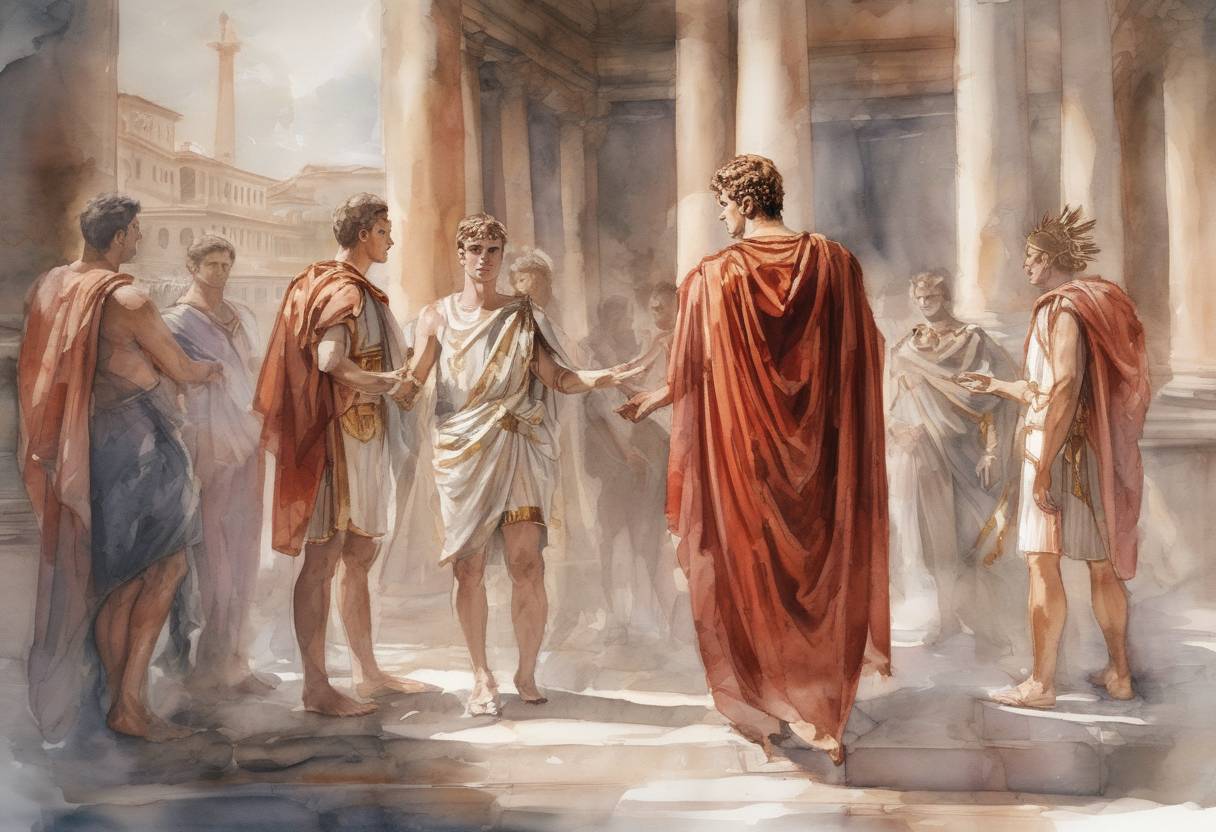
On March 4, 51 AD, Nero, who would later become one of Rome’s most infamous emperors, was granted the title of princeps iuventutis (prince of the youth) by the Roman Senate. This event marked a significant step in his path to becoming the successor to Emperor Claudius.
Emperor Claudius: Claudius had become emperor in 41 AD after the assassination of Caligula. His reign was marked by significant administrative reforms and expansion of the Roman Empire, including the conquest of Britain.
Nero’s Background: Born Lucius Domitius Ahenobarbus in 37 AD, Nero was the son of Gnaeus Domitius Ahenobarbus and Agrippina the Younger, who was the sister of Caligula and a great-granddaughter of Augustus. His lineage placed him in a favorable position within the Julio-Claudian dynasty.
Agrippina’s Influence: Nero’s mother, Agrippina, was a formidable political figure. After marrying Claudius in 49 AD, she worked diligently to position her son as the heir to the throne, sidelining Claudius’s own biological son, Britannicus.
Significance: The title princeps iuventutis was traditionally given to young men of the imperial family who were being groomed for future leadership. It was a symbolic gesture that indicated Nero’s status as the designated successor to the emperor.
Senate’s Role: The Roman Senate’s conferral of this title was a formal recognition of Nero’s position within the imperial hierarchy, reflecting Agrippina’s successful maneuvering and the consolidation of Nero’s claim to the throne.
Adoption by Claudius: In 50 AD, prior to receiving the title, Nero had been adopted by Claudius, further solidifying his status as heir. This adoption was a critical step in his path to power.
Ascension to Emperor: Nero became emperor in 54 AD following the death of Claudius, which many historical sources suggest was orchestrated by Agrippina through poisoning.
Nero’s Reign: Nero’s rule, lasting until 68 AD, was marked by a mix of cultural patronage and notorious excesses. His reign saw significant events such as the Great Fire of Rome in 64 AD and increasing tensions with the Senate, ultimately leading to his downfall and suicide.
Nero’s rise to power highlights the complex dynamics of succession within the Roman Empire, where familial ties, political alliances, and strategic marriages played crucial roles. His reign is often remembered for its tyrannical aspects, but it also reflects the challenges of maintaining stability and continuity in an empire as vast and diverse as Rome.
The events surrounding Nero’s designation as princeps iuventutis underscore the influence of powerful women like Agrippina in Roman politics and the intricate web of intrigue that characterized the Julio-Claudian dynasty.
Source: en.wikipedia.org