Announcement of the Hydrogen Bomb Development by President Truman
1953 · Washington, D.C., United States
U.S. President Harry S. Truman announced the United States had developed a hydrogen bomb, escalating the nuclear arms race during the Cold War.
March 12, 1947
U.S. President Harry S. Truman announces the Truman Doctrine, pledging American support for countries resisting communism.
Washington, D.C., United States | United States Government
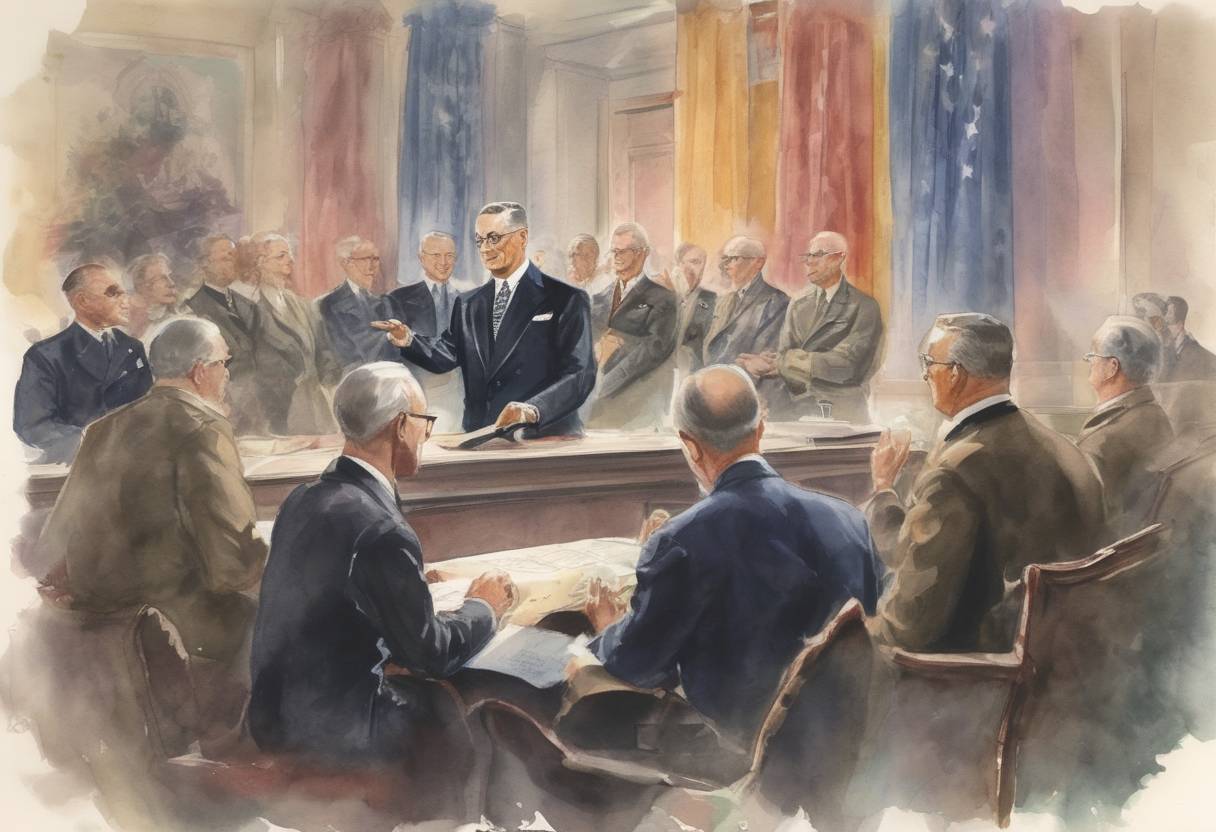
On March 12, 1947, U.S. President Harry S. Truman delivered a pivotal address to a joint session of Congress, marking the formal announcement of what would become known as the Truman Doctrine. This doctrine was a significant policy shift for the United States, setting the stage for American foreign policy during the Cold War.
In the aftermath of World War II, Europe was in a state of economic and political turmoil. The Soviet Union was expanding its influence across Eastern Europe, and there was growing concern in the United States about the spread of communism. Two countries, in particular, Greece and Turkey, were seen as vulnerable to communist influence:
The British government, financially exhausted by the war, announced in February 1947 that it could no longer provide military and economic support to Greece and Turkey. This development prompted the United States to step in.
In his speech, President Truman outlined the necessity of U.S. support for Greece and Turkey, framing it as a broader struggle between democracy and totalitarianism. The key points of the doctrine included:
The Truman Doctrine had far-reaching implications for U.S. foreign policy and the global geopolitical landscape:
The Truman Doctrine represented a commitment by the United States to play a leading role in global affairs, marking a departure from its previous isolationist stance. It underscored the ideological divide between the U.S. and the Soviet Union, setting the stage for decades of Cold War tensions.
Source: en.wikipedia.org