Assassination Attempt on President Andrew Jackson - January 30, 1835
1835 · Washington, D.C., United States
Richard Lawrence attempted to assassinate U.S. President Andrew Jackson, marking the first assassination attempt on a sitting U.S. president.
July 9, 1850
U.S. President Zachary Taylor dies after serving only 16 months in office, and Millard Fillmore becomes the 13th President of the United States.
Washington, D.C., United States | U.S. Government
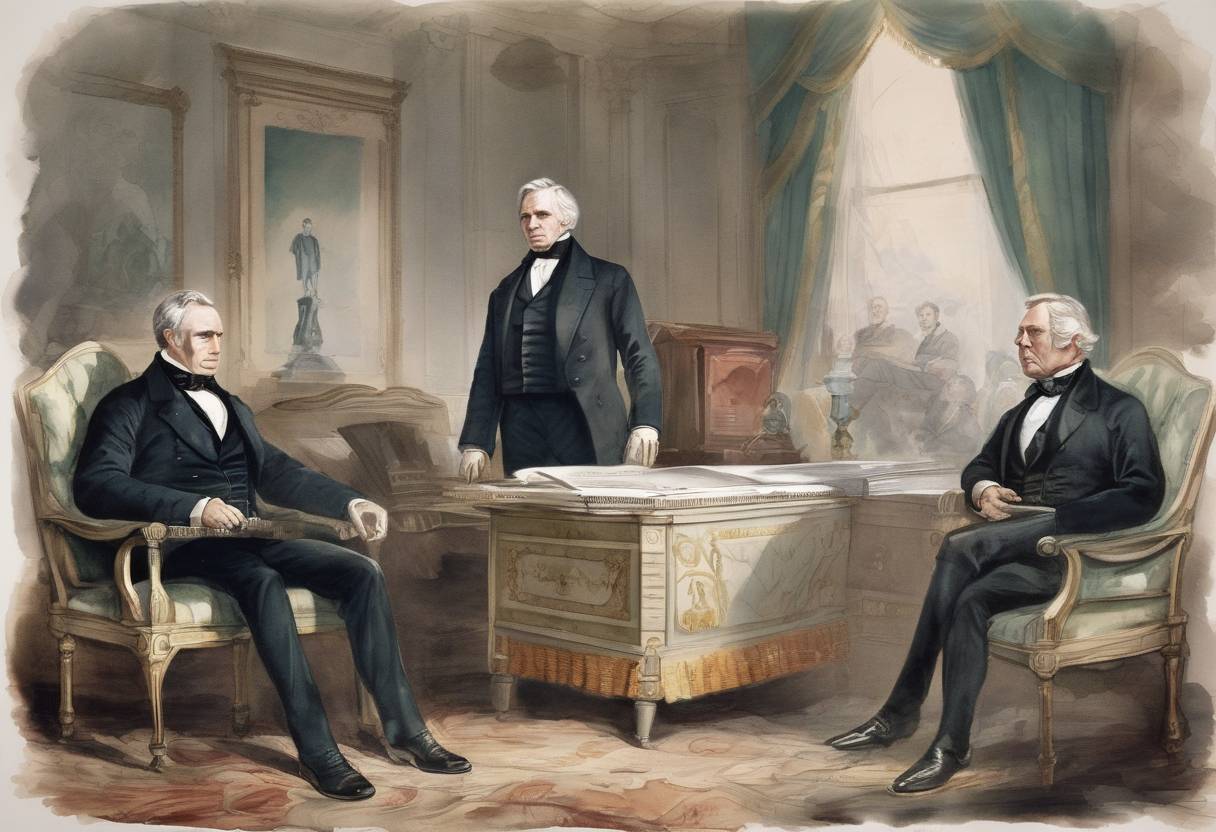
On July 9, 1850, the United States experienced a significant transition in its executive leadership. President Zachary Taylor, the 12th President of the United States, passed away after serving only 16 months in office. His death led to Vice President Millard Fillmore becoming the 13th President.
Zachary Taylor, a career military officer and national hero from the Mexican-American War, was elected as the 12th President of the United States in 1848. A member of the Whig Party, Taylor was known for his apolitical stance and lack of prior political experience. His presidency was marked by tensions over the expansion of slavery into the newly acquired territories from the Mexican-American War, a contentious issue that threatened to divide the nation.
Taylor’s health began to decline after attending a Fourth of July celebration in Washington, D.C., in 1850. He reportedly consumed large quantities of raw fruit and iced milk, which led to severe gastrointestinal distress. Despite medical treatment, Taylor’s condition worsened, and he succumbed to what was diagnosed at the time as acute gastroenteritis, though modern historians speculate it may have been a form of cholera or other illness.
Upon Taylor’s death, Vice President Millard Fillmore was sworn in as the 13th President of the United States. Fillmore, also a member of the Whig Party, had a more pronounced political background than his predecessor. His presidency would be marked by his support for the Compromise of 1850, a series of legislative measures aimed at diffusing the tensions between free and slave states.
The Compromise of 1850 was a pivotal moment in Fillmore’s presidency. It included several key provisions:
Fillmore’s support for the Compromise was instrumental in its passage, though it also alienated some Northern Whigs and contributed to the eventual dissolution of the Whig Party.
The transition from Taylor to Fillmore marked a critical juncture in American history. Taylor’s unexpected death and Fillmore’s subsequent presidency underscored the fragility of the Union during a period of intense sectional conflict. The Compromise of 1850, while temporarily easing tensions, ultimately delayed but did not prevent the outbreak of the Civil War a decade later.
In summary, the events of July 9, 1850, highlighted the challenges of leadership during a time of national crisis and set the stage for the complex political landscape that would continue to evolve in the years leading up to the Civil War.
Source: en.wikipedia.org