Victory in Europe Day (V-E Day) - May 8, 1945
1945 · Berlin, Germany
Victory in Europe Day (V-E Day) is celebrated as the Allies formally accept Nazi Germany's unconditional surrender, marking the end of World War II in Europe.
March 24, 1944
The Great Escape: 76 Allied prisoners of war broke out of Stalag Luft III, a German POW camp, during World War II.
Sagan, Germany | Allied Forces
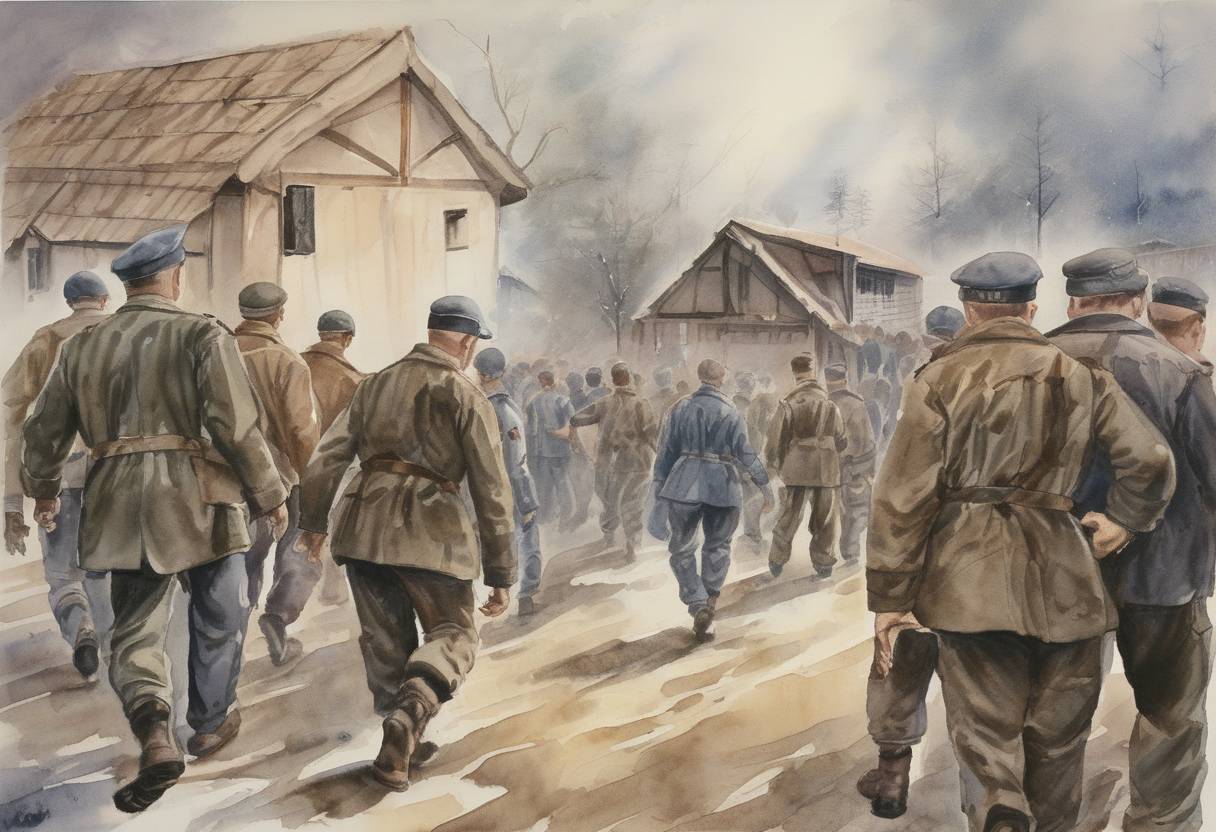
On March 24, 1944, one of the most daring and well-coordinated prisoner of war (POW) escapes of World War II took place at Stalag Luft III, a German POW camp located near the town of Sagan (now Żagań, Poland). This event, famously known as “The Great Escape,” involved 76 Allied airmen who managed to break out of the camp through a meticulously planned tunnel system.
Stalag Luft III was a high-security POW camp primarily for captured Allied airmen. It was designed to be escape-proof, with features such as elevated prisoner barracks to prevent tunneling and sensitive microphones buried around the perimeter to detect underground activity. Despite these measures, the prisoners were determined to escape and devised an elaborate plan.
The escape plan was orchestrated by Squadron Leader Roger Bushell, known as “Big X,” who led the camp’s escape committee. The plan involved digging three tunnels, codenamed “Tom,” “Dick,” and “Harry,” to increase the chances of success. The tunnels were equipped with ventilation systems, lighting, and even a small railway to transport soil. The prisoners used ingenious methods to dispose of the excavated soil and to disguise their activities from the guards.
On the night of March 24, 1944, the escape attempt commenced. The tunnel “Harry” was completed, stretching over 300 feet beyond the camp’s perimeter. Despite numerous challenges, including a tunnel collapse and a shorter-than-expected exit point, 76 men managed to crawl through the tunnel to freedom.
The escape triggered a massive manhunt by the German authorities. Of the 76 escapees, only three successfully reached Allied territory: two Norwegians, Per Bergsland and Jens Müller, made it to neutral Sweden, and a Dutchman, Bram van der Stok, reached Gibraltar. Tragically, 73 were recaptured, and 50 of them were executed on the orders of Adolf Hitler, in violation of the Geneva Convention.
The Great Escape stands as a testament to the resilience and ingenuity of the Allied POWs. It highlighted the harsh realities of war and the brutal response of the Nazi regime to defiance. The event was later immortalized in the 1963 film “The Great Escape,” which, while dramatized, brought widespread attention to the bravery and sacrifice of those involved.
The escape also had significant repercussions, leading to increased security measures in POW camps and influencing post-war trials where the execution of the recaptured prisoners was prosecuted as a war crime.
In summary, The Great Escape remains a powerful symbol of courage and the unyielding spirit of those who fought for freedom during World War II.
Source: www.britannica.com