The Battle of Quebec: December 31, 1775
1775 · Quebec City, Canada
The Battle of Quebec took place during the American Revolutionary War, where British forces successfully defended the city against an American attack.
December 11, 1719
The first recorded sighting of the Aurora Borealis in North America was made by Europeans near Quebec City.
Quebec City, New France
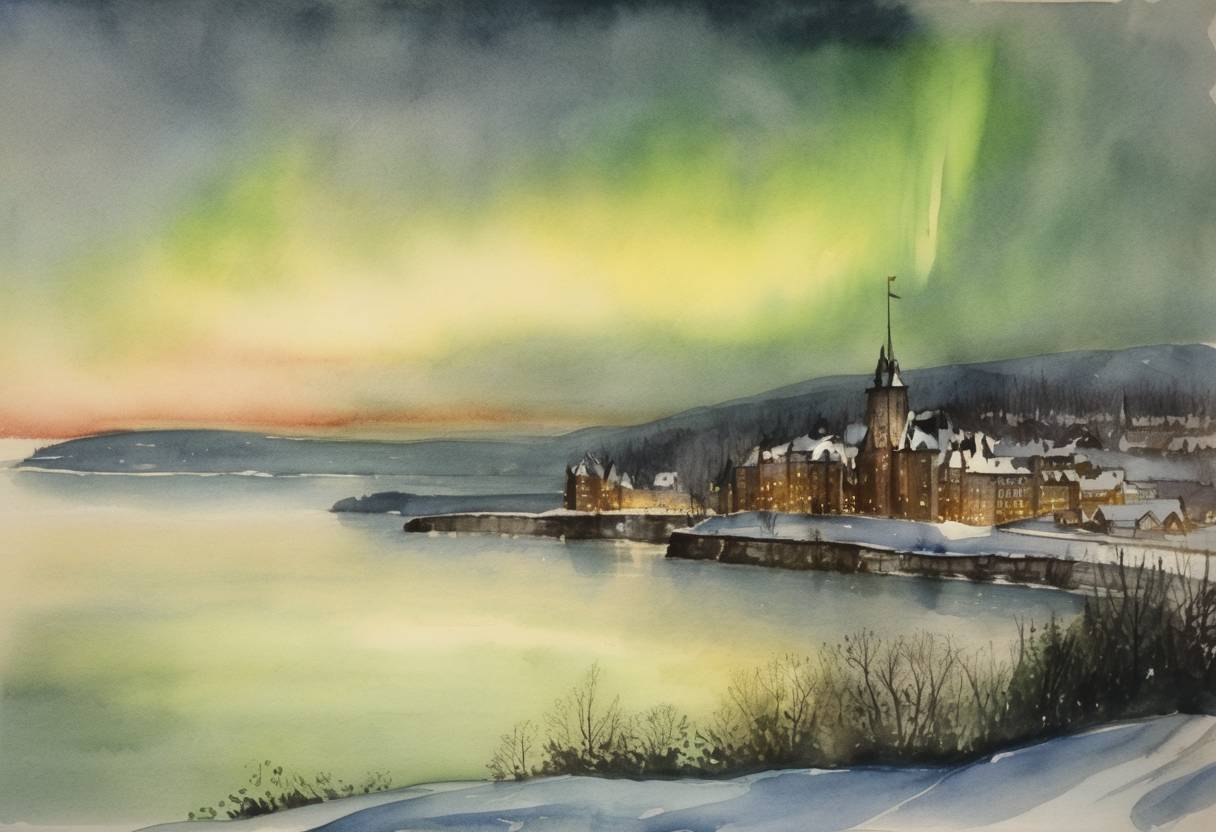
On December 11, 1719, European settlers near Quebec City documented the first known sighting of the Aurora Borealis, or Northern Lights, in North America. This spectacular natural phenomenon, characterized by vibrant, dancing lights in the sky, had been observed by indigenous peoples for centuries, but this record marks the first time Europeans documented it in the region.
Aurora Borealis is caused by the collision of charged particles from the sun with atoms in Earth’s atmosphere. While the phenomenon is most commonly seen in high-latitude regions near the Arctic and Antarctic Circles, such events are visible at lower latitudes on rare occasions when solar activity is particularly intense.
The documentation of this event was the result of the increased interest in the natural world during the Enlightenment, a period marked by scientific inquiry and exploration. Europeans in North America during the early 18th century were beginning to systematically observe and record natural phenomena as part of a broader effort to understand the New World’s environment.
This recorded sighting added to the body of knowledge that would later contribute to scientific studies on geomagnetism and atmospheric phenomena. Understanding the Aurora Borealis, in particular, eventually played a crucial role in developments in space weather research.
The sighting was likely regarded with a mix of awe and superstition, as auroral displays were often interpreted as omens or messages. In an era when many natural phenomena were poorly understood, such sights could inspire fear or wonder among communities unfamiliar with their causes.
The 1719 sighting contributed to the European folklore surrounding auroras and propelled further studies into atmospheric and magnetic phenomena, eventually supporting advancements in fields such as chemistry and physics. Over time, efforts to understand the aurora borealis also led to insights into the Earth’s magnetosphere and interactions with solar winds.
In conclusion, this event is a pivotal moment in the early scientific observation of atmospheric phenomena in North America by Europeans, reflecting both the curiosity and the limited scientific frameworks of the time.
Source: www.canadiangeographic.ca