The Battle of Lake Poyang: August 30, 1363
1363 · Lake Poyang, China
The Battle of Lake Poyang, one of the largest naval battles in history, begins between the forces of the Ming dynasty and the Han forces of Chen Youliang.
October 4, 1363
The Battle of Lake Poyang ended, one of the largest naval battles in history, where the forces of Zhu Yuanzhang defeated the Han forces of Chen Youliang in a struggle for supremacy over southern China during the late Yuan Dynasty.
Lake Poyang, China | Forces of Zhu Yuanzhang
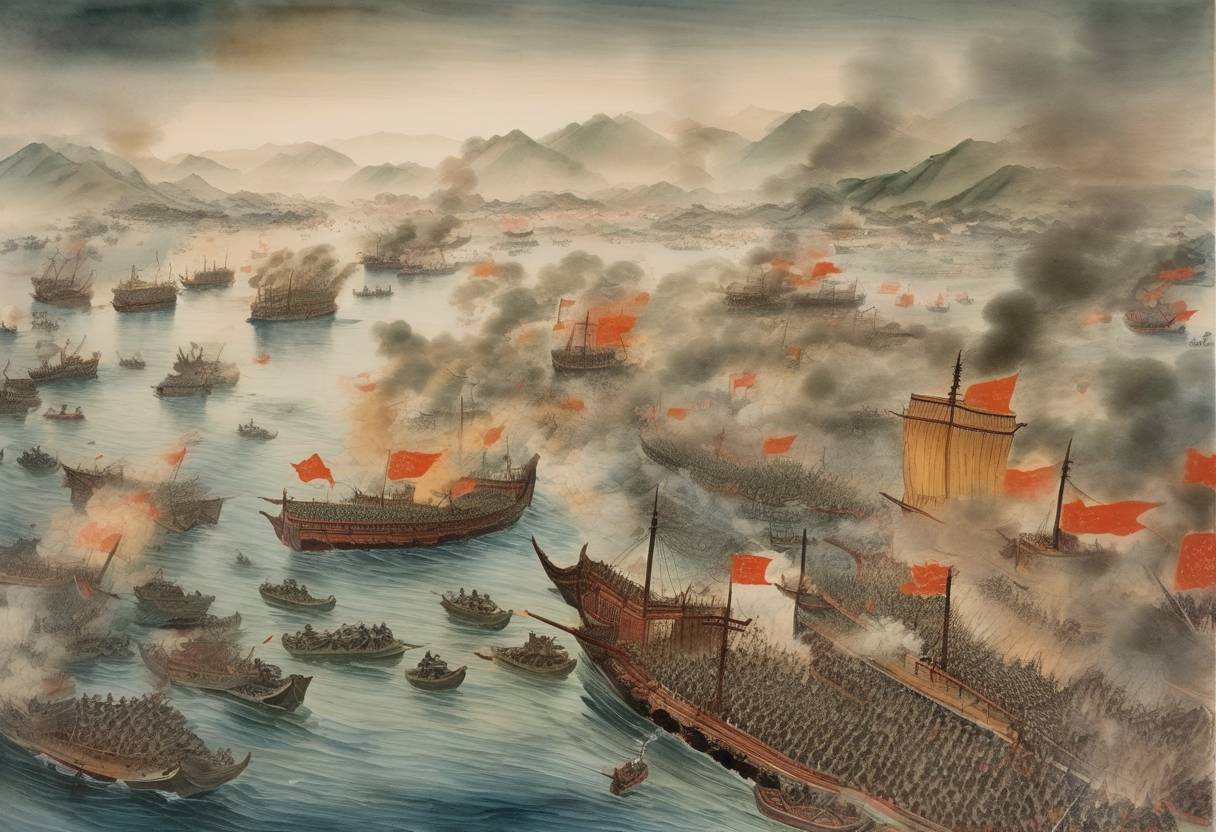
The Battle of Lake Poyang, concluding on October 4, 1363, remains one of the largest naval battles in recorded history. It marked a crucial phase in the conflicts leading to the end of the Yuan Dynasty and the rise of the Ming Dynasty in China. The battle featured the forces of Zhu Yuanzhang, the future founding emperor of the Ming Dynasty, against the naval might of the Han army led by Chen Youliang.
By the mid-14th century, the Yuan Dynasty faced widespread internal strife and rebellion. One such uprising was led by Zhu Yuanzhang, a former Buddhist monk who became a prominent military leader. Zhu’s forces, primarily composed of peasant rebels, were part of the larger Red Turban Rebellions aimed at overthrowing the Yuan rulers.
Chen Youliang, another rebel warlord and former ally of Zhu, had established the Han Dynasty in competition with Zhu’s power, seeking control over the strategically critical territories in southern China.
The conflict took place over several weeks, from late August to early October, on Lake Poyang, the largest freshwater lake in China. This battle was critical as both leaders sought to assert dominance over the Yangtze River basin—a crucial commercial and strategic area.
On October 4, Zhu Yuanzhang emerged victorious, having decisively defeated the better-equipped yet demoralized Han forces. This victory not only consolidated Zhu’s control over southern China but also significantly weakened Chen Youliang’s power, who was mortally wounded during the battle and subsequently died.
The triumph at Lake Poyang was pivotal for Zhu Yuanzhang, cementing his rise to power. Over the following years, he continued to expand his control, eventually overthrowing the Yuan Dynasty to establish the Ming Dynasty in 1368, ushering in a new era in Chinese history.
This battle highlighted the importance of naval power and innovative tactics, shaping future military engagements in China. It also underscored the strategic importance of controlling key waterways, a theme that resonated throughout Chinese history.
Zhu’s victory not only set the stage for the Ming Dynasty but also marked a broader shift, as the power dynamics within China realigned drastically, laying the groundwork for a centralized and prosperous state.
Source: en.wikipedia.org