The Fall of Vitellius: December 22, 69 AD
69 · Rome, Roman Empire
Vitellius, the Roman emperor, was captured and killed in Rome by Vespasian's forces, effectively ending his rule and the Year of the Four Emperors.
December 21, 0069
The Roman Senate declared Vespasian the Roman Emperor, marking the end of the Year of the Four Emperors. This event was significant as it stabilized the Roman Empire after a period of chaos following the death of Emperor Nero and set the stage for the rise of the Flavian dynasty.
Rome, Roman Empire | Roman Senate
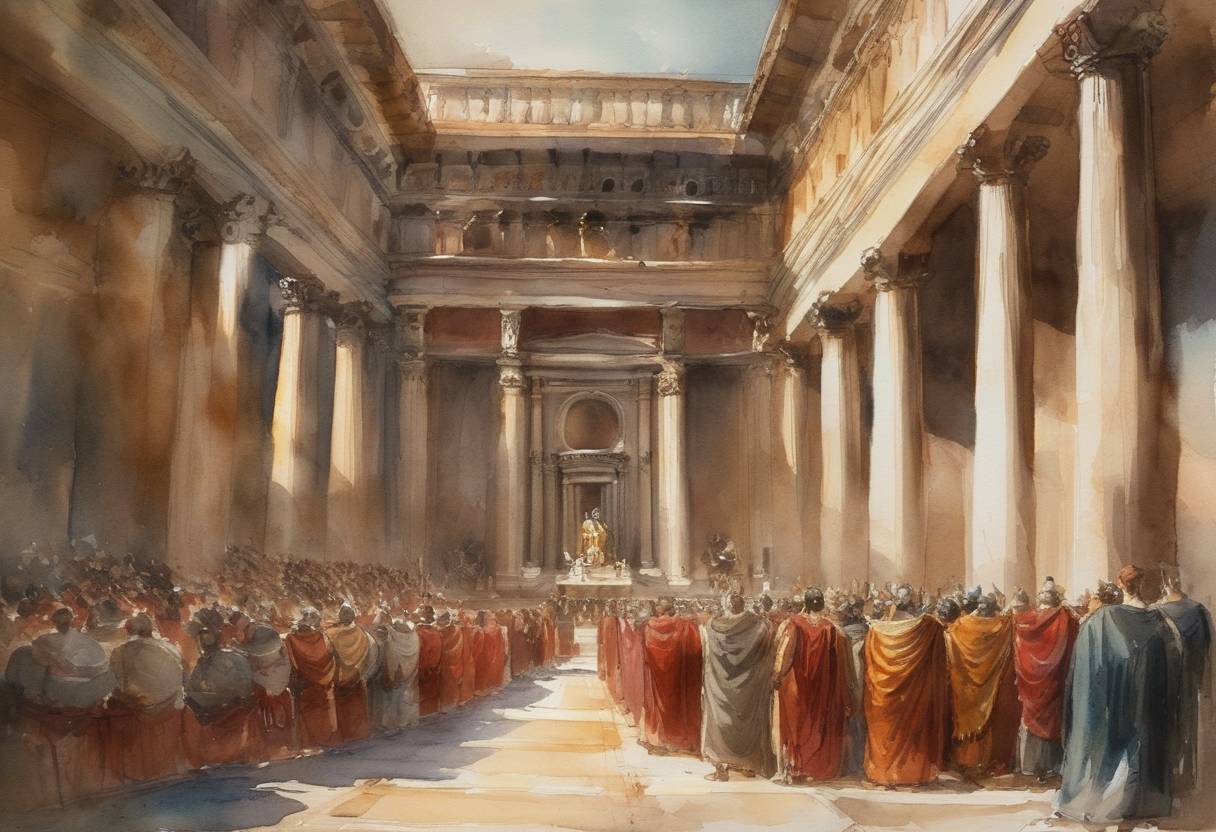
The Roman Senate declared Vespasian the Roman Emperor on December 21, 69 AD, an action that concluded the tumultuous Year of the Four Emperors and paved the way for the Flavian dynasty. This event marked a significant turning point in Roman history, bringing stability following a chaotic period that began with the demise of the Julio-Claudian Dynasty after the death of Emperor Nero.
The Year of the Four Emperors: This was a year of civil war and political upheaval, where four different emperors—Galba, Otho, Vitellius, and Vespasian—rose to power in quick succession. The power vacuum left by Nero’s death in 68 AD sparked a fierce struggle among ambitious generals and senators.
Vespasian’s Background: Vespasian, born Titus Flavius Vespasianus, was a seasoned military leader renowned for his campaigns in Britain and Judea where he had garnered considerable respect. He was declared emperor by his own troops in Judea in July 69 AD, initiating his quest for the imperial throne.
Senatorial Declaration: On this date, the Roman Senate formally acknowledged Vespasian as emperor. Despite his absence from Rome, this endorsement was critical in legitimizing his claim amid the power struggle.
Political and Military Support: Vespasian’s ascendancy was bolstered by the support of influential military commanders, most notably Marcus Antonius Primus, who had achieved significant victories against Vitellius’ forces, pivotal in securing the capital for Vespasian.
Establishment of the Flavian Dynasty: With Vespasian’s accession to the throne, the unstable chain of events dividing the empire was brought to an end, ushering in the Flavian dynasty. His rule was marked by fiscal reforms, consolidation of imperial power, and large-scale construction projects, including the commencement of the Colosseum.
Legacy: The stability and relative prosperity achieved under the Flavian dynasty reaffirmed the importance of military prowess and the support of the legions in the establishment of rulership in Rome. Vespasian’s reign and those of his successors, Titus and Domitian, reflected a shift towards autocracy tempered with pragmatism and military strength, which would endure as characteristics of subsequent Roman administration.
Vespasian’s ascension effectively ended a chaotic chapter in Roman history, demonstrating the resilience and adaptability of the Roman political system in the face of internal strife. His tenure and that of his successors contributed to a temporarily stabilized empire, enabling further expansion and consolidation of Roman governance throughout the known world.
Source: en.wikipedia.org