Apollo 8: A Historic Milestone in Space Exploration
1968 · Cape Canaveral, United States
Apollo 8, the first manned mission to orbit the Moon, was launched from the Kennedy Space Center, marking a significant achievement in the space race.
September 12, 1962
President John F. Kennedy delivered his famous "We choose to go to the Moon" speech at Rice University, outlining the United States' intention to land a man on the Moon before the end of the decade.
Houston, USA | Rice University
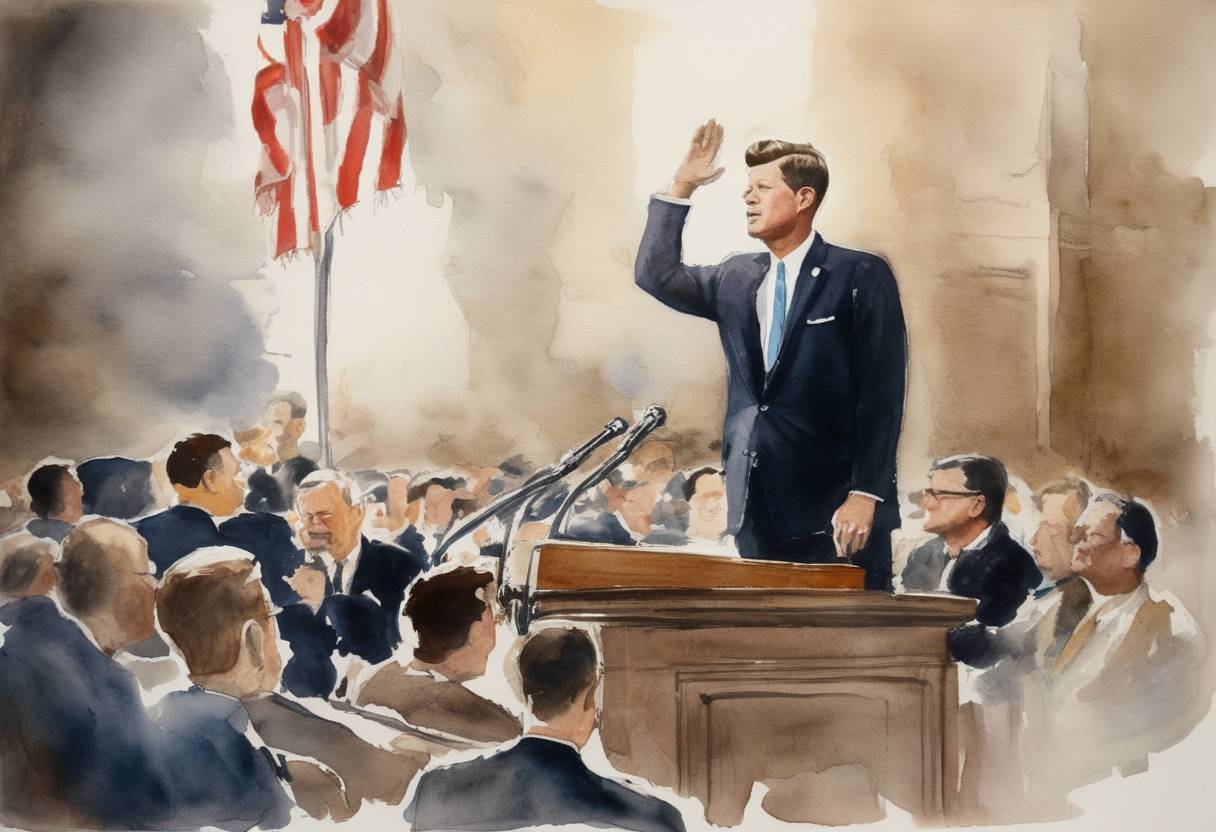
On September 12, 1962, President John F. Kennedy delivered a historic speech at Rice University in Houston, Texas, articulating the United States’ ambitious goal of landing a man on the Moon and returning him safely to Earth by the end of the decade. This address became a defining moment in the U.S. space program and a pivotal event in the Cold War-era space race between the United States and the Soviet Union.
In the early 1960s, the space race was a critical frontier of the Cold War. The Soviet Union had taken an early lead with the successful launch of Sputnik in 1957, the first artificial satellite to orbit Earth, followed by the first human-crewed spaceflight with Yuri Gagarin in 1961. These achievements highlighted the strategic and technological competition between the two superpowers.
Kennedy’s commitment to the space program was reinforced by his desire to restore American prestige and demonstrate the nation’s capacity for technological innovation and leadership on a global stage.
During the speech, Kennedy emphasized several key themes:
Challenge and Vision: He articulated a vision for space exploration as a grand challenge and a testament to American ingenuity and determination. The decision to pursue a lunar landing was framed as a bold and daring effort, one reflective of national character and ambition.
Technological and Scientific Advancement: Kennedy highlighted the role of space exploration in advancing scientific knowledge and expanding the boundaries of human capability. He underscored the numerous scientific and technological benefits that would arise from the space program.
National Unity and Effort: The president called for national unity and collective effort, urging all Americans to contribute to achieving this ambitious goal. He encouraged public support for this government-led initiative, asserting that overcoming such challenges was crucial for national and global progress.
One of the most memorable lines from Kennedy’s speech was:
“We choose to go to the Moon in this decade and do the other things, not because they are easy, but because they are hard, because that goal will serve to organize and measure the best of our energies and skills, because that challenge is one that we are willing to accept, one we are unwilling to postpone, and one we intend to win, and the others, too.”
Kennedy’s speech galvanized support for NASA and the Apollo program, leading to significant government funding and resources being directed towards achieving a manned lunar landing. This endeavor culminated in the successful Apollo 11 mission, which saw astronauts Neil Armstrong and Buzz Aldrin land on the Moon on July 20, 1969.
The achievement of this goal not only fulfilled Kennedy’s vision but also stood as a symbolic victory in the space race, showcasing American scientific and technological prowess on an unprecedented stage.
Source: www.nasa.gov