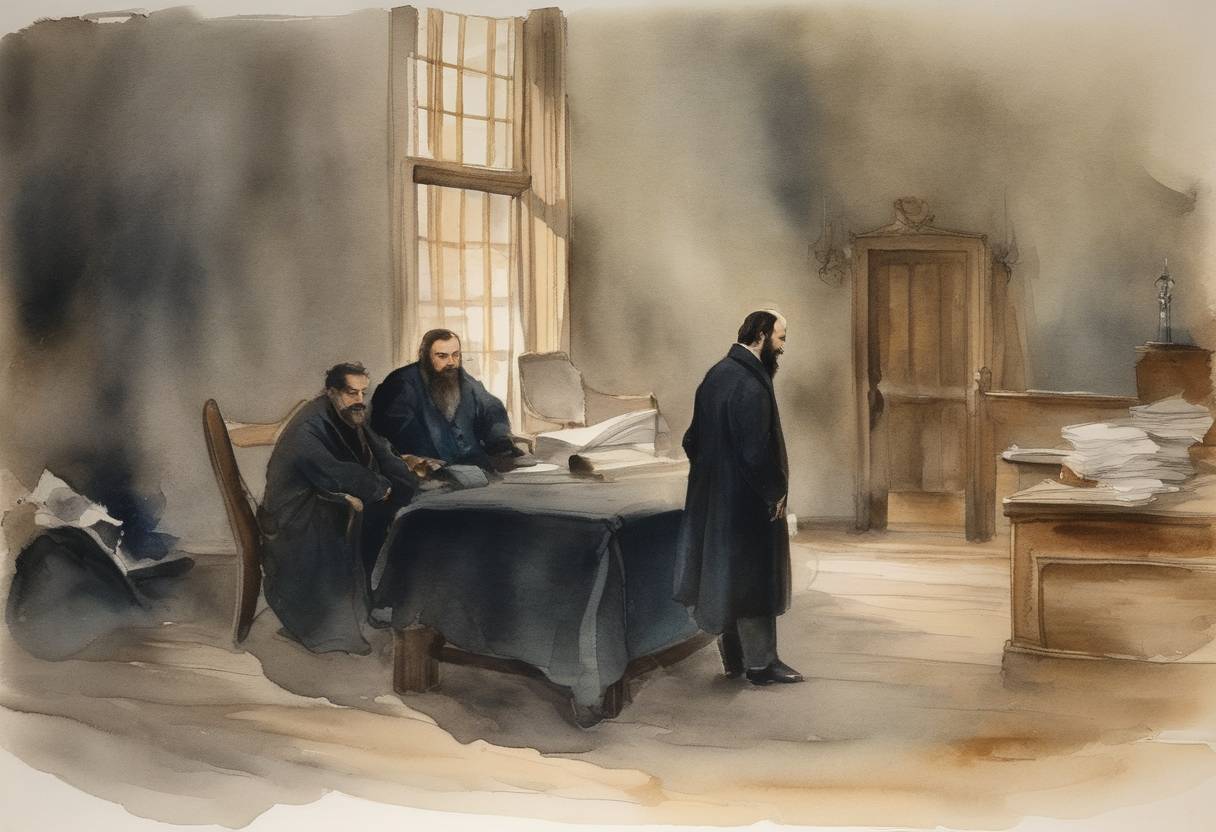
Sentencing and Commutation of Fyodor Dostoevsky - November 17, 1849
On November 17, 1849, the celebrated Russian novelist Fyodor Dostoevsky, along with other members of the Petrashevsky Circle, were sentenced to death by the Russian authorities. The Petrashevsky Circle was a group of intellectuals and dissidents who were critical of the Tsarist regime, advocating for political and social reform.
Background
Fyodor Dostoevsky was deeply engaged in the intellectual and political currents of his time. The Petrashevsky Circle, named after its founder Mikhail Petrashevsky, was composed of progressive thinkers who discussed Western philosophies, socialism, and reforms. These discussions were considered subversive by Tsar Nicholas I’s government, which was vigilant against revolutionary activities following the 1848 revolutions across Europe.
Arrest and Trial
In April 1849, Dostoevsky and other members of the circle were arrested for their alleged anti-government activities, particularly their criticism of serfdom and advocacy for freedom of speech. The authorities saw these activities as not only a threat to the autocracy but as potentially revolutionary.
Sentencing
The trial concluded with a harsh sentence. On November 17, 1849, Dostoevsky was sentenced to death by firing squad. However, this was part of a dramatic maneuver: unbeknownst to the prisoners, their execution was to be staged as a form of psychological torment and to demonstrate the Tsar’s mercy.
Pardon and Commutation
Just moments before the execution was to be carried out, a reprieve arrived, ostensibly from the Tsar himself. Dostoevsky’s sentence was commuted to four years of hard labor in a Siberian penal camp, followed by mandatory military service.
Aftermath and Impact
Dostoevsky’s experience of near-execution and subsequent imprisonment had profound influences on his worldview and writing. His time in Siberia exposed him to the harsh realities of life in the penal system, as well as the diverse psychological and moral conditions of the human spirit. These themes are evident in his later works, such as “Crime and Punishment” and “The Brothers Karamazov,” which explore human psychology, existential suffering, and redemption.
The Tsar’s demonstration of apparent clemency also underscored the oppressive yet strategically lenient mechanisms of control used by the autocratic regime. Dostoevsky’s life and the transformation of his personal ideology under this regime continue to be subjects of study in understanding 19th-century Russian societal and political complexities.