The Franklin Expedition Sets Sail: May 20, 1845
1845 · Greenhithe, United Kingdom
The HMS Erebus and HMS Terror set sail from England on an ill-fated expedition to the Arctic under Captain Sir John Franklin, searching for the Northwest Passage.
January 21, 1840
The British exploratory expedition led by Captain James Clark Ross discovered the Royal Company Islands in Antarctica during his expedition to the Southern Ocean.
Royal Company Islands (Antarctica), Antarctica | Royal Navy
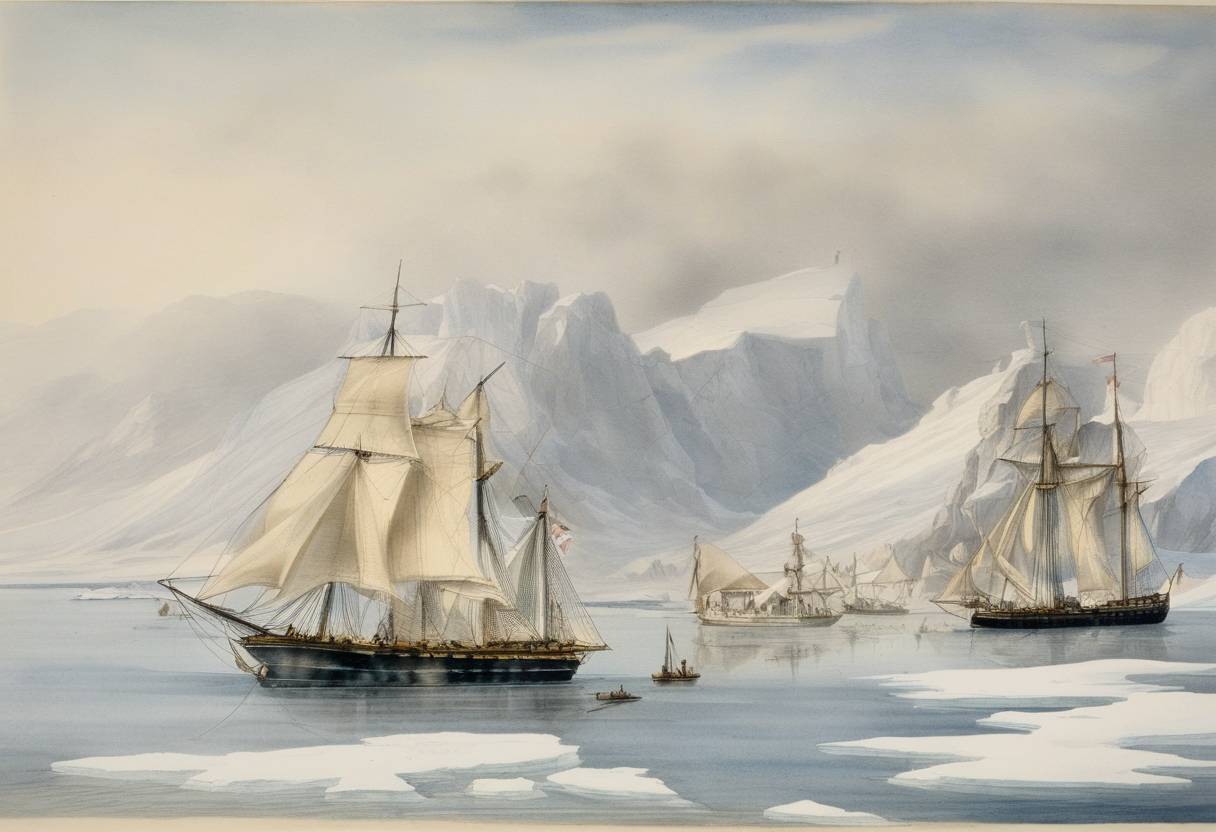
On January 21, 1840, the British exploratory expedition led by Captain James Clark Ross made a significant discovery, the Royal Company Islands, during their journey through the Southern Ocean. This discovery was part of a larger scientific and exploratory mission undertaken by Ross to chart and explore Antarctica’s coastal regions, contributing significantly to our understanding of the southernmost continent.
James Clark Ross was an accomplished British naval officer, renowned for his earlier voyages to the Arctic. By the early 19th century, the scientific community was increasingly interested in Antarctica due to its largely unexplored lands and the potential scientific knowledge to be gained. Ross’s expedition, onboard HMS Erebus and HMS Terror, set sail in 1839 with the dual aim of exploring the Antarctic coastline and conducting geomagnetic surveys.
The expedition navigated through challenging ice-filled waters, aiming to reach as far south as possible. On January 21, 1840, Ross and his team discovered the Royal Company Islands, a previously uncharted group of islands in proximity to Antarctica. This discovery was part of a broader exploration during which Ross identified and mapped several other geographical features, including the Ross Sea and Ross Ice Shelf.
The discovery of the Royal Company Islands added critical data to the cartographic and geographical understanding of Antarctica at the time. Ross’s expedition provided invaluable insights, not only into Antarctic geography but also into the conditions and challenges faced by explorers in polar environments. This endeavor laid groundwork for future scientific explorations and studies of Antarctic regions.
Ross’s meticulous documentation and the successful execution of the expedition cemented his reputation as one of the leading explorers of his time. Moreover, the expedition’s achievements highlighted the importance of scientific inquiry and international cooperation in exploring the less understood parts of the world.
Source: www.britannica.com