1644 · Chester, England
The Battle of Rowton Heath takes place during the English Civil War, resulting in a victory for the Parliamentarians over the Royalists.
July 2, 1644
The Battle of Marston Moor took place during the English Civil War, resulting in a decisive victory for the Parliamentarians.
Long Marston, England | Parliamentarian Army
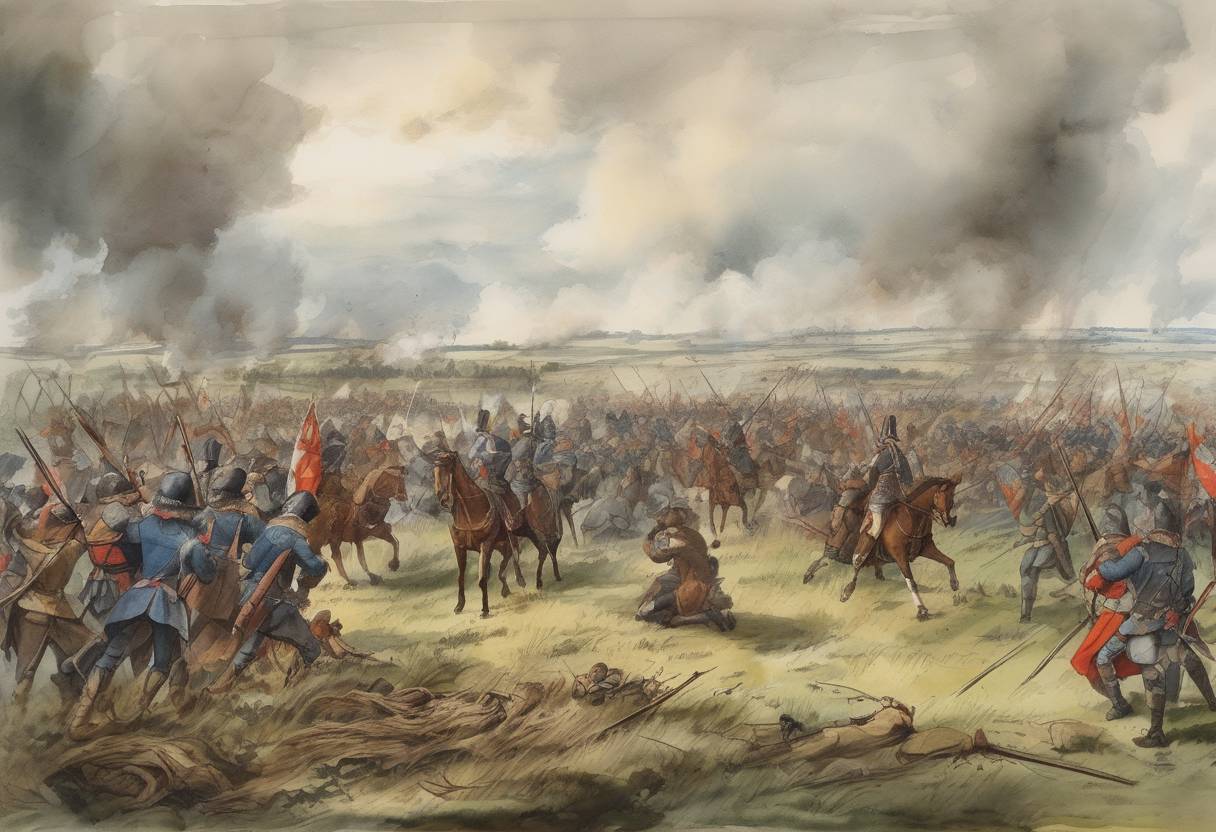
The Battle of Marston Moor, fought on July 2, 1644, was a pivotal engagement during the English Civil War. This battle marked a significant turning point in favor of the Parliamentarians against the Royalist forces loyal to King Charles I.
The English Civil War, which began in 1642, was primarily a conflict between the Royalists, who supported King Charles I, and the Parliamentarians, who sought greater parliamentary power and reform. By 1644, the war had spread across England, with both sides vying for control of key regions.
The city of York was a strategic stronghold for the Royalists in the north of England. In the spring of 1644, a combined force of Parliamentarians and their Scottish allies, under the command of Lord Fairfax, the Earl of Manchester, and Alexander Leslie, the Earl of Leven, laid siege to York. The Royalist army, led by Prince Rupert of the Rhine, was dispatched to relieve the besieged city.
The two forces met on the fields of Marston Moor, located west of York. The Royalist army, numbering around 18,000 men, faced a larger Parliamentarian-Scottish force of approximately 28,000 troops. The battle commenced in the late afternoon and continued into the evening.
Key figures in the Parliamentarian ranks included Oliver Cromwell, who commanded the cavalry on the left flank. His disciplined and effective cavalry maneuvers played a crucial role in the outcome of the battle. The Royalists, despite initial successes, were ultimately overwhelmed by the superior numbers and coordination of the Parliamentarian forces.
The Battle of Marston Moor ended in a decisive victory for the Parliamentarians. The Royalists suffered heavy casualties, with estimates of around 4,000 killed and many more captured. The defeat effectively ended Royalist control in the north of England and marked a significant shift in the momentum of the war.
The victory at Marston Moor bolstered the reputation of Oliver Cromwell, who emerged as a key military leader for the Parliamentarians. The battle demonstrated the effectiveness of the New Model Army, which would later become a formidable force in the conflict.
Following the battle, York surrendered to the Parliamentarian forces, further consolidating their control in the north. The defeat weakened the Royalist cause and contributed to their eventual downfall in the war.
The Battle of Marston Moor is remembered as one of the largest and most significant battles of the English Civil War. It underscored the growing power of the Parliamentarian forces and set the stage for their eventual victory in the conflict.
In summary, the Battle of Marston Moor was a crucial event that helped shape the course of English history, highlighting the strategic and military shifts that would lead to the eventual establishment of a Commonwealth under Oliver Cromwell.
Source: en.wikipedia.org