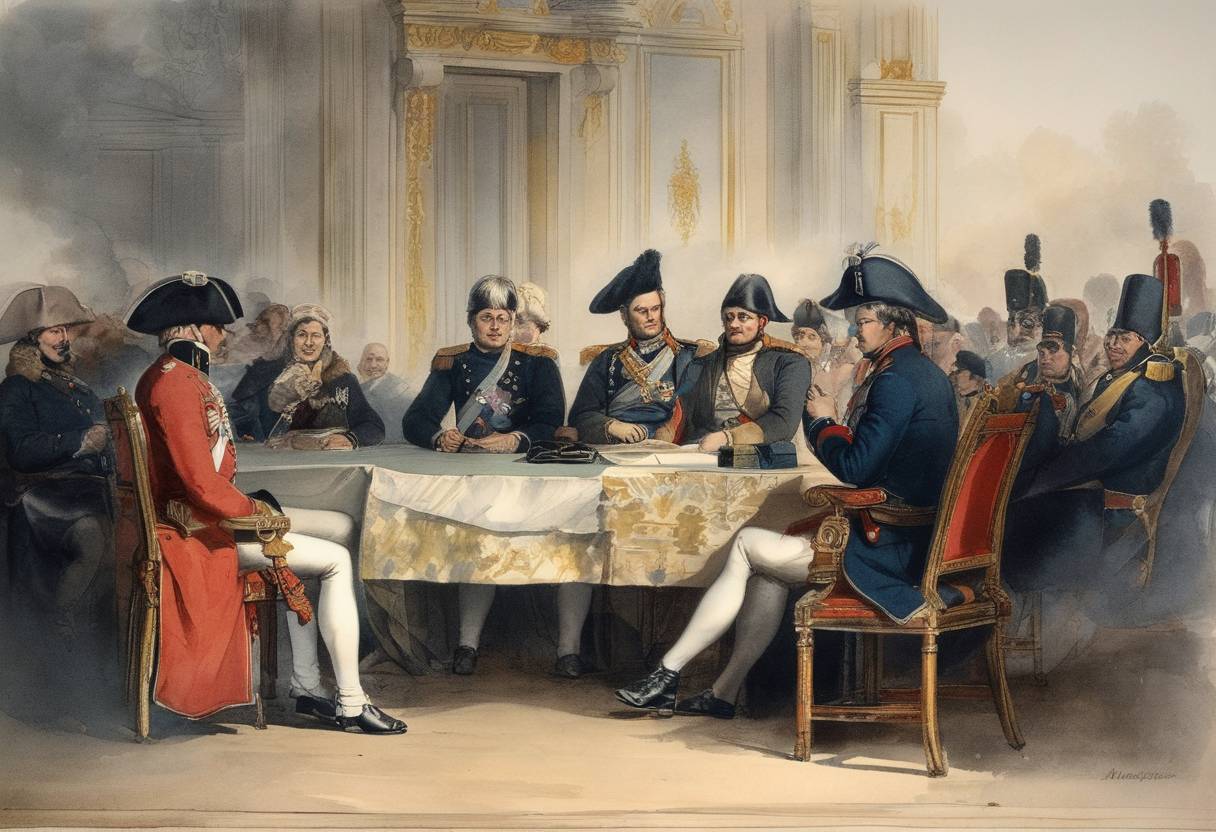
First Treaty of Tilsit - July 1, 1807
The First Treaty of Tilsit was signed on July 1, 1807, marking a critical diplomatic agreement between Napoleon I of France and Tsar Alexander I of Russia. This accord followed Napoleon’s decisive victory over the Russian and Prussian armies during the War of the Fourth Coalition, primarily at the Battle of Friedland on June 14, 1807.
Context and Background
The War of the Fourth Coalition (1806-1807) saw France facing off against a coalition of European powers, including Russia, Prussia, Saxony, and others. Following Napoleon’s military successes, notably the devastating defeat of the Prussian forces at the Battle of Jena-Auerstedt in 1806 and the overwhelming victory against the Russian army at Friedland, the balance of power in Europe tilted significantly in favor of France.
Key Provisions
- Recognition of Territorial Changes: The treaty acknowledged French dominance in central Europe. Russia agreed to recognize the changes Napoleon had made in Europe, particularly the establishment of the Kingdom of Westphalia and the Duchy of Warsaw, both client states under French influence.
- Division of the Prussian Territories: As a consequence of the Prussian defeat, significant portions of Prussian territories were ceded. The Treaty of Tilsit effectively reduced Prussia’s influence and size dramatically.
- Alliance against Britain: One of Napoleon’s strategic objectives was to impose the Continental System, an economic blockade against Great Britain. The agreement brought Tsar Alexander I into this system, pressuring Russia to join the anti-British alliance.
Aftermath and Significance
The First Treaty of Tilsit had profound implications for European geopolitics:
- Temporary Alliance: The treaty resulted in a short-lived Franco-Russian alliance that altered the dynamics of European politics. This alliance was pivotal in maintaining a period of peace on the Eastern front for Napoleon.
- Impact on Prussia: The treaty significantly weakened Prussia, leading to a period of reform and militarization in response to its reduced status.
- Philosophical Encounters: The personal meetings between Napoleon and Alexander I during the Tilsit negotiations have been noted for their philosophical discussions and attempts to shape a new European order.
Overall, the First Treaty of Tilsit demonstrated Napoleon’s diplomatic acumen following his military triumphs, consolidating his control over Europe and temporarily securing peace with Russia. However, the tenuous nature of the agreements made in Tilsit would eventually unravel, leading to further conflicts in the early 19th century.