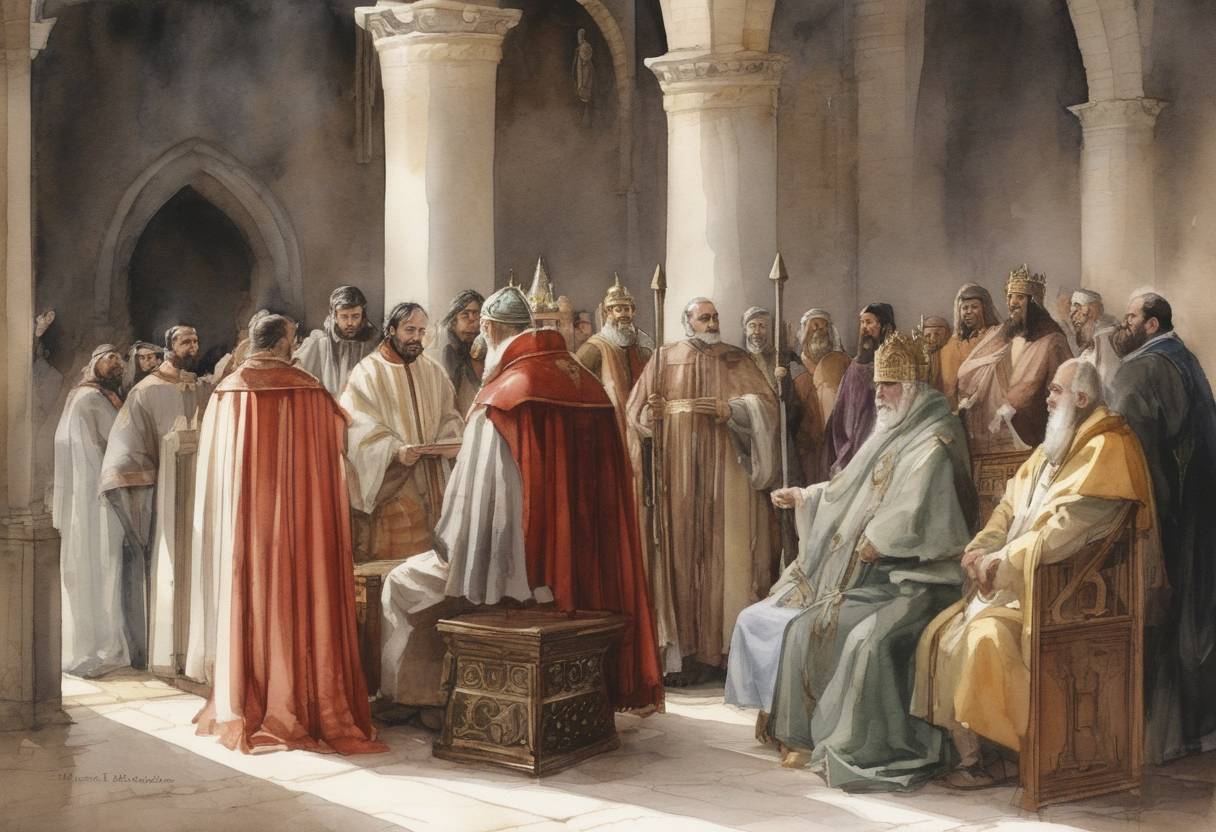
The Second Council of Toledo
Overview
On May 4, 589, the Second Council of Toledo commenced under the auspices of King Reccared I of the Visigothic Kingdom. This ecclesiastical synod, convened in Toledo, Spain, was a critical turning point in the religious and political landscape of early medieval Spain. It marked a decisive moment in the consolidation of Catholic Christianity as the state religion of the Visigothic realm.
Historical Context
The period leading up to the Council saw significant religious tension in the Iberian Peninsula. The Visigoths, who had established their rule in Hispania, were predominantly Arian Christians, a branch that diverged from the Catholic Church primarily in its teachings about the nature of Christ. The Catholic Nicene doctrine, held by the majority of the Hispano-Roman population, preached the consubstantiality of the Father, Son, and Holy Spirit.
Key Events Leading to the Council
King Reccared I, succeeding his father King Leovigild in 586, recognized the potential for religious division to undermine the unity of his kingdom. His conversion to Catholic Christianity and subsequent actions were pivotal. He convened the Second Council of Toledo to formalize the transition of the Visigothic state from Arianism to Catholicism, thereby aligning more closely with the religious beliefs of the majority Iberian populace and the broader Christian world.
Events of the Council
The council assembled numerous bishops and ecclesiastical authorities from across the kingdom. The primary agenda was to affirm the Catholic faith and denounce Arianism. Statements were made to renounce Arianism rigorously, and the Nicene Creed was reaffirmed as the correct expression of Christian orthodoxy.
Additionally, the council addressed issues of church governance, the conduct of clergy, and sought to strengthen the bond between the monarchy and the Catholic Church. Measures were also passed to facilitate the return of ecclesiastical properties seized during Arian dominance.
Consequences and Significance
The Second Council of Toledo had profound implications for the religious alignment of the Visigothic Kingdom. It marked the formal acceptance of Nicene Christianity as the state religion, effectively integrating the Visigoths into the greater Roman Christian tradition. This move helped to ease sectarian tensions and unify the diverse populations under one religious banner.
The council’s decisions solidified alliances with other Catholic regions of Europe, strengthening Reccared’s reign and enhancing the kingdom’s political stability. Additionally, it laid the groundwork for later Councils of Toledo, which became significant ecclesiastical and legislative assemblies in the medieval period.
The conversion from Arian Christianity also had cultural and intellectual impacts, as it facilitated greater integration with Roman customs and accelerated the Christianization of the Iberian Peninsula, influencing its subsequent historical trajectory.