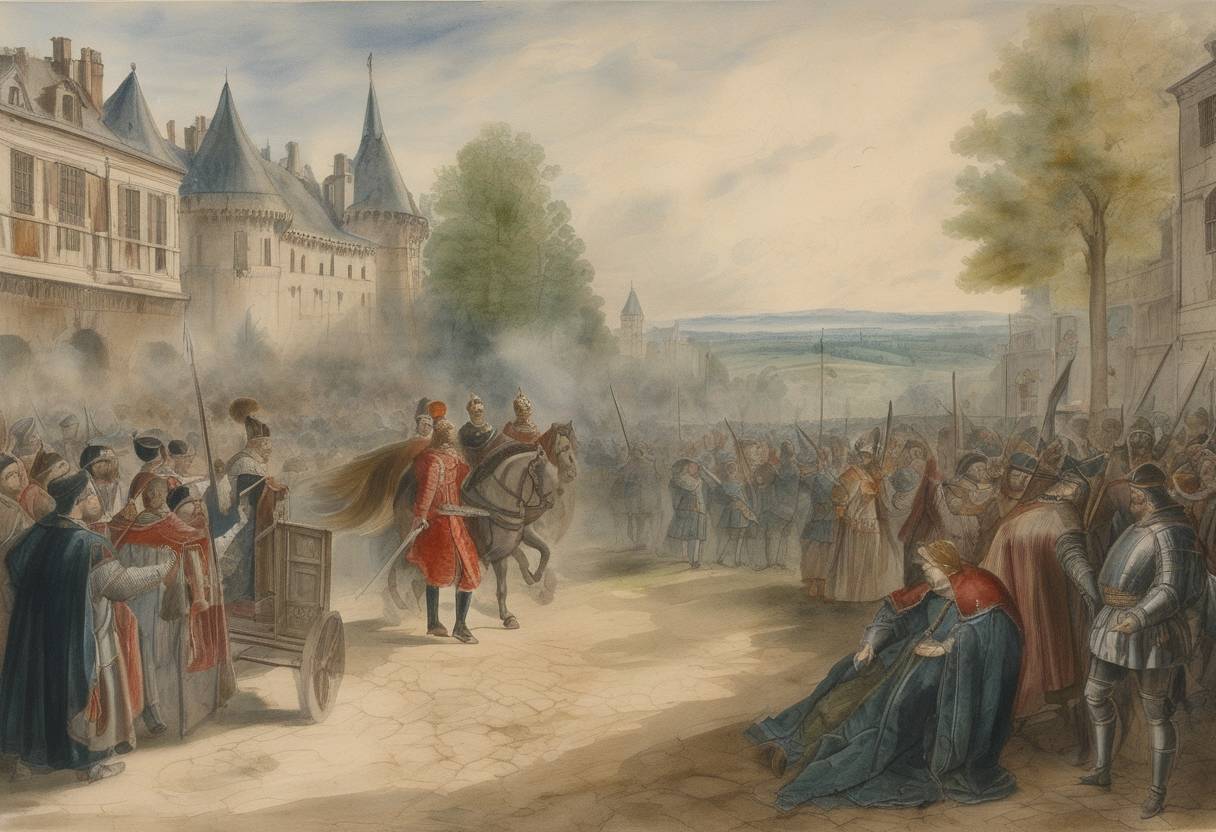
Assassination of King Henry III of France
On August 1, 1589, King Henry III of France was assassinated by Jacques Clément, a fervent Dominican friar. This act marked a pivotal moment in the French Wars of Religion, setting the stage for the Bourbon dynasty’s rise to the throne with Henry of Navarre.
Context Leading Up to the Assassination
The late 16th century in France was marred by continuous religious conflicts between Catholics and Huguenots (French Protestants), known as the French Wars of Religion. Henry III, a Catholic, had been struggling to stabilize his kingdom amidst these upheavals. Tensions were further exacerbated by the Catholic League, a powerful coalition led by the Duke of Guise, which sought to eradicate Protestantism and opposed the king’s tolerance policies.
Henry III’s situation worsened with the War of the Three Henrys—an intricate power struggle involving himself, Henry of Guise, and Henry of Navarre, the Huguenot leader and heir presumptive to the French throne. After securing a temporary alliance with Navarre, Henry III ordered the assassination of Henry of Guise in December 1588. This grave act alienated many of his Catholic supporters, isolating him politically.
The Assassination
Amidst this turbulent backdrop, Jacques Clément, driven by his extreme Catholic beliefs, sought to eliminate what he perceived as the last Catholic king sympathetic to Protestant interests. Disguised as a messenger, Clément gained access to King Henry III at the Château of Saint-Cloud, near Paris. On the morning of August 1, he fatally stabbed the king in the abdomen. Henry III succumbed to his wounds the following day.
Clément was immediately killed by the king’s guards. Despite his death, the assassin was celebrated as a martyr by radical Catholics of the era.
Consequences and Historical Significance
The death of Henry III left the French throne without a direct Catholic heir, propelling Henry of Navarre, as the legitimate successor, into the spotlight. His path to kingship was fraught with resistance from the Catholic League, which refused to accept a Protestant monarch. In 1593, to secure his rule and pacify the divided nation, Henry of Navarre converted to Catholicism, famously stating, “Paris is worth a mass.”
Crowned as King Henry IV, he eventually issued the Edict of Nantes in 1598, granting substantial rights to Huguenots and laying the groundwork for religious tolerance in France. His ascension marked the beginning of Bourbon rule, which would dominate French affairs for over two centuries.
Henry III’s assassination was a turning point that reshaped the political and religious landscape of France, ushering in a period of relative peace and consolidation of royal power under the Bourbon monarchy.