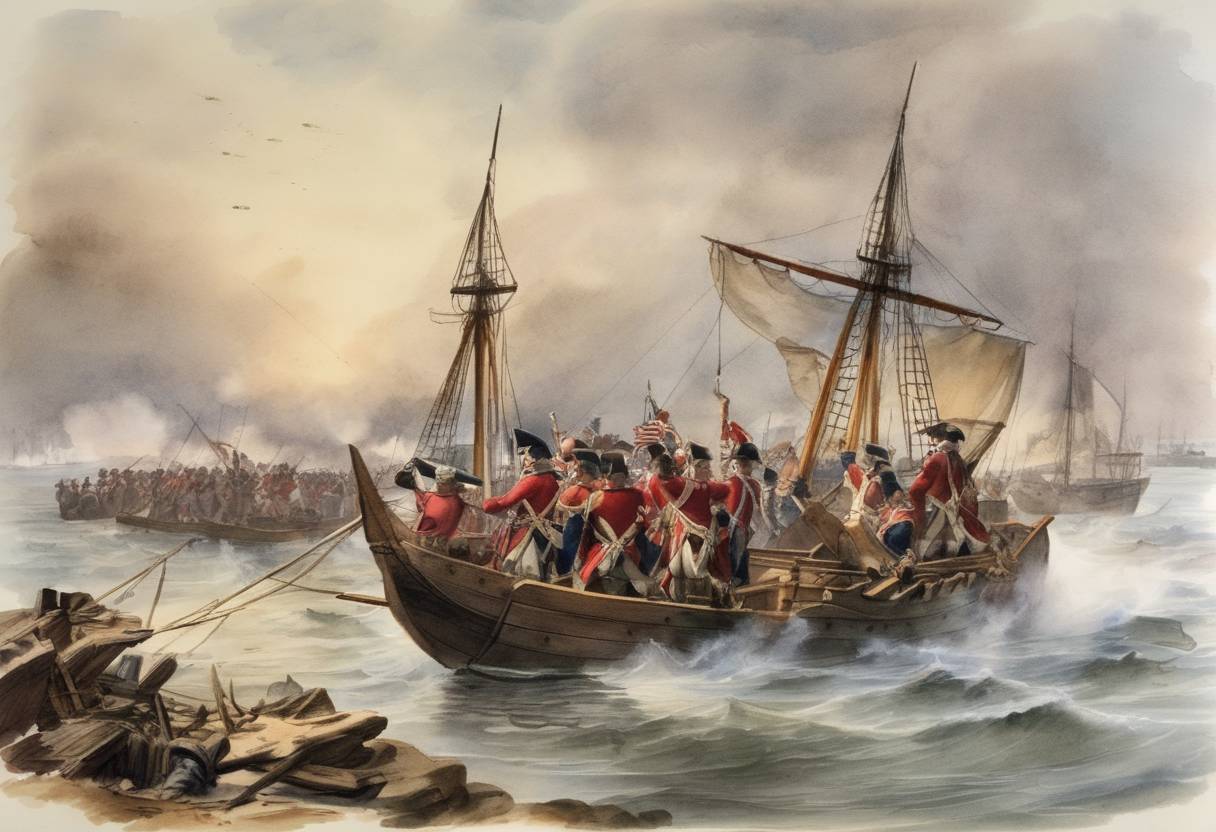
British Landing at Long Island - August 25, 1776
On August 25, 1776, during the American Revolutionary War, British forces initiated a significant tactical maneuver by landing troops on Long Island, New York, an action that prefaced the Battle of Long Island, one of the largest engagements of the war.
Background
The British, under General William Howe, aimed to capture New York City to gain control over the Hudson River and divide the American colonies. New York’s strategic location made it a prime target, and General George Washington, aware of this, had amassed Continental Army troops to defend this critical region.
The Landing
On August 25, 1776, British forces began to disembark at Gravesend Bay on the southwestern edge of Long Island. The landing involved approximately 15,000 troops, including highly trained British regulars and Hessian mercenaries, commanded by Generals Howe, Henry Clinton, and Charles Cornwallis. The choice of landing at Long Island allowed the British to establish a beachhead with minimal resistance, as the main body of the Continental Army was stationed on the Manhattan side.
Strategic Significance
The successful landing was a precursor to the Battle of Long Island, also known as the Battle of Brooklyn. It allowed the British forces to consolidate their positions and prepared the ground for a full-scale assault on American defenses, leading to the largest battle of the war in terms of manpower and scale.
Aftermath
The subsequent Battle of Long Island, fought on August 27, 1776, resulted in a decisive victory for the British. It forced Washington’s forces to execute a strategic withdrawal from Brooklyn Heights, eventually leading to the loss of New York City. Despite this setback, the Continental Army demonstrated resilience and adaptability in their retreat, which would be critical in the protracted struggle that followed.
Broader Historical Impact
The events at Long Island underscored the formidable challenge faced by the Continental Army in confronting the well-organized and numerically superior British forces. The battle demonstrated the strategic importance of New York as a military objective and highlighted the complexities of warfare in the American Revolutionary context. Although a defeat, this episode was crucial in shaping the strategic decisions of both the American and British leadership throughout the remainder of the war.