The End of the Battle of the Bulge: January 25, 1945
1945 · Ardennes, Belgium
The Battle of the Bulge ended with an Allied victory which repelled the last major German offensive of World War II.
May 8, 1945
Victory in Europe Day (V-E Day) is celebrated as the Allies formally accept Nazi Germany's unconditional surrender, marking the end of World War II in Europe.
Berlin, Germany | Allied Forces
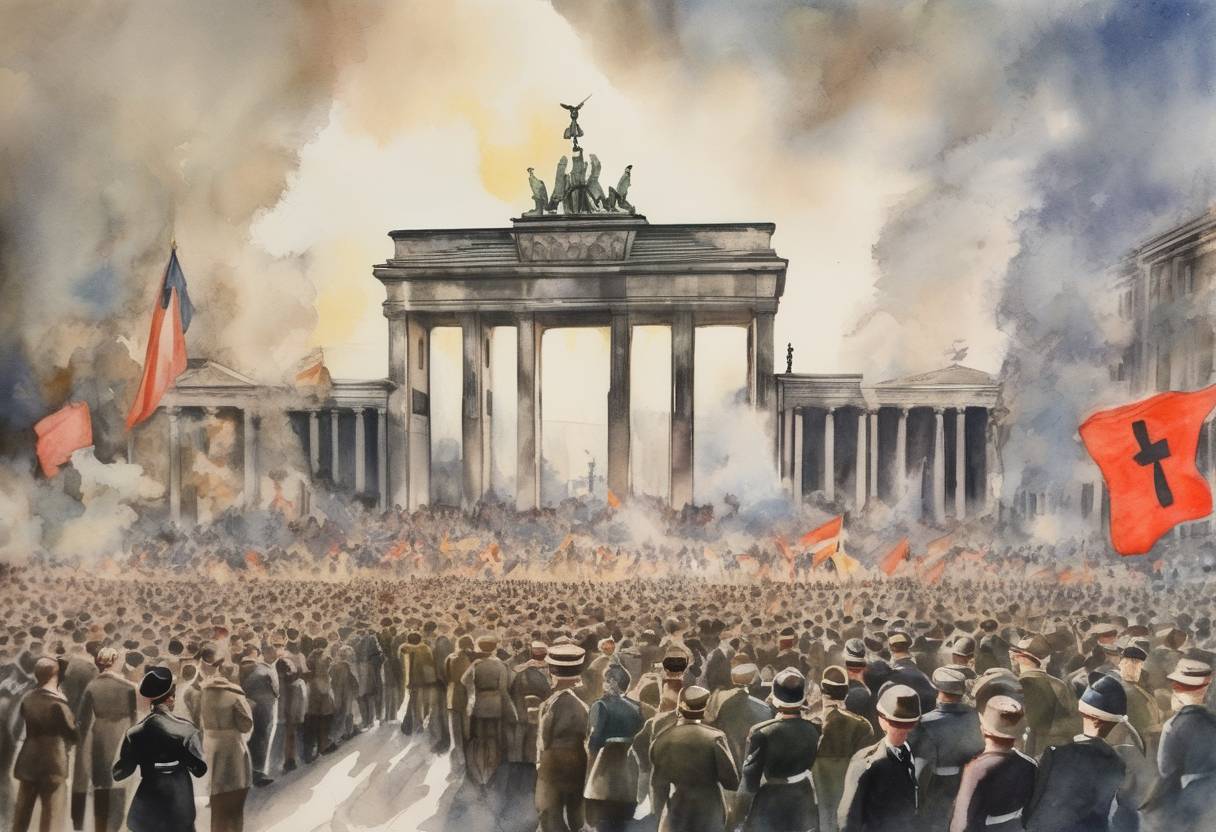
Victory in Europe Day, commonly known as V-E Day, marks the formal acceptance by the Allies of World War II of Nazi Germany’s unconditional surrender of its armed forces on May 8, 1945. This event signified the end of World War II in Europe, a conflict that had ravaged the continent for nearly six years.
Allied Advances: By early 1945, Allied forces had made significant advances into German-occupied territories. The Western Allies, including the United States, the United Kingdom, and France, had crossed the Rhine River and were advancing into the heart of Germany. Meanwhile, the Soviet Union was pushing from the east, having liberated much of Eastern Europe.
Fall of Berlin: The Battle of Berlin was a pivotal moment leading to V-E Day. Soviet forces launched a massive assault on the German capital in April 1945. After intense fighting, Berlin fell to the Soviets on May 2, 1945.
Hitler’s Death: Adolf Hitler, the leader of Nazi Germany, committed suicide on April 30, 1945, as Soviet troops closed in on his bunker in Berlin. His death left Germany without a clear leader and hastened the country’s surrender.
Unconditional Surrender: On May 7, 1945, General Alfred Jodl, representing the German High Command, signed the unconditional surrender documents at the Allied headquarters in Reims, France. The surrender was to take effect at 23:01 Central European Time on May 8, 1945.
Formal Ratification: To ensure the surrender was recognized by all Allied powers, a second signing ceremony took place in Berlin on May 8, 1945, with representatives from the Soviet Union, the United States, the United Kingdom, and France.
Public Celebrations: News of the surrender sparked widespread celebrations across Europe and North America. In London, large crowds gathered in Trafalgar Square and outside Buckingham Palace, where King George VI and Prime Minister Winston Churchill appeared on the balcony. In the United States, President Harry S. Truman dedicated the victory to the memory of his predecessor, Franklin D. Roosevelt, who had died just weeks earlier.
Continued Conflict in the Pacific: While V-E Day marked the end of the war in Europe, World War II continued in the Pacific theater. The Allies were still engaged in intense battles against Japan, which would not surrender until August 1945, following the atomic bombings of Hiroshima and Nagasaki.
V-E Day is a significant milestone in 20th-century history, symbolizing the defeat of Nazi Germany and the end of a devastating conflict in Europe. It marked the beginning of a new era, leading to the reconstruction of Europe, the establishment of the United Nations, and the onset of the Cold War as tensions between the Soviet Union and Western Allies began to surface.
V-E Day remains a day of remembrance and reflection, honoring the sacrifices made during the war and celebrating the restoration of peace in Europe.
Source: en.wikipedia.org