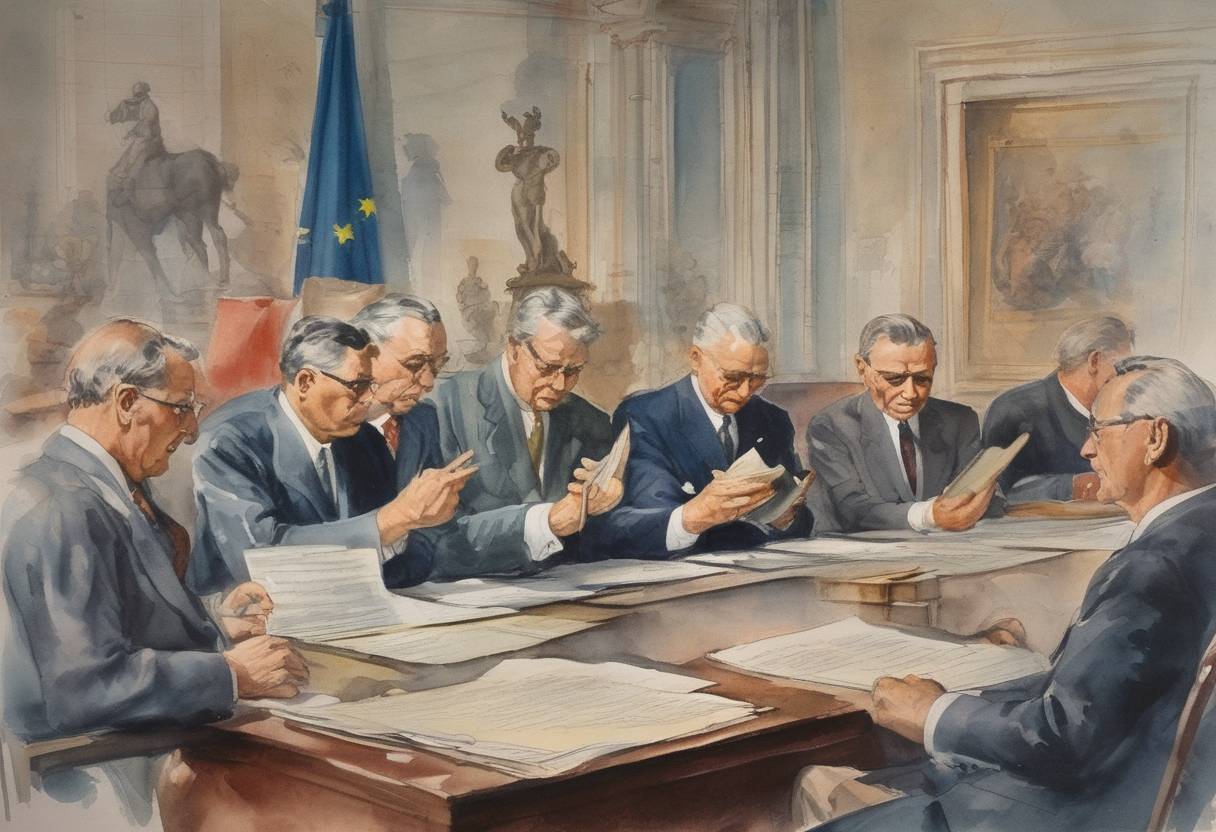
On March 25, 1957, a pivotal moment in European history unfolded with the signing of the Treaty of Rome. This treaty laid the foundation for the European Economic Community (EEC), a significant step towards economic integration in Europe and a precursor to what is now the European Union (EU).
Context and Background
The Treaty of Rome was signed in the aftermath of World War II, a period marked by a strong desire for peace and stability in Europe. The devastation of the war had highlighted the need for economic cooperation and integration to prevent future conflicts. The success of the European Coal and Steel Community (ECSC), established in 1951, demonstrated the potential benefits of economic collaboration among European nations.
Key Events Leading to the Treaty
The Messina Conference (1955): The idea of a common market was first proposed at this conference, where the foreign ministers of the six ECSC countries—Belgium, France, Italy, Luxembourg, the Netherlands, and West Germany—agreed to explore further economic integration.
The Spaak Report (1956): Led by Belgian Foreign Minister Paul-Henri Spaak, this report outlined the framework for a common market and an atomic energy community, setting the stage for the Treaty of Rome.
Negotiations: Intensive negotiations followed, with the six countries working to reconcile their national interests with the goal of creating a unified economic area.
The Signing of the Treaty
The Treaty of Rome was signed by the six founding countries—Belgium, France, Italy, Luxembourg, the Netherlands, and West Germany—at the Capitoline Hill in Rome. The treaty established two key institutions:
The European Economic Community (EEC): Aimed at creating a common market and customs union among the member states, promoting free movement of goods, services, capital, and labor.
The European Atomic Energy Community (Euratom): Focused on the peaceful use of nuclear energy.
Provisions of the Treaty
- Customs Union: The treaty called for the gradual elimination of customs duties and quantitative restrictions between member states.
- Common Policies: It established common policies in agriculture, transport, and trade.
- Institutions: The treaty set up several institutions, including the European Commission, the Council of Ministers, the European Parliament, and the European Court of Justice, to oversee and implement its provisions.
Aftermath and Significance
The Treaty of Rome marked a significant step towards European integration, fostering economic cooperation and political stability. It laid the groundwork for the expansion of the EEC and the eventual creation of the European Union. Over the decades, the EEC evolved, expanding its membership and scope, leading to the Maastricht Treaty in 1992, which formally established the European Union.
The Treaty of Rome remains a cornerstone of European integration, symbolizing the commitment of European nations to work together for mutual prosperity and peace. Its legacy continues to influence the political and economic landscape of Europe today.