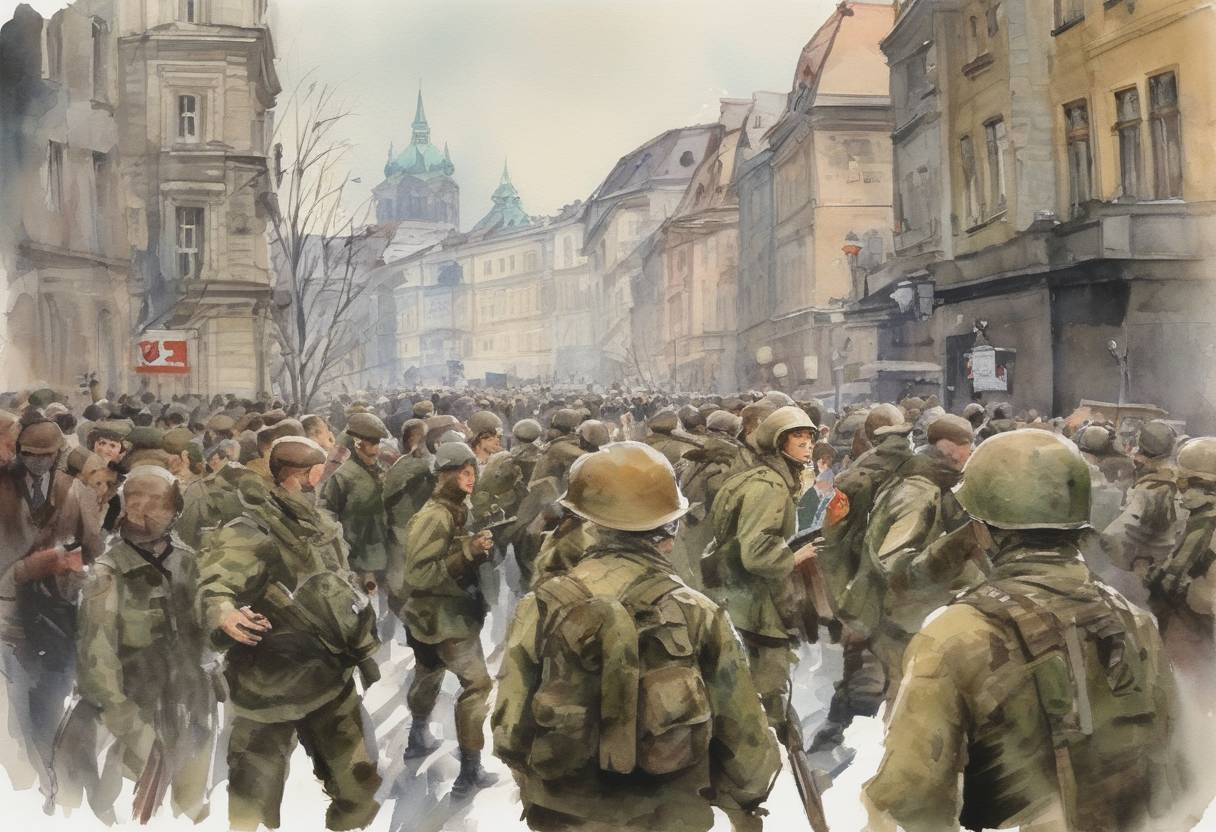
Warsaw Pact Invasion of Czechoslovakia - August 20, 1968
On the night of August 20, 1968, troops from the Warsaw Pact countries, led by the Soviet Union, invaded Czechoslovakia to halt the liberalizing reforms of the Prague Spring. This military intervention marked a significant moment in Cold War history, reflecting the tensions between the Soviet Union’s desire to maintain control over its satellite states and the growing demand for political freedom and reform within those states.
Background
Prague Spring: The Prague Spring was a period of political liberalization in Czechoslovakia that began in January 1968 when Alexander Dubček was elected First Secretary of the Communist Party of Czechoslovakia. Dubček introduced a series of reforms aimed at creating “socialism with a human face,” which included increased freedom of speech, press, and movement, as well as economic reforms and a reduction in the power of the secret police.
Soviet Concerns: The Soviet Union, under the leadership of Leonid Brezhnev, viewed these reforms with alarm. The liberalization threatened to weaken Soviet influence in Eastern Europe and potentially inspire similar movements in other Warsaw Pact countries. The Brezhnev Doctrine, which justified the use of force to maintain the socialist regime in satellite states, was a direct response to these concerns.
The Invasion
Forces Involved: Approximately 200,000 troops and 5,000 tanks from the Soviet Union, Poland, East Germany, Hungary, and Bulgaria participated in the invasion. The operation was one of the largest military mobilizations in Europe since World War II.
Execution: The invasion began late on August 20 and continued into August 21. Key locations, including Prague, were quickly occupied. The Czechoslovak government was taken by surprise, and despite some resistance from civilians, the military intervention was largely unopposed by Czechoslovak forces.
Aftermath
End of Reforms: The invasion effectively ended the Prague Spring. Dubček was removed from power and replaced by Gustáv Husák, who reversed the reforms and reinstated a hardline communist regime.
International Reaction: The invasion was widely condemned internationally, including by Western countries and even some communist states like Romania and Yugoslavia. However, direct intervention from the West was limited due to the geopolitical realities of the Cold War.
Long-term Impact: The invasion reinforced the Soviet Union’s control over Eastern Europe but also exposed the limits of Soviet influence, as it led to increased dissent and disillusionment with communism in the region. It also solidified the Brezhnev Doctrine, which would influence Soviet policy until the late 1980s.
The invasion of Czechoslovakia in 1968 remains a poignant example of the Cold War’s impact on Eastern Europe, highlighting the struggle between authoritarian control and the desire for political and social freedoms.