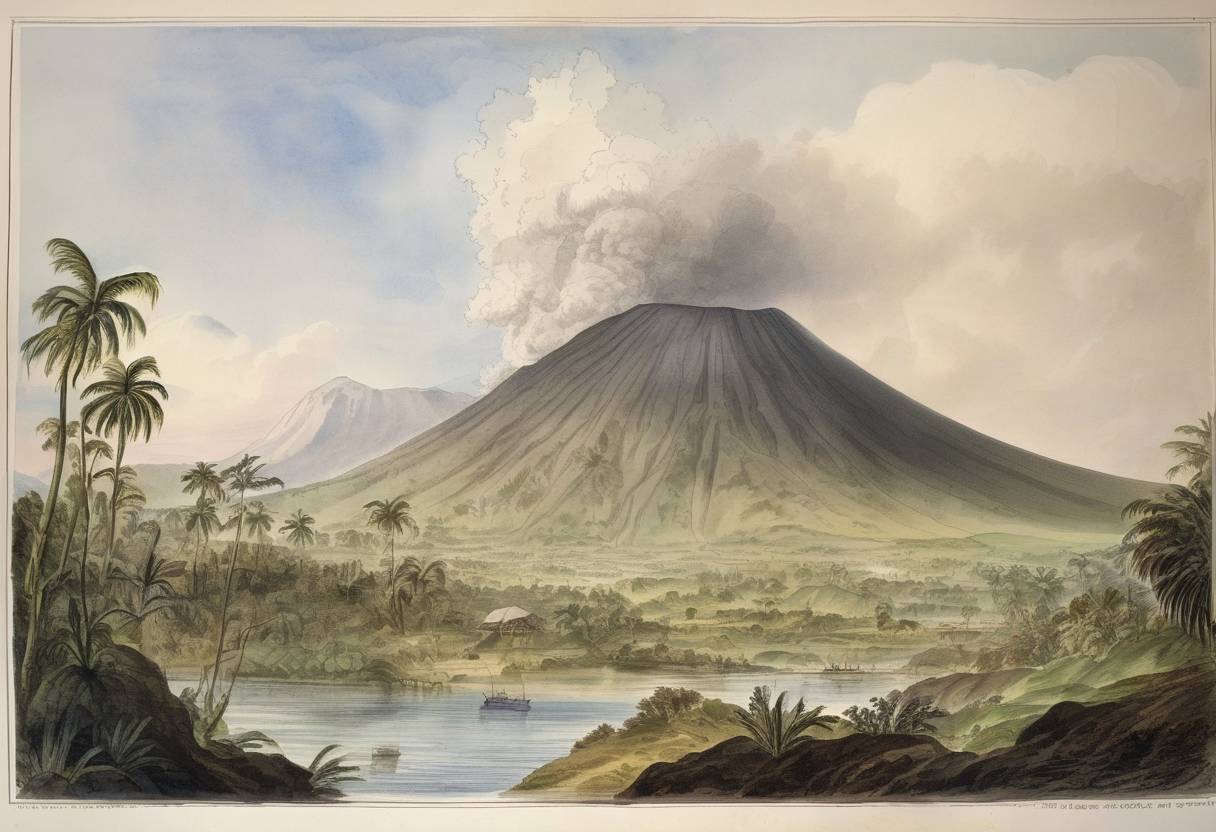
The Eruption of Mount Tambora: April 10, 1815
On April 10, 1815, Mount Tambora, located on the island of Sumbawa in present-day Indonesia, began one of the most powerful volcanic eruptions in recorded history. This catastrophic event had profound global climatic effects, leading to what became known as the “Year Without a Summer” in 1816.
Background
Mount Tambora is a stratovolcano, and prior to its 1815 eruption, it stood approximately 4,300 meters (14,100 feet) tall. The volcano had been dormant for several centuries, but in 1812, it began to show signs of increased activity. By April 1815, these signs culminated in a massive eruption.
The Eruption
- Initial Activity: The eruption began on April 5, 1815, with smaller explosions and ash emissions. However, the most significant and devastating phase occurred on April 10.
- Main Eruption: On the evening of April 10, the eruption reached its climax. It is estimated that the explosion was equivalent to 800 megatons of TNT, making it one of the most powerful eruptions in human history.
- Volcanic Fallout: The eruption ejected an estimated 160 cubic kilometers (38 cubic miles) of volcanic material into the atmosphere. The explosion was heard as far away as Sumatra, over 2,000 kilometers (1,200 miles) away.
- Local Impact: The eruption and its immediate aftermath resulted in the deaths of tens of thousands of people. The island of Sumbawa and surrounding areas were devastated by pyroclastic flows, ashfall, and tsunamis.
- Environmental Devastation: The eruption destroyed crops and vegetation, leading to widespread famine and disease in the region.
Global Climatic Effects
- Volcanic Winter: The massive amount of ash and sulfur dioxide released into the stratosphere formed aerosols that reflected sunlight, causing a significant drop in global temperatures.
- Year Without a Summer: In 1816, the Northern Hemisphere experienced severe climate anomalies. Europe and North America faced unseasonably cold temperatures, leading to crop failures and food shortages. Snow fell in June in parts of New England, and persistent rain and frost plagued Europe.
Aftermath and Historical Significance
- Economic and Social Impact: The climatic disruptions caused by the eruption led to widespread food shortages, economic hardship, and social unrest. In Europe, the crisis exacerbated the economic difficulties following the Napoleonic Wars.
- Scientific Advancements: The eruption and its effects contributed to the early study of climate science and the understanding of volcanic impacts on global weather patterns.
The eruption of Mount Tambora stands as a stark reminder of the power of natural events to influence human history on a global scale. Its legacy is a testament to the interconnectedness of environmental and human systems.