The Battle of Brustem: A Turning Point in the Liège Wars
1467 · Brustem, present-day Belgium
The Battle of Brustem took place during the Liège Wars, resulting in a victory for Charles the Bold, Duke of Burgundy, over the Prince-Bishopric of Liège.
January 5, 1477
Charles the Bold, Duke of Burgundy, was killed at the Battle of Nancy, leading to the end of the Burgundian Wars and significant territorial changes in Europe.
Nancy, France | Duchy of Burgundy
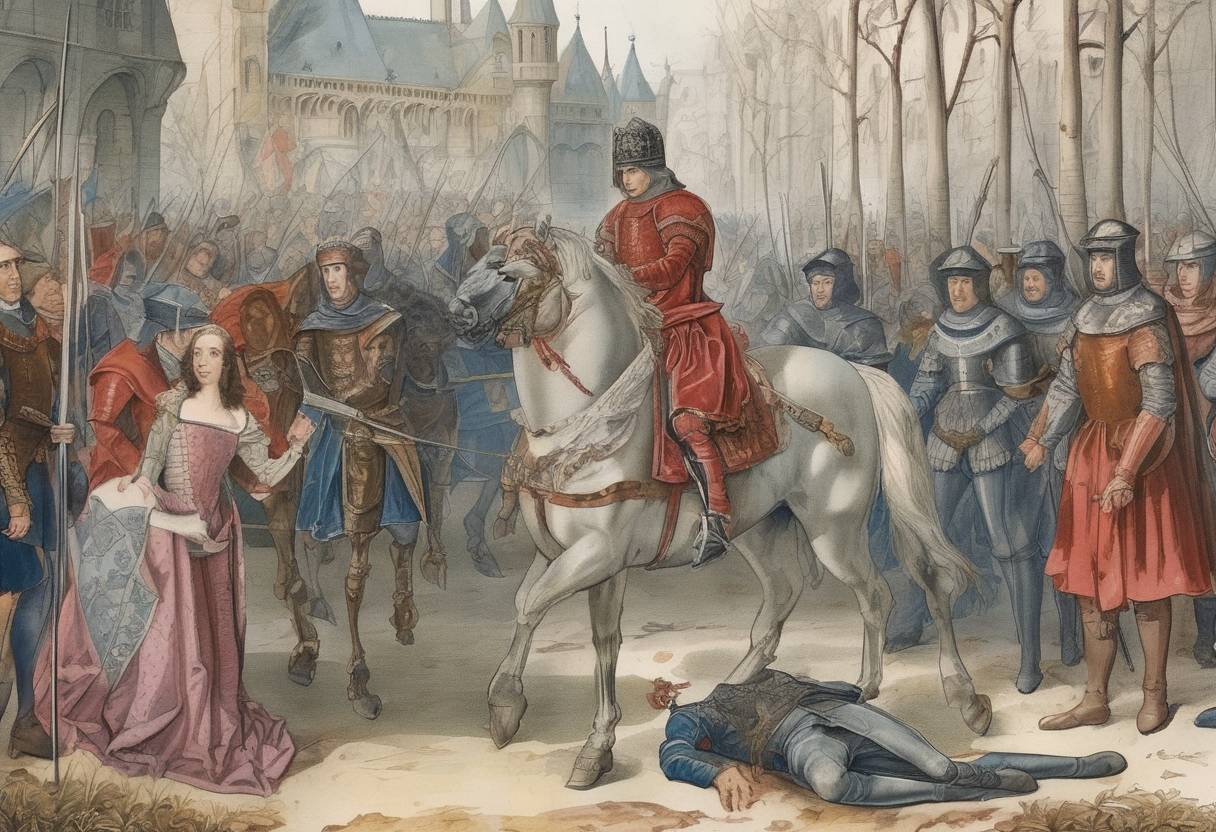
On January 5, 1477, Charles the Bold, Duke of Burgundy, met his demise at the Battle of Nancy, a pivotal event that marked the end of the Burgundian Wars and led to significant territorial changes in Europe.
Charles the Bold, born in 1433, was the last Valois Duke of Burgundy. His ambition was to expand and consolidate his territories into a kingdom that could rival France. The Burgundian State, under his rule, was a formidable power, stretching from the Low Countries to parts of modern-day France and Switzerland. Charles’s aggressive expansionist policies, however, led to conflicts with neighboring states, including France and the Swiss Confederacy.
The Burgundian Wars were a series of conflicts from 1474 to 1477, primarily involving the Duchy of Burgundy against the Swiss Confederacy, the Duchy of Lorraine, and the Kingdom of France. Charles’s military campaigns initially saw some success, but his overreach eventually led to his downfall.
The Battle of Nancy was the culmination of Charles’s military endeavors. In late 1476, Charles laid siege to Nancy, the capital of Lorraine, which had been recaptured by Duke René II with Swiss support. On January 5, 1477, René II’s forces, bolstered by Swiss mercenaries, engaged Charles’s army outside Nancy.
The battle was a decisive defeat for Charles. His forces were overwhelmed by the numerically superior and tactically adept Swiss and Lorraine troops. Charles the Bold was killed during the battle, his body reportedly found days later, frozen in a nearby stream.
The death of Charles the Bold had profound implications for European politics:
End of the Burgundian State: With no male heir, Charles’s death effectively ended the independent Burgundian State. His territories were divided, with the Duchy of Burgundy itself being annexed by France under King Louis XI.
Rise of the Habsburgs: Mary of Burgundy, Charles’s only child, married Maximilian I of Austria, a member of the Habsburg dynasty. This marriage brought the rich Burgundian Netherlands under Habsburg control, significantly enhancing their power and setting the stage for future conflicts in Europe.
Shift in Power Dynamics: The collapse of Burgundy altered the balance of power in Western Europe. France consolidated its territories, while the Habsburgs gained a foothold in the Low Countries, leading to centuries of rivalry between these two powers.
Impact on Swiss and Lorraine: The victory at Nancy solidified the Swiss Confederacy’s military reputation and independence, while Lorraine regained its autonomy, strengthening its position in the region.
The Battle of Nancy and the death of Charles the Bold thus marked a turning point in European history, reshaping the political landscape and influencing the course of events in the late 15th and early 16th centuries.
Source: en.wikipedia.org