Battle of Dyrrhachium: Caesar's Civil War
48 · Dyrrhachium, Roman Republic (modern-day Albania)
Julius Caesar's forces decisively defeat Pompey's army at the Battle of Dyrrhachium during Caesar's Civil War.
April 6, 0046
Julius Caesar defeats the forces of the Optimates led by Metellus Scipio and Cato the Younger in the Battle of Thapsus, effectively ending the Roman Republic's civil war.
Thapsus, Roman Republic (modern-day Tunisia) | Roman Republic
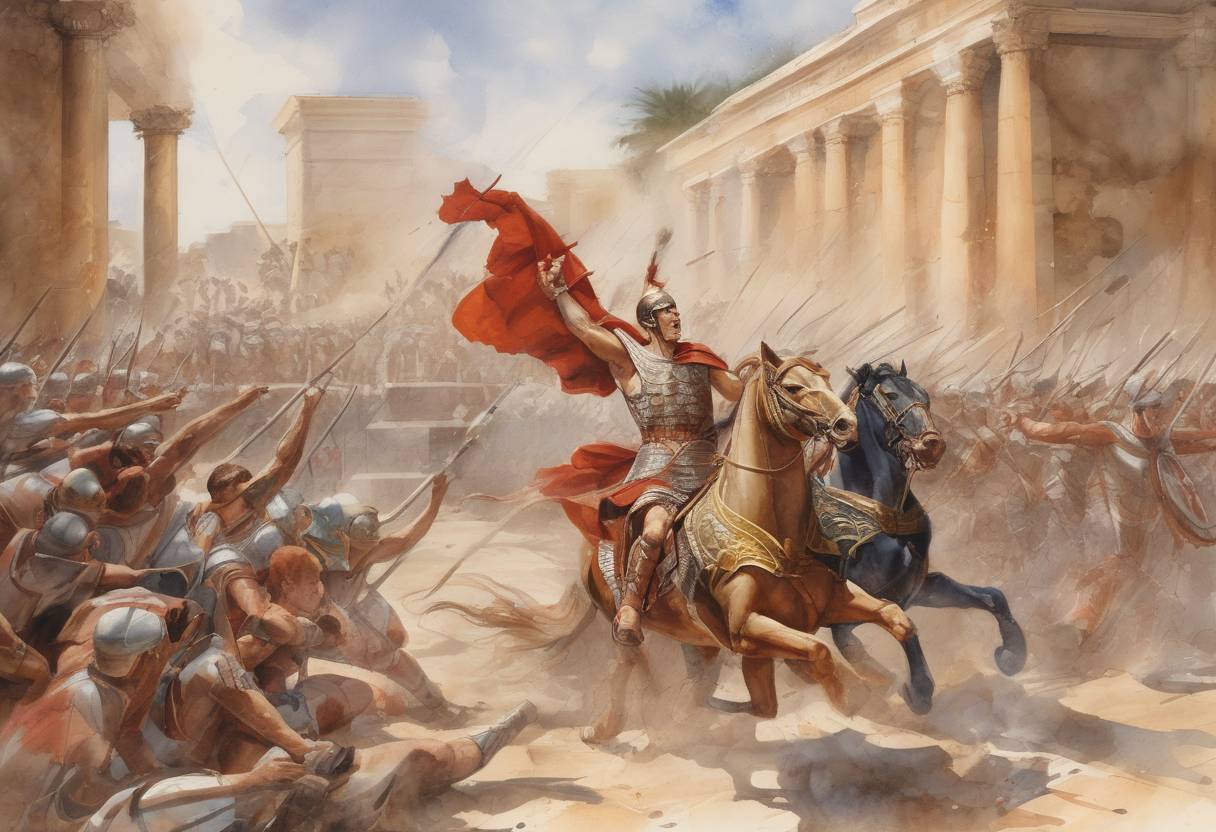
The Battle of Thapsus, fought on April 6, 46 BCE, was a decisive engagement in the series of civil wars that marked the end of the Roman Republic. This battle saw Julius Caesar’s forces defeat the Optimates, led by Metellus Scipio and Cato the Younger, effectively consolidating Caesar’s power and paving the way for the transition from Republic to Empire.
The Roman Republic had been embroiled in a series of civil wars, primarily between the populares, who supported reforms and were often led by Julius Caesar, and the optimates, the conservative senatorial faction. The conflict intensified after Caesar crossed the Rubicon River in 49 BCE, igniting a civil war against the forces loyal to the Senate and Pompey the Great.
Following Pompey’s defeat and subsequent assassination in Egypt in 48 BCE, the remaining senatorial forces regrouped in North Africa under the leadership of Metellus Scipio and Cato the Younger. This faction sought to continue the resistance against Caesar’s dominance.
The battle took place near Thapsus, a coastal town in modern-day Tunisia. Caesar’s forces, though outnumbered, were well-disciplined and experienced, having been hardened by years of campaigning. The Optimates, on the other hand, were a coalition of Roman and allied troops, including a significant number of Numidian cavalry.
Caesar employed his typical aggressive tactics, launching a direct assault on the enemy’s fortified positions. His forces quickly overwhelmed the Optimates’ defenses, leading to a rout. The battle was marked by a high number of casualties, particularly among the Optimates, as Caesar’s troops showed little mercy in their pursuit of the fleeing enemy.
The defeat at Thapsus was catastrophic for the Optimates. Metellus Scipio attempted to flee but was captured and killed. Cato the Younger, a staunch defender of the Republic, chose to commit suicide in Utica rather than surrender to Caesar, becoming a symbol of republican virtue and resistance.
With the victory at Thapsus, Caesar effectively eliminated the last significant opposition to his rule. This victory allowed him to return to Rome, where he was appointed dictator perpetuo (dictator for life) in 44 BCE. However, his concentration of power and subsequent assassination in 44 BCE led to further turmoil and the eventual rise of his heir, Octavian (later Augustus), marking the end of the Roman Republic and the beginning of the Roman Empire.
The Battle of Thapsus was a turning point in Roman history. It not only marked the end of the civil war but also highlighted the decline of the senatorial power that had characterized the Roman Republic. The battle and its aftermath set the stage for the rise of imperial rule, fundamentally transforming Roman governance and laying the groundwork for centuries of imperial expansion and consolidation.
In summary, the Battle of Thapsus was a critical event that underscored the shifting power dynamics in Rome, illustrating the fragility of the Republic and the inevitability of change towards autocratic rule.
Source: en.wikipedia.org